What's really driving the AI buildout is starting to come out in the open. The earnings report from NVIDIA Corp. NASDAQ: NVDA made clear that the AI revolution is happening at the edges. That means chatbots on websites, copilots in spreadsheets, and summarization tools stapled onto software that already works fine.
However, for a growing category of organizations, such as defense contractors, hospital systems, and global banks, that kind of peripheral AI is not only inefficient; it’s unacceptable.
Palantir Technologies Today
PLTR
Palantir Technologies
$136.88 -0.53 (-0.39%) As of 05/22/2026 04:00 PM Eastern
- 52-Week Range
- $118.93
▼
$207.52 - P/E Ratio
- 153.80
- Price Target
- $192.76
That's the opening Dell Technologies Inc. NYSE: DELL and Palantir Technologies Inc. NASDAQ: PLTR are stepping into. At Dell Technologies World, the two companies announced a joint solution: Palantir's Foundry and Ontology platform running on-premises inside Dell AI Factory with NVIDIA.
The result is what they're calling an AI operating system—a full software and hardware stack that brings production-grade AI agents and workflows to organizations that can't afford to let their data leave the building.
This isn't a partnership of convenience. It's a direct answer to a problem that has quietly stalled AI adoption at the highest levels of enterprise and government: you can have powerful AI, or you can have control. Until now, you couldn't easily have both.
The Real Problem Isn't the Model—It's the Operating Environment
The announcement reframes what enterprise AI actually requires. According to Dell's blog post, most organizations aren't stuck because they lack access to capable AI models. They're stuck because their data is fragmented across ERP systems, electronic health records, core banking platforms, logistics software, and document stores—spread across on-premises infrastructure and multiple clouds—and almost none of it is "AI-ready."
Palantir's contribution to the joint architecture directly addresses this. Its Foundry platform and Ontology layer take that fragmented data and build what the companies describe as a governed semantic layer—a unified, strongly typed representation of the business's assets, processes, people, and relationships. Developers and AI agents don't interact with dozens of brittle backend systems. They interact with Ontology objects that carry data lineage and clear semantics through every transaction.
Underneath that software layer sits Dell AI Factory with NVIDIA—PowerEdge servers with NVIDIA HGX B-series accelerators, Dell ObjectScale and PowerFlex storage replacing the default persistence layer in the Palantir stack, and Ethernet-based networking aligned with NVIDIA Spectrum-class fabrics. Palantir's Apollo runtime manages each cluster with zero-trust governance, continuous audit logging, and centralized fleet management across sites—including air-gapped environments where no cloud connection is possible or permitted.
This is the architecture for organizations where a data breach is a national security event, a regulatory catastrophe, or a patient safety failure.
This Is Exactly the Valuation Argument Palantir Has Been Making
Critics of Palantir's stock price have long pointed to the same objection: the valuation is too rich for a company selling expensive software to a limited set of government clients. The Dell partnership is a pointed rebuttal.
Palantir has always sold to CEOs who understand that AI transformation isn't a pilot project—it's a platform decision. The Dell integration expands the addressable market for that platform dramatically, offering a validated, on-premises reference architecture that any regulated enterprise can deploy without building the infrastructure stack from scratch. The argument against Palantir's scale was always that its market was finite. This deal makes that argument harder to sustain.
Technical Analysis: PLTR Chart Shows a Stock Finding Its Floor
The daily chart for PLTR as of May 20, 2026, shows a stock that has been working through a significant correction from its November 2025 highs near $200. Price is currently near $137, trading below the 50-day simple moving average of $143.26—a level that now acts as near-term resistance.
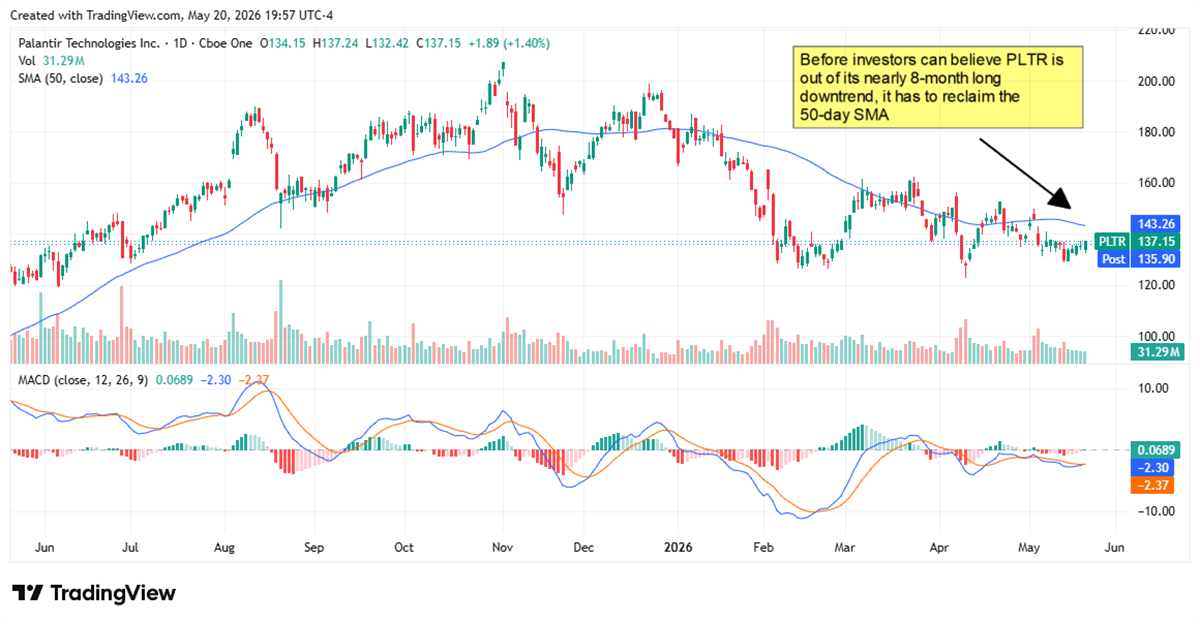
The MACD tells a nuanced story. The MACD line has crossed back above zero at 0.0689, while the signal line sits at -2.30, suggesting early-stage bullish momentum. The histogram, while still showing some softness, has been narrowing—a pattern consistent with a base-building phase rather than continued breakdown.
Volume has been elevated on recent sessions, pointing to accumulation. For investors, the key technical question is whether the stock can reclaim and hold the 50-day SMA. A sustained close above $143 would shift the near-term bias constructively.
Locked-Down AI at Enterprise Scale
The Dell and Palantir partnership matters for reasons that go beyond the product announcement. It validates a model of AI deployment that has been underappreciated: secure, sovereign, on-premises AI that doesn't force organizations to choose between capability and control.
The broader signal is this: the most consequential AI decisions being made right now aren't happening in the cloud. They're happening in secured data centers, in air-gapped facilities, in hospital server rooms—places where the data is too sensitive and the stakes too high for anything less than complete control. Palantir and Dell just made a serious bid to own that space. Maybe this will move the Palantir conversation beyond valuation.
Before you consider Palantir Technologies, you'll want to hear this.
MarketBeat keeps track of Wall Street's top-rated and best performing research analysts and the stocks they recommend to their clients on a daily basis. MarketBeat has identified the five stocks that top analysts are quietly whispering to their clients to buy now before the broader market catches on... and Palantir Technologies wasn't on the list.
While Palantir Technologies currently has a Moderate Buy rating among analysts, top-rated analysts believe these five stocks are better buys.
View The Five Stocks Here
Market downturns give many investors pause, and for good reason. Wondering how to offset this risk? Click the link to learn more about using beta to protect your portfolio.
Get This Free Report