Otis Worldwide Today
$70.87 +0.46 (+0.66%) As of 03:59 PM Eastern
This is a fair market value price provided by Massive. Learn more. - 52-Week Range
- $69.16
▼
$94.57 - Dividend Yield
- 2.48%
- P/E Ratio
- 18.85
- Price Target
- $96.55
Otis Worldwide NYSE: OTIS just gave income investors a gift wrapped in a sell-off. Shares dropped by more than 2% the day the elevator giant reported Q2 2026 earnings.
The company met expectations with adjusted earnings per share (EPS) of $1.01. Then, management trimmed its profit outlook for the second consecutive quarter.
But look past the short-term outlook, and a different story emerges. Sales are growing, the backlog is the strongest it's been in years, and the company’s dividend keeps getting bigger.
For investors willing to separate this quarter's cost pressure from next year's payoff, Otis looks less like a broken story and more like a company in the middle of a renovation.
Otis Earnings Show Strong Sales, But Margin Pressure Persists
Net sales in the quarter climbed 7% year-over-year to $3.86 billion, with organic growth of 6%. Service, which is Otis's highest-margin, most durable business at 94% of segment operating profit, grew organic sales 9%. Modernization orders were up 24%, and the backlog was up a striking 26% on a constant currency basis. That backlog number is a leading indicator of revenue that Otis hasn't even booked yet.
That was the good news. The bad news showed up in margins. Adjusted operating profit fell to $587 million from $612 million, and adjusted operating margin contracted 180 basis points to 15.2%. Adjusted EPS, as stated earlier, came in at $1.01, down from $1.05 a year ago. New Equipment was the drag. Sales were flat, but operating profit was down 41% as new-equipment sales in China fell in the "high teens" and productivity investments bit into margins.
Why Otis Lowered Guidance Despite Solid Revenue Growth
Otis didn't touch its sales outlook. Total net sales guidance stays at $15.1B to $15.3B, still framed as "up low to mid-single digits" organically. What moved was cost: management now expects constant-currency adjusted operating profit down $45 million to $15 million for the year, versus a prior call for growth of $20M–$60M. Translate that to EPS, and 2026 guidance lands at $4.01 to $4.05, essentially flat against 2025's $4.05.
The culprit is a familiar one in this earnings season. That is, labor and material cost inflation outrunning pricing gains in the near term. The cut is also due to $20 million in spending to balance micro-pricing against customer retention, and $50 million in productivity and field-cost initiatives that management is choosing to absorb now rather than defer.
Why OTIS Still Appeals to Dividend Investors
Otis raised its dividend by 5% this quarter and still repurchased approximately $400 million in stock. That brought year-to-date buybacks to approximately $800 million. That’s unchanged from the company’s prior guidance despite the profit cut.
Adjusted free cash flow guidance did dip slightly, to $1.5B–$1.55B from $1.6B–$1.65B, but management isn't pulling back capital return to fund the investment cycle. That should make investors comfortable that Otis is treating margin pressure as a controllable, temporary cost of building future capacity, not a sign of a deteriorating business.
The bet for income-oriented investors is straightforward: get paid a growing dividend to hold through a period where Otis is reinvesting in service quality, pricing discipline, and a backlog that's already up 26%. If modernization and repair volumes convert that backlog into revenue as planned in 2027, today's margin trough becomes tomorrow's operating leverage.
The Biggest Risks Facing OTIS
Two consecutive guidance cuts on profitability is not nothing, and "flattish EPS" for a full year is a tough sell to growth investors. Labor and material cost inflation could persist longer than management expects. Also, a slowdown in its New Equipment business, particularly in China, where organic growth fell more than 20% in the first half, remains a genuine drag with no clear inflection point yet.
Otis Stock Tests Key Support After Earnings
The chart tells a story of a stock that’s still looking for a bottom. OTIS peaked near $96 in February 2026 and slid roughly 27% into a low near $70 by June, well below its 50-day SMA, which currently sits at about $72. That’s right where July 22's intraday decline stalled (high of $72.26) before reversing to close at $70.25.
The relative strength index (RSI) reading of 41, below its own 14-period average of 51, shows momentum has rolled over again after a brief attempt to reclaim the 50-day line in July. It's not oversold territory yet, but it's a stock that has repeatedly failed to hold above its 50-day average since March. This is a level bulls will want to see reclaimed and held before calling this a real turn.
OTIS chart displaying a price floor around $72, with RSI of 41.
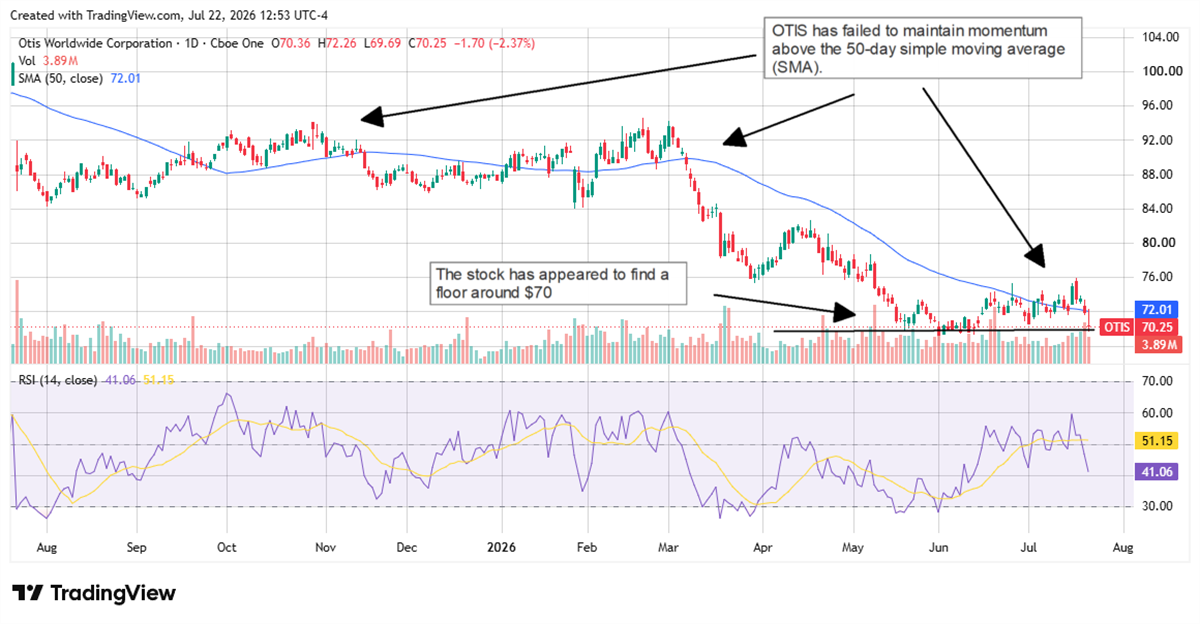
For now, OTIS looks like a name in a basing pattern: beaten down, dividend-supported, and waiting on either a cost inflection or a technical breakout to confirm the next leg. But investors with a time horizon of over 12 months may be rewarded with growth as the company’s backlog drives future earnings.
Before you consider Otis Worldwide, you'll want to hear this.
MarketBeat keeps track of Wall Street's top-rated and best performing research analysts and the stocks they recommend to their clients on a daily basis. MarketBeat has identified the five stocks that top analysts are quietly whispering to their clients to buy now before the broader market catches on... and Otis Worldwide wasn't on the list.
While Otis Worldwide currently has a Hold rating among analysts, top-rated analysts believe these five stocks are better buys.
View The Five Stocks Here
Discover the 10 Best High-Yield Dividend Stocks for 2026 and secure reliable income in uncertain markets. Download the report now to identify top dividend payers and avoid common yield traps.
Get This Free Report
