Most Active Stocks by Dollar Volume

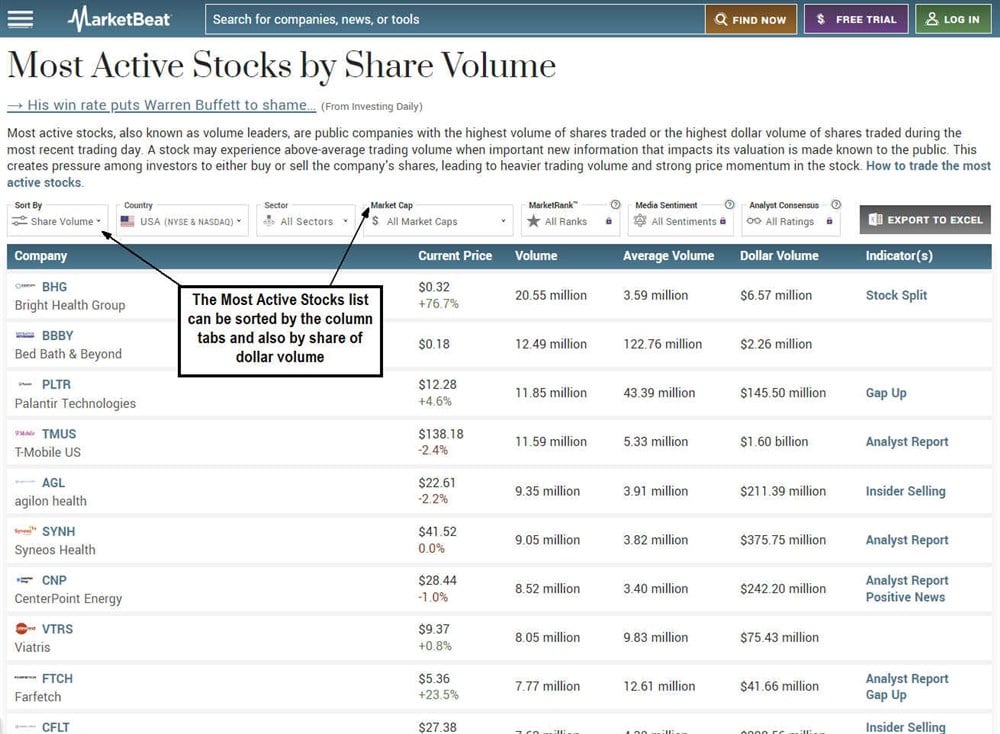
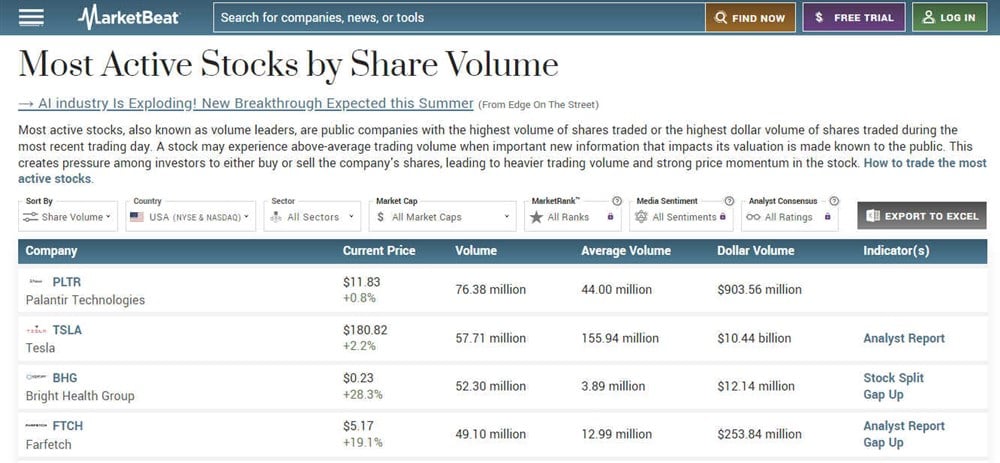
Most active stocks, also known as volume leaders, are companies with the most shares traded or the highest dollar volume of shares traded over one trading day. A stock may experience above-average trading volume when important new information affecting the stock's valuation is made known to the public. This creates pressure among investors to either buy or sell the stock, leading to heavier trading volume and strong price momentum in the stock. How to trade the most active stocks.

Most Active By: 
Country: 
CompanyVolumeAverage VolumeDollar VolumeCurrent PricePrice ChangeIndicator(s)
SPY
SPDR S&P 500 ETF Trust
70.97 million81.40 million$27.86 billion$392.59+0.8%
Tesla logo
TSLA
Tesla
38.79 million35.79 million$25.99 billion$670.00+2.3%Gap Down
Invesco QQQ Trust logo
QQQ
Invesco QQQ Trust
54.51 million49.22 million$17.37 billion$318.61+1.8%
QQQ
Invesco QQQ Trust
54.51 million49.22 million$17.37 billion$318.61+1.8%News Coverage
Apple logo
AAPL
Apple
107.63 million112.22 million$13.28 billion$123.39+2.8%Analyst Report
Amazon.com logo
AMZN
Amazon.com
2.80 million3.70 million$8.71 billion$3,110.87+1.2%
Facebook logo
FB
Facebook
27.34 million20.83 million$8.03 billion$293.54+1.2%Insider Selling
News Coverage
Microsoft logo
MSFT
Microsoft
28.37 million30.60 million$6.70 billion$235.99+2.4%Dividend Announcement
IWM
iShares Russell 2000 ETF
23.16 million30.34 million$5.22 billion$225.23-0.8%
Alphabet logo
GOOG
Alphabet
1.93 million1.63 million$3.94 billion$2,038.59-0.2%
NVIDIA logo
NVDA
NVIDIA
7.28 million8.60 million$3.84 billion$527.45+2.6%
The Boeing logo
BA
The Boeing
15.15 million16.32 million$3.81 billion$251.23-1.8%Analyst Report
Alphabet logo
GOOGL
Alphabet
1.63 million1.86 million$3.31 billion$2,030.69+0.2%
TQQQ
ProShares UltraPro QQQ
34.94 million37.31 million$3.18 billion$91.09+5.1%Gap Down
TQQQ
ProShares UltraPro QQQ
34.94 million37.31 million$3.18 billion$91.09+5.1%Gap Down
Advanced Micro Devices logo
AMD
Advanced Micro Devices
39.31 million45.25 million$3.16 billion$80.30+1.5%
NIO logo
NIO
NIO
71.97 million110.61 million$3.09 billion$42.94-1.0%
Alibaba Group logo
BABA
Alibaba Group
11.31 million19.38 million$2.68 billion$237.12-1.1%Analyst Revision
JPMorgan Chase & Co. logo
JPM
JPMorgan Chase & Co.
16.86 million15.47 million$2.54 billion$150.97-2.8%Dividend Announcement
Analyst Report
HYG
iShares iBoxx $ High Yield Corporate Bond ETF
29.30 million31.01 million$2.53 billion$86.37+0.4%News Coverage
Kansas City Southern logo
KSU
Kansas City Southern
9.59 million913,203$2.39 billion$249.09+10.0%Analyst Upgrade
Unusual Options Activity
News Coverage
Gap Down
Visa logo
V
Visa
11.13 million10.43 million$2.32 billion$208.00+0.5%Analyst Report
Insider Selling
News Coverage
TLT
iShares 20+ Year Treasury Bond ETF
16.92 million14.67 million$2.31 billion$136.26+1.1%
TLT
iShares 20+ Year Treasury Bond ETF
16.92 million14.67 million$2.31 billion$136.26+1.1%
XLF
Financial Select Sector SPDR Fund
67.44 million65.19 million$2.27 billion$33.63-1.3%
Intel logo
INTC
Intel
33.98 million36.77 million$2.23 billion$65.63+2.8%
LQD
iShares iBoxx $ Investment Grade Corporate Bond ETF
16.65 million16.53 million$2.15 billion$129.09+0.4%
EFA
iShares MSCI EAFE ETF
27.97 million21.67 million$2.14 billion$76.50+0.1%
Bank of America logo
BAC
Bank of America
54.15 million56.59 million$2.04 billion$37.66-2.3%
Baidu logo
BIDU
Baidu
7.64 million10.91 million$2.03 billion$266.13+3.3%
Support.com logo
SPRT
Support.com
277.01 million5.36 million$1.97 billion$7.10+69.9%Upcoming Earnings
High Trading Volume
Unusual Options Activity
Gap Down
ViacomCBS logo
VIAC
ViacomCBS
19.54 million19.33 million$1.96 billion$100.34+3.0%Analyst Report
GameStop logo
GME
GameStop
9.60 million48.28 million$1.87 billion$194.49-3.0%Gap Down
Takung Art logo
TKAT
Takung Art
37.05 million3.77 million$1.82 billion$49.00+39.4%High Trading Volume
News Coverage
Gap Up
Micron Technology logo
MU
Micron Technology
19.08 million20.35 million$1.74 billion$91.28+0.8%Analyst Report
General Motors logo
GM
General Motors
29.46 million26.55 million$1.71 billion$58.10-3.0%Insider Selling
Netflix logo
NFLX
Netflix
3.26 million4.90 million$1.71 billion$523.11+2.1%Analyst Report
Snap logo
SNAP
Snap
27.37 million22.80 million$1.59 billion$58.16-0.3%Analyst Downgrade
Insider Selling
News Coverage
Gap Up
Exxon Mobil logo
XOM
Exxon Mobil
27.00 million32.10 million$1.51 billion$55.91-1.0%
The Home Depot logo
HD
The Home Depot
5.19 million4.69 million$1.50 billion$288.94-0.1%
IVV
iShares S&P 500 ETF
3.78 million4.24 million$1.50 billion$395.30+0.8%
The Walt Disney logo
DIS
The Walt Disney
7.73 million12.18 million$1.49 billion$192.86+0.9%
Mastercard logo
MA
Mastercard
4.13 million4.71 million$1.48 billion$358.40+0.5%Analyst Report
Canadian Pacific Railway logo
CP
Canadian Pacific Railway
4.13 million374,585$1.47 billion$356.53-6.2%Analyst Report
Unusual Options Activity
News Coverage
Twitter logo
TWTR
Twitter
22.55 million23.05 million$1.47 billion$65.21-1.6%
DraftKings logo
DKNG
DraftKings
20.39 million17.09 million$1.46 billion$71.72-0.4%
Cisco Systems logo
CSCO
Cisco Systems
28.78 million22.03 million$1.45 billion$50.30+2.6%
XLE
Energy Select Sector SPDR Fund
29.51 million35.63 million$1.43 billion$48.54-1.0%
Square logo
SQ
Square
6.30 million10.84 million$1.42 billion$226.13+0.6%
Upstart logo
UPST
Upstart
8.45 million2.04 million$1.39 billion$164.87+24.0%Earnings Announcement
Analyst Report
Gap Down
PayPal logo
PYPL
PayPal
5.60 million10.06 million$1.37 billion$244.39+1.3%
Broadcom logo
AVGO
Broadcom
2.83 million2.19 million$1.34 billion$475.28+0.2%
EEM
iShares MSCI Emerging Markets ETF
24.73 million44.46 million$1.33 billion$53.92-0.3%
Costco Wholesale logo
COST
Costco Wholesale
3.97 million3.08 million$1.33 billion$334.49+1.7%
Applied Materials logo
AMAT
Applied Materials
11.07 million8.77 million$1.32 billion$119.33+3.7%Gap Down
HOFV
Hall of Fame Resort & Entertainment
248.04 million14.56 million$1.31 billion$5.29+24.4%News Coverage
Gap Up
Wells Fargo & Company logo
WFC
Wells Fargo & Company
31.97 million37.41 million$1.25 billion$38.97-1.7%
UnitedHealth Group logo
UNH
UnitedHealth Group
3.40 million3.52 million$1.25 billion$366.86+0.3%
Adobe logo
ADBE
Adobe
2.74 million2.80 million$1.24 billion$452.41+2.4%
DIA
SPDR Dow Jones Industrial Average ETF Trust
3.79 million4.07 million$1.24 billion$327.24+0.4%
VOO
Vanguard S&P 500 ETF
3.40 million4.01 million$1.23 billion$362.07+0.8%
Berkshire Hathaway logo
BRK.B
Berkshire Hathaway
4.88 million4.51 million$1.22 billion$250.36-0.3%
Berkshire Hathaway logo
BRK/B
Berkshire Hathaway
4.88 millionN/A$1.22 billion$250.36-0.3%
QUALCOMM logo
QCOM
QUALCOMM
8.94 million10.97 million$1.20 billion$134.09+2.3%
Chevron logo
CVX
Chevron
11.68 million11.75 million$1.20 billion$102.54-0.8%Analyst Report
JNK
SPDR Bloomberg Barclays High Yield Bond ETF
11.03 million9.81 million$1.19 billion$107.85+0.3%
Union Pacific logo
UNP
Union Pacific
5.74 million3.07 million$1.18 billion$206.27-2.2%News Coverage
XLI
Industrial Select Sector SPDR Fund
12.27 million13.06 million$1.18 billion$96.12-0.1%
Booking logo
BKNG
Booking
528,399415,092$1.18 billion$2,231.89-2.5%Analyst Upgrade
Gap Down
SMH
VanEck Vectors Semiconductor ETF
4.91 million4.17 million$1.17 billion$239.25+2.3%
SMH
VanEck Vectors Semiconductor ETF
4.91 million4.17 million$1.17 billion$239.25+2.3%
Pinduoduo logo
PDD
Pinduoduo
8.48 million8.00 million$1.16 billion$137.15-3.4%Earnings Announcement
Analyst Upgrade
Analyst Revision
QS
QuantumScape
17.98 million19.00 million$1.16 billion$64.29+7.7%
Johnson & Johnson logo
JNJ
Johnson & Johnson
7.15 million8.43 million$1.15 billion$160.50+0.3%
JFIN
Jiayin Group
76.66 million4.42 million$1.12 billion$14.64+43.9%High Trading Volume
News Coverage
Gap Up
Verizon Communications logo
VZ
Verizon Communications
19.78 million21.22 million$1.12 billion$56.59+0.6%
ARKK
ARK Innovation ETF
8.84 million12.10 million$1.10 billion$124.72+1.9%
SQQQ
ProShares UltraPro Short QQQ
82.84 million96.78 million$1.10 billion$13.25-5.7%Gap Up
AMC Entertainment logo
AMC
AMC Entertainment
87.69 million190.15 million$1.10 billion$12.49-11.5%Gap Up
Palantir Technologies logo
PLTR
Palantir Technologies
45.11 million89.05 million$1.09 billion$24.22-0.4%Gap Down
RLX
RLX Technology
106.41 million12.30 million$1.08 billion$10.15-91.7%Upcoming Earnings
Unusual Options Activity
News Coverage
Gap Up
Citigroup logo
C
Citigroup
14.96 million21.29 million$1.08 billion$71.96-1.5%
SQQQ
ProShares UltraPro Short QQQ
80.67 million96.78 million$1.07 billion$13.25-5.7%News Coverage
Gap Up
CrowdStrike logo
CRWD
CrowdStrike
5.45 million4.22 million$1.07 billion$195.73+0.6%Analyst Report
Analyst Revision
NXP Semiconductors logo
NXPI
NXP Semiconductors
5.31 million4.34 million$1.06 billion$200.40-0.8%Analyst Report
Walmart logo
WMT
Walmart
8.03 million9.59 million$1.06 billion$132.37+0.5%
salesforce.com logo
CRM
salesforce.com
4.90 million7.68 million$1.05 billion$215.17+1.4%
XLK
Technology Select Sector SPDR Fund
7.98 million9.09 million$1.05 billion$131.87+1.9%
PepsiCo logo
PEP
PepsiCo
7.59 million5.76 million$1.05 billion$137.80+2.4%Analyst Upgrade
Shopify logo
SHOP
Shopify
893,5501.41 million$1.04 billion$1,160.00+3.4%
Dollar General logo
DG
Dollar General
5.33 million2.82 million$1.03 billion$193.96+3.2%Earnings Announcement
Dividend Increase
Analyst Upgrade
Analyst Revision
Pinterest logo
PINS
Pinterest
14.13 million13.31 million$1.02 billion$72.35-0.9%Analyst Downgrade
Ford Motor logo
F
Ford Motor
79.29 million86.59 million$1.02 billion$12.85+0.2%
American Airlines Group logo
AAL
American Airlines Group
42.32 million57.93 million$1.01 billion$23.83-4.8%
NIKE logo
NKE
NIKE
7.27 million5.96 million$1.01 billion$138.27+0.6%Earnings Announcement
Analyst Report
Analyst Revision
The Procter & Gamble logo
PG
The Procter & Gamble
7.65 million8.28 million$996.19 million$130.18+1.7%
Taiwan Semiconductor Manufacturing logo
TSM
Taiwan Semiconductor Manufacturing
8.37 million13.76 million$981.33 million$117.18+3.0%News Coverage
Comcast logo
CMCSA
Comcast
17.32 million19.13 million$976.52 million$56.37+1.6%Analyst Report
XLP
Consumer Staples Select Sector SPDR Fund
14.50 million12.68 million$967.13 million$66.72+1.0%
Riot Blockchain logo
RIOT
Riot Blockchain
17.19 million32.65 million$963.07 million$56.01-8.3%Upcoming Earnings
CSV / Excel Export To export this table to CSV or Excel, upgrade to MarketBeat All Access.
Most Active Stocks: Dollar Volume vs Share Volume

Most-active stocks are companies with the most shares traded or the highest dollar volume of shares traded over one trading day. A stock may experience above-average trading volume when important new information affecting the stock's valuation becomes public knowledge. This creates pressure among investors to either buy or sell the stock, leading to heavier trading volume and strong price momentum in the stock. Learn more.

How to Use the Most Active Stocks to Increase Your Investing Profits

When people think of the excitement of Wall Street, they sometimes think of investors making rapid-fire trades as stock prices rise and fall. But there is a large difference between trading and investing. Investors tend to take long-term positions in the stocks that they are buying. A stock that shows aggressive price movement or significant movement in trading volume on a given day is not likely to change an investor's underlying opinion about the stock. However, active traders know that the difference between a successful trade often comes down to finding the most actively traded stocks. To find these stocks, traders look at the most active stocks list for a given exchange.

The Most Active Stock list shows the stocks that have the highest trading volume for a specified period of time, usually a trading day. Although most financial news sites show most active stocks in terms of dollar volume and trading volume, individual investors are typically only concerned about the most active stocks in terms of trading volume. The stocks that are most active in terms of dollar volume tend to belong to large institutional investors.

The “most active stocks” can sometimes be conflated with the most volatile stocks, but this is not always accurate. Remember that "active" is more of a neutral word, while "volatile" is usually negative—though trading volatile stocks can yield great profits.

While active stocks are those with a high degree of trading activity, volatile stocks are experiencing wild price fluctuations, which does not necessarily indicate a high degree of liquidity. Liquidity is what active traders care about because it indicates the ease with which a stock can be traded.

The list of the most active stocks is a subset of stocks that have a high average daily trading volume (ADTV). As part of their technical analysis, ADTV helps traders determine when to enter (buy) or exit (sell) a position they have in a security. These investors are typically looking to buy and sell a security, oftentimes in the same day. For this reason, they use average daily trading volume to select securities.

One way to measure demand for a stock is to look at trading volume—and one of the most common ways to measure demand for a stock is the average daily trading volume (ADTV). A stock is an active stock when its ADTV is exceptionally high. The stocks that are the most active in terms of volume or dollars being traded make a daily list of most active stocks. In this article, we'll define what the most active stocks mean and why a stock may make the most active list. We'll also go over a list of strategies that traders can use to narrow down the most active list to identify their best trading opportunities.

There is actually no official benchmark for “active stocks,” but according to some investors, stocks are active if their trading volume is at least 1 to 2 million shares per day. In fact, there are over 250 publicly traded companies that are trading at 250 million shares per day.

The most active stocks are listed for every major stock exchange, such as the New York Stock Exchange (NYSE), NASDAQ, and AMEX. In many cases, the most active stocks are divided into two categories: most active by dollar volume and most active by trading volume.

Because “most active” does not designate which direction a stock is moving, the most active stocks may also be listed as daily winners and losers. Knowing what stocks are most active by dollar volume is typically more important to institutional investors and large hedge fund managers that have to execute large block trades. Individual investors, particularly day traders, will pay more attention to the most active stocks by volume because this metric helps ensure they can efficiently enter and exit trades at the price they want.

It can also be helpful to understand a stock’s average volume over a longer period of time, so that you can gauge how active it actually is, relative to its own performance. Another stat that can help position a stock’s activity contextually is the overall activity of the market. On select days of high activity, it would not be odd for a particular index of stocks to have a trading volume of a billion shares or more.

What Causes a Stock to be Most Active?

In many cases, a stock becomes “most active” because there has been a significant change in stock price. Such a change is usually caused by a newsworthy event. A positive earnings report can generate interest in the stock, causing the price to rise. Conversely, a negative earnings report can put selling pressure on the stock, causing the price to decline. This increased trading volume can stay in place for a while, as other investors jump in for fear of missing out (FOMO). Alternatively, they might have a fear of losing money, which spurs on more and more sales of the stock, further driving down the price and increasing the volume.

However, some stocks are consistently on the most active list simply because they are popular companies, and news about their every action is never delayed. Amazon and Apple are good examples of stocks that are consistently among the most active stocks regardless of what is happening with the company—because of their size and global impact, it’s hard for these companies to not have active stocks.

How Are “Most Active Stocks” Different from Active Stocks?

Simply put, all of the most active stocks for a given trading day are active stocks. However, not all “active stocks” make the most active list for the day. An active stock is a stock that is generating a lot of trading activity throughout a given trading day. Depending on the curator of the list, the most active stocks are limited to the stocks with the highest trading and/or dollar volume. The reasons why these stocks are active are the same as the reason why a stock makes the most active list—there is usually some news about the company that is generating interest in the stock.

What Causes a Stock to be Most Active?

Active stocks have a large number of outstanding shares being traded. Outstanding shares are the number of shares of stock that a company has issued and can be bought and sold by public and institutional investors. These are sometimes referred to as “shares in float” and are different from the number of authorized shares a company may issue, such as ones that are currently owned.

Another common characteristic of active stocks is a high amount of liquidity. Liquidity in terms of active stocks simply means that the availability of a stock can meet its demand. If a stock is experiencing a high trading volume, it is usually a signal that there is a high demand, and that in turn often makes it easier to buy and sell. At different times, an asset class may go through periods where they exhibit more or less liquidity.

For example, if a trader is attempting to trade stocks in after-hours trading, they may find a lack of buyers. And most traders know that volume tends to peak at the beginning and the end of a trading day.

Some aspiring investors may conflate the idea of “most active stocks” with the best growth stocks. This second type of list indicates which stocks have a high potential for growth. Some of those stocks might even be winners for active stock traders, but some of them might just be exhibiting a stable and long-term climb upward —not necessarily the best choice for traders who ride the waves of the market in search of profit.

One of the easiest ways to find the most active stocks is to use a daily listing provided by MarketBeat or a marketplace like the NYSE or NASDAQ. Such a compilation of active data can be a good place to focus your energy because they’ll typically only list the most active stocks as indicated by the highest trade volume and/or dollar volume that day.

There are other tools and dashboards provided by websites and major search engines. Many of these dashboards give you the option to filter the data, so you can zone in on active stocks that meet your particular criteria, such as a price range. Some boards will even let you know if there are any hidden causes of an increase in volume, such as insider buying (not to be confused with the illegal act of insider trading).

The basic stats that these lists often include are the current price, the volume (essentially the number of shares that have been traded that day), the dollar volume of traded shares, and the change in price, as expressed as a percentage.

Select dashboards may have other bells and whistles, such as a “heat map” that will give a graphic representation of which stocks are seeing the biggest changes in price, indicated by the fact that they’re taking up the most space on the chart. These tools are good for visual learners who may struggle with the numbers-heavy data of active stock trading.

You can also create your own lists with select software or online services. If you’ve been trading for a while, you may have already zoned in on a number of the most active stocks that are your “favorite” ones to monitor, buy, and sell. A customized, real-time list like this can let you know which stocks are the most active that day, whether you’re into tech stocks like Advanced Micro or financial services stocks like Bank of America Corp.

Other means of tracking the most active stocks require a little more constant surveillance. News outlets, especially ones geared toward finance, such as the Wall Street Journal, are constantly releasing updates from around the world about current events that can drive stock prices up or down. You may also follow pundits and analysts on social media and see what they’re saying about the stock market. If you catch wind of the right word, you’ll know about other stocks that can certainly be considered “active.”

Of course, once you get that information, you’ll want to back it up with some analysis, because active stock trading is fraught with potential dangers for the unscrupulous trader. Remember that successful traders don’t place trades based on emotions; they use research.

Traders with an appetite for risk (and the ability to take it on) might also consider looking for active stocks that are not on a publicly listed market, such as stocks under $1. These unproven companies may be listed on pink sheets or over-the-counter boards, though some are listed on public markets. Some of these stocks are already active, though the activity is usually in terms of fractions of a penny. Others may be quiet now, but a major breakthrough could lead to a flurry of activity.

The list of most active stocks can be a useful guide for investors. It is sometimes called a road map for day traders. But with so many options to choose from, how can traders know which stocks to choose? Trading active stocks requires a lot more numbers-based analysis of market data, sometimes in a short time frame. It can be more intense than investing in other securities like futures, stocks, and EFS. Here are some guidelines that any trader can apply.

  1. Assign a minimum and maximum percentage move (expressed in +/- terms) in price level and look for stocks that fit that range. All of the most active stocks are volatile, but it’s possible to have too much or too little volatility. The reason for choosing a minimum percentage move is to ensure that the stocks you select have enough price movement to provide the return a trader needs. Conversely, the reason to assign a maximum value is to avoid having a stock with too much movement—which could trigger any trailing stops an investor has in place and add risk to their overall strategy.
  2. Assign an appropriate volume. Just because a stock is active does not mean it trades with enough volume to allow traders to easily move in and out of trades—for example, if a stock price is up 10%, but does not trade a high volume of shares. Most traders want to see volume that is measured in tens of thousands of shares over a specified time. Once you find a stock whose price has moved up or down within the range you specify, make sure it is trading at a high enough volume to let you easily enter and exit a trade.
  3. Focus on one index. Once you have assigned your percentage range and volume, look at the major indices and focus your attention on the index that has the most stocks that meet those criteria. Most trading platforms will break down the most active stocks by one of the major indices (NYSE, NASDAQ, or AMEX).
  4. Pay attention to the stocks that are most active in the pre-market trading period. This can allow you to monitor technical indicators, such as support and resistance levels for stocks that meet your criteria.
  5. Pay less attention to the after-hours most active list. After-hours trading can be very volatile, but breaking news immediately after the market closes does not always continue in the same direction overnight and into pre-market trading the following day.
  6. Know how to interpret the most active by dollar volume list. This list largely exists for the institutional investors and large hedge funds that are making block trades with large sums of money. While it may help keep you abreast of larger trends in particular sectors, traders of stocks on the most active list are looking for individual stocks that are trading actively on their own merits.

Share volume is the number of total shares that have been traded over the course of a specific time period (usually that day). It can be a good indicator of investor sentiment around that particular company, but not necessarily.

For example, share volume could soar upward, but without an attendant increase in stock price, it’s not likely to be a lasting trend. That’s why it’s best to combine share volume analysis with other technical indicators to get a whole picture.

Dollar volume, on the other hand, is the total value of all those trades. This value is found by multiplying the share volume by the stock price. Dollar volume can give investors a better sense of a stock’s actual liquidity—essentially how easy or difficult it is to make trades.

Larger institutional investors, such as banks, prefer active stocks with higher degrees of liquidity because it allows them to buy or sell shares without affecting the price since there are plenty of other shares to go around.

Dollar volume is sometimes conflated with market cap, which actually represents the number of total outstanding shares (both those traded and held) multiplied by the stock value. It helps determine the value and size of a company, but not necessarily trading activity.

Like any other stat, these numbers can fluctuate throughout the day, and certainly will for active stocks. Volume can help traders confirm trends and identify potential momentum, especially when examined over a longer span of time. A trader trying to assess an investment can look at volume and determine the level of excitement around a stock.

Steady increases in volume, accompanied by upwardly trending prices, confirm that a stock is a good buy. Of course, this increase in volume would only be confirming the stock is good after some research into the company and fundamental analysis. Inversely, steady decreases in volume may indicate that a trader should take their profits and sell while they’re ahead—because the low volume indicates a weakness in the upward trend, and that it may end soon.

Whether you focus more on dollar volume or share volume will depend on what type of trader you are, and your trading strategy. For example, if you’re a scalper who is going to buy and sell the same stock within minutes, you might not care about the long-term trend indicated by dollar volume—but a spike in share volume may suit your needs just fine.

The thrust of all trading strategies for active stocks is to capitalize on market movements and make a profit from price changes. In this way, active trading is different than passive-income approaches such as buying and holding income-generating equities as part of a dividend investing strategy. Active traders have eschewed the portfolio-building approach in favor of making a series of profits with the short-term movements of the stock market.

However, the definition of short-term may vary based on the active trading strategy. Some traders would consider just a few minutes to be short-term, while others would consider a day to be definitive. Many traders view themselves as active traders, even if they are holding on to stocks for weeks or months, because it’s all about the intention of riding a stock’s wave of activity.

Day trading is the most popular strategy for trading active stocks. Day trading involves buying and selling stocks, usually within the same trading period, or at least within the same day. Day traders convert all their shares to cash by the end of the day, leaving no unexecuted orders and holding no stocks overnight. Until recently, only specialists and market makers were involved in day trading, but the ease and accessibility of electronic venues, such as apps, has made day trading accessible to novices.

Swing traders take advantage of breaking trends, usually as a trend ends and stock prices go through some volatility. Swing traders buy or sell during these volatile periods and hold on to stocks for a short time—typically longer than a day, but just long enough to make a profit from the swing.

Position trading is somewhat of a cross between active trading and buy-and-hold investing. These traders analyze current market trends and potential directions, before placing trades. They might hold on to these securities for several days, weeks, or months before selling them for a profit next time they can leverage the position of the market.

Scalping is done by traders who want to capitalize on minor price changes. The philosophy driving this approach is that smaller fluctuations are easier to catch than larger ones. Scalpers will place up to several hundred trades in a single day, buying stocks and selling them just hours or minutes later, leveraging profit from the space between the bid and ask spreads. Their hope is that the small gains compound into a large profit and that losses are mitigated by a sound exit strategy—though scalping is considered a high-risk strategy.

Scalpers might look to make their profits on high-priced active stocks that experience ups and downs, such as the ever-popular Apple, Google, Facebook, and Amazon. Other scalpers might look at cheap stocks to buy and trade a larger number of shares to build their bankroll.

Whatever your active stock trading strategy may be, it’s important to realize that FINRA requires active trades to have $25,000 of equity in their trading accounts every day, and will suspend activity until that level of equity is returned. Their definition of “day trading” is placing just four trades or more in a five-day period.

There are other regulations to keep in mind that were put in place to protect consumers from harming their own best interests—because trading active stocks does carry a certain amount of risk.

The Final Word on Most Active Stocks

Active traders have many strategies for executing successful trades, and we’ve outlined four of the most popular ones above: day trading, position trading, swing trading, and scalping. One of the common sorting metrics traders use is to find stocks that have high volume—which indicates liquidity—and show a particular percentage price movement. As we’ve mentioned, everything about stocks is always fluctuating, but when a stock is trading at exceptionally high volume, it is considered to be one of the “most active” stocks. Though trading the high volume stocks can carry a certain amount of risk, it’s the bread-and-butter of select traders, and it does yield enormous possibilities for wealth building—if done right, with the requisite amount of care and research.

Every day, investors can get a list of stocks that are most active for a given exchange (NYSE, NASDAQ, AMEX, etc.). This list can be quite extensive, so many traders use different strategies and tools—like a stock screener—to help filter the list to identify stocks that meet their specific trading criteria. Aside from using lists, it’s extremely important that active stock traders keep abreast of current events and market trends, such as stock market gainers. While anyone who invests in the stock market should make informed choices based on events and numbers, traders of active stocks need to be especially on their proverbial toes, in order to leverage market movements for the most profit.

MarketBeat - Stock Market News and Research Tools logo

MarketBeat empowers individual investors to make better trading decisions by providing real-time financial data and objective market analysis. Whether you’re looking for analyst ratings, corporate buybacks, dividends, earnings, economic reports, financials, insider trades, IPOs, SEC filings or stock splits, MarketBeat has the objective information you need to analyze any stock. Learn more.

MarketBeat is accredited by the Better Business Bureau

© American Consumer News, LLC dba MarketBeat® 2010-2021. All rights reserved.
326 E 8th St #105, Sioux Falls, SD 57103 | [email protected] | (844) 978-6257
MarketBeat does not provide financial advice and does not issue recommendations or offers to buy stock or sell any security. Learn more.

Our Accessibility Statement
Do Not Sell My Information

© 2021 Market data provided is at least 10-minutes delayed and hosted by Barchart Solutions. Information is provided 'as-is' and solely for informational purposes, not for trading purposes or advice, and is delayed. To see all exchange delays and terms of use please see disclaimer. Fundamental company data provided by Zacks Investment Research. As a bonus to opt-ing into our email newsletters, you will also get a free subscription to the Liberty Through Wealth e-newsletter. You can opt out at any time.

Enter your email address below to receive a concise daily summary of analysts' upgrades, downgrades and new coverage with MarketBeat.com's FREE daily email newsletter.