Best Buy Co., Inc. NYSE: BBY just delivered an earnings report for Q1 of its fiscal year 2027 that was exactly what the bulls had been waiting for. One of the most encouraging signs was that comparable sales were up 2%, ahead of guidance. That may sound modest, but context matters. Best Buy had been running negative comps for the better part of two years, so positive territory is genuinely significant.
Best Buy Today
$75.22 -2.73 (-3.50%) As of 02:07 PM Eastern
This is a fair market value price provided by Massive. Learn more. - 52-Week Range
- $55.10
▼
$84.99 - Dividend Yield
- 5.10%
- P/E Ratio
- 13.97
- Price Target
- $78.60
Digging into the category mix, the largest contributors on a weighted basis were gaming, computing, and mobile phones, with services adding support.
Appliances were the notable drag, down 13.6% on a comparable basis, which tracks with the ongoing housing market freeze keeping renovation and move-related purchases depressed.
Adjusted EPS was up 11% to $1.28. BBY reacted accordingly, surging approximately 15% on the day to close at $74.84. After years of grinding revenue declines, this is a meaningful data point.
The question worth sitting with is whether it marks an inflection, or whether investors are front-running a story that still has plenty of ways to disappoint.
AI PCs and Gaming Powered the Q1 Earnings Beat
The computing and gaming strength is where the AI narrative starts to look real. Computing and mobile phones now make up 47% of domestic revenue, and that category grew 4.2% on a comparable basis. Gaming was the single biggest driver, benefiting from what management described as a "very successful gaming launch" in the prior June period that they'll be lapping in Q2. But the computing strength is the more durable signal here, and it ties directly to the AI PC thesis that's been circulating for over a year.
The margin picture was also encouraging. Domestic gross profit rate expanded to 23.7% from 23.5%, driven by growth in Best Buy Ads and Marketplace. These are the newer profit stream initiatives the company has been building out, and they're starting to move the needle. Adjusted SG&A actually held flat as a percentage of revenue at 19.3%, which means the operating leverage is real—not just top-line driven.
Is the AI Laptop Upgrade Cycle Just Beginning?
The AI PC refresh cycle has been the central bull thesis for Best Buy for the better part of 18 months. The logic is straightforward: Microsoft's Copilot+ requirements, combined with a massive installed base of aging laptops (many purchased during the 2020–2021 pandemic surge), create a natural upgrade wave.
Best Buy, as the dominant brick-and-mortar electronics retailer, stands to be the primary physical destination for those purchases. This is particularly true given that consumers tend to want to touch and compare laptops before buying.
The Q1 results offer some validation of that thesis. A 4.2% comp in computing is good. But the real question is whether the cycle is in its early innings or whether a portion of the upgrade demand has already been pulled forward?
Given that management maintained rather than raised full-year guidance—revenue of $41.2 to $42.1 billion, comparable sales of -1.0% to +1.0%—they're clearly not extrapolating the Q1 beat into the rest of the year. That's either prudent conservatism or a signal that the back half looks murkier than the front.
The tariff environment adds another layer of uncertainty. Best Buy sells a lot of hardware manufactured in Asia, and while tariff impacts weren't a major topic in the earnings release, the risk sits squarely in the background for any consumer electronics retailer. If tariffs drive price increases on laptops and TVs, unit volumes could soften even if average selling prices hold up.
The CEO Transition Adds a New Variable for BBY
There was also an unexpected element in the earnings announcement that deserves attention: Corie Barry is stepping down as CEO, with Chief Customer and Product Officer Jason Bonfig taking the reins on Nov. 1, 2026. Barry framed the transition positively, and from a surface read, it appears orderly—an internal promotion rather than an external hire or an emergency change.
But leadership transitions during a potential cyclical inflection always introduce execution risk. Bonfig will inherit a company with real momentum and will need to keep the Ads and Marketplace initiatives scaling without disruption.
What the Technical Setup Says About BBY Stock
Before earnings, BBY was trading well below both its 50-day SMA (about $61.84) and its 200-day SMA (about $69.75) and had been in a sustained downtrend since late 2024. The earnings gap launched the stock to $77, decisively through both moving averages as well as its consensus price target of $70.70.
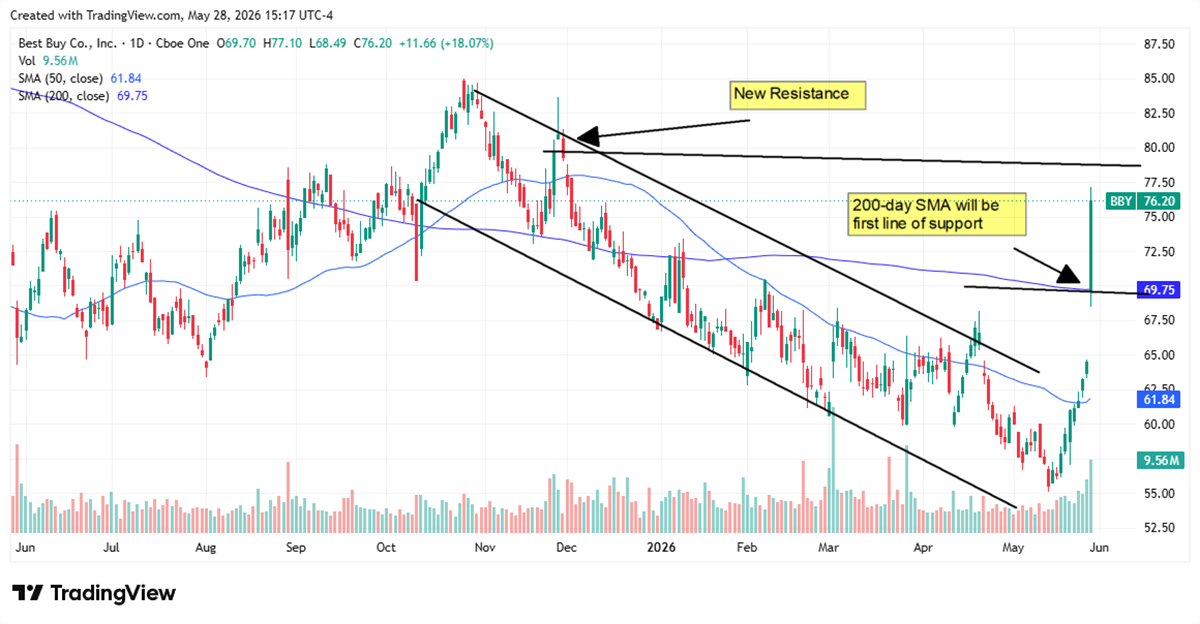
That kind of move is exciting for investors who are already long. For new buyers, it creates a tactical problem. Gap-ups of 15% on earnings frequently see at least partial mean reversion in the weeks following, particularly when the stock is clearing major technical resistance levels all at once. The 200-day SMA near $69.75 is now a logical first support level on any pullback, and the prior resistance zone around $75–$77 will need to be digested before the stock can sustain levels above it.
Is BBY a Buy After Earnings?
Chasing a gap of this magnitude is typically a losing proposition. The more patient approach is to let the stock work off some of the excitement, watch whether the $70–$72 range holds on any pullback (former resistance becoming support), and look for a setup with a more defined risk level.
The full-year guidance of $6.30–$6.60 in adjusted EPS—reiterated, not raised—gives you a valuation anchor. At $76, the stock trades at roughly 11x–12x that range, which is not expensive for a company that's re-accelerating on comps and building out higher-margin revenue streams. But the multiple expansion argument requires solid execution over multiple quarters.
The fundamental thesis is cleaner than it's been in years. AI PCs are a real cycle, Ads and Marketplace are working, the operational discipline appears intact, and the dividend—which has a yield of 4.9%—looks safe. The trade is watching for a pullback that offers a better risk-reward entry, likely somewhere in the low-to-mid $70s, rather than following the gap on day one.
Before you consider Best Buy, you'll want to hear this.
MarketBeat keeps track of Wall Street's top-rated and best performing research analysts and the stocks they recommend to their clients on a daily basis. MarketBeat has identified the five stocks that top analysts are quietly whispering to their clients to buy now before the broader market catches on... and Best Buy wasn't on the list.
While Best Buy currently has a Hold rating among analysts, top-rated analysts believe these five stocks are better buys.
View The Five Stocks Here
Market downturns give many investors pause, and for good reason. Wondering how to offset this risk? Click the link to learn more about using beta to protect your portfolio.
Get This Free Report
