Planet Labs PBC Today
PL
Planet Labs PBC
$32.20 -0.02 (-0.07%) As of 03:37 PM Eastern
This is a fair market value price provided by Massive. Learn more. - 52-Week Range
- $4.90
▼
$51.76 - Price Target
- $35.11
Space stocks are having a moment. But as the Q1 earnings report for fiscal 2027 from Planet Labs PBC NYSE: PL shows, it may be a big, irrational moment.
When SpaceX's IPO became the most anticipated market event in years, investors did what investors always do—they got ahead of themselves. If you couldn't buy SpaceX directly, you'd buy the next best thing. Planet Labs, with its constellation of Earth-imaging satellites and genuine government contracts, became a proxy trade. The stock ran hard. Too hard.
That tuition has a bill attached.
The Quarter Itself Was More Than Fine
Let's be fair to Planet Labs—the business delivered a strong Q1. Revenue came in at $94.2 million, up 42% year over year. The company's backlog exploded to $906 million, a 72% jump from the same period a year ago. Around 92% of contracts are annual or multi-year. The NGA renewed. The Navy renewed. Sweden bought a sovereign reconnaissance satellite. These aren't vanity metrics.
The Rule of 40 score hit 41—a number many software companies would envy. Non-GAAP gross margins held at 56%. Free cash flow came in at negative $2.5 million, which is essentially breakeven at this stage of investment. Management guided full-year revenue of $425 to $441 million.
On the fundamentals, Planet Labs is executing.
So What's the Problem?
The problem isn't the earnings report. The problem is the price tag attached to a company that still loses money on a GAAP basis. The net loss for Q1 was $138.9 million—though that figure is heavily distorted by a $106 million non-cash swing in warrant liability fair value. Strip that out, and the operating picture looks much cleaner.
But the stock trades at a price-to-sales ratio that implies perfection. Price-to-book tells a similar story. These are momentum multiples—and momentum is a fickle engine once the original catalyst fades.
The SpaceX IPO excitement was that catalyst. And it's fading.
The Institutional Story Matters Here
Planet Labs carries roughly 40% institutional ownership. That's not negligible—serious money has looked at this company and said yes. But it also means the majority of the float sits with retail traders, many of whom aren't particularly interested in backlog reconciliations or satellite services unit economics.
That creates a specific kind of risk. Planet Labs isn't a meme stock. It has real revenues, real government customers, and real technology. But a meaningful slice of its shareholder base will trade it like one. They'll push the stock higher because they can—because the narrative is fun, because satellites are cool, and because "space" carries a reflexive excitement that few other sectors can match.
This makes price discovery messy. It also means the pullback that began before earnings may not follow a clean, fundamental-driven script.
A Reset, Not a Crash
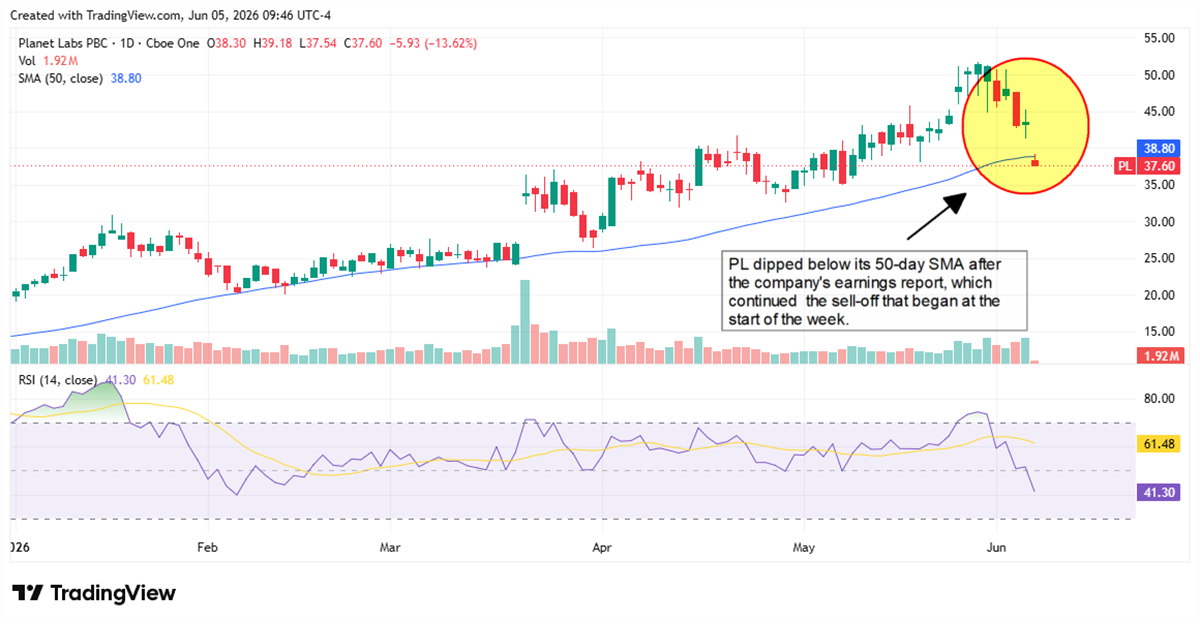
Planet Labs traded down slightly in overnight sessions, but the real action happened when the market opened on June 5. PL plunged by more than 25% that day, closing around $32. Whether that represents relief or renewed selling pressure will tell you something about who's still in control of this name.
Arguing for the former, PL had already started rolling over before the report hit. The MACD turned negative heading into earnings — a subtle warning that the post-SpaceX-fever momentum was losing steam. The 50-day moving average is still trending sharply up, indicating the longer-term trend remains intact. But extended stocks have a way of returning to their averages.
So What Do You Actually Do?
Here's the honest truth: there probably isn't a perfect entry point coming. PL closed at $43.44 on June 4. That was nearly 30% above its consensus price forecast of $30.61. Something had to give, and that something was profit-taking, maybe with more to come.
If Planet Labs continues executing—converting that $906 million backlog, scaling its AI-enabled analytics products, and landing more sovereign satellite services contracts—the fundamentals will eventually grow into the valuation. The company turned free cash flow positive for the full fiscal year 2026. That's a real milestone.
But "eventually grow into the valuation" is not a comfortable place to park capital when the stock has already run 300%+ from its lows. Investors who want exposure to this story need to think about sizing and staging. Pick a price range you can live with. Buy a partial position. Add on weakness. Don't chase it back to the highs, hoping the SpaceX-proxy trade reignites.
Planet Labs is building something real. It images the entire Earth, every single day. That capability has genuine value for defense agencies, civil governments, agricultural monitors, and financial analysts tracking physical-world signals. The product roadmap—SuperRes, Maritime Domain Awareness, the new agentic AI application—shows a company that isn't standing still.
But great companies can be bad stocks at the wrong price.
The space rush gave a lot of investors an expensive education in the difference between a compelling story and a compelling valuation. Planet Labs is one of the more interesting companies to come out of that frenzy. Just make sure you're paying the right price for interesting.
Before you consider Planet Labs PBC, you'll want to hear this.
MarketBeat keeps track of Wall Street's top-rated and best performing research analysts and the stocks they recommend to their clients on a daily basis. MarketBeat has identified the five stocks that top analysts are quietly whispering to their clients to buy now before the broader market catches on... and Planet Labs PBC wasn't on the list.
While Planet Labs PBC currently has a Hold rating among analysts, top-rated analysts believe these five stocks are better buys.
View The Five Stocks Here
Robotics and automation are rapidly becoming essential infrastructure across healthcare, manufacturing, logistics, and many other industries.
"Physical AI" is coming to the United States, and there are four ways that investors can gain exposure to this new robotics revolution. Plus, learn which seven companies are most positioned to benefit as intelligent robots enter the workforce.
Get This Free Report
