GE Aerospace NYSE: GE is telling investors a familiar story after its Q2 2026 earnings report on July 16. The stock dropped about 5% in early trading the day after the release, despite strong top and bottom-line beats. The company also raised its full-year guidance.
GE Aerospace Today
GE
GE Aerospace
$348.58 +2.85 (+0.82%) As of 03:59 PM Eastern
This is a fair market value price provided by Massive. Learn more. - 52-Week Range
- $254.66
▼
$382.97 - Dividend Yield
- 0.54%
- P/E Ratio
- 42.93
- Price Target
- $370.33
That pattern of a strong earnings report followed by a stock price decline has been the case for the last two earnings reports.
The reason is a familiar one—valuation. GE trades at around 46x forward earnings, which is a premium to the S&P 500.
It’s also expensive compared to its historical average. But that needs some context, because GE Aerospace has only existed since 2024, when General Electric spun off its energy and healthcare businesses into GE Vernova NYSE: GEV and GE Healthcare Technologies NASDAQ: GEHC, respectively.
That means the “what have you done for me lately?” sentiment impatiently expressed by many investors may actually be an apt way of analyzing GE.
Aging Fleets Are Driving Growth
The headline earnings numbers were impressive. Revenue of $12.63 billion beat estimates for $11.87 billion and was over 21% higher year over year (YOY). Earnings per share (EPS) of $2.02 beat the forecasted $1.86 and was also 21% higher YOY. Orders were up 17%, and free cash flow (FCF) was up a whopping 43%.
Those numbers looked even stronger over the first half of 2026. Orders grew 49% YOY to $39.5 billion. Adjusted revenue for the half rose 27%, and FCF climbed 31% to $4.7 billion.
As impressive as the headline numbers were, there’s a reason that GE Aerospace was willing to raise its full-year revenue and earnings outlook. The company is getting high demand from its airline customers who need to maintain aging fleets.
Management’s commentary provided more specifics. Commercial services revenue grew 32% in the first half, and total engine deliveries rose 31%. GE credited its internal "FLIGHT DECK" lean operating program for cutting shop turnaround times by roughly a week since the end of 2025. That helped drive record internal shop visit output during the quarter.
Defense demand added a second growth engine. GE's Defense & Propulsion Technologies segment posted a 1.55x book-to-bill ratio for the first half, meaning new orders outpaced revenue by 55%. Revenue in that segment grew 17% for the half, with strong contributions from Avio Aero.
Backlog Still the Real Story
Making the results even stronger is the company’s reported backlog of over $210 billion. That backlog gives GE unusual visibility into future revenue, since engine orders typically convert into decades of service revenue once delivered. New wins in the quarter included Copa Airlines selecting up to 120 LEAP-1B engines and a U.S. Air Force contract for an autonomous collaborative platform design review.
The Guidance Raise Was Sweeping
The expectation of continued strong demand was a catalyst for GE to raise its full-year 2026 guidance for revenue, earnings, operating profit, and FCF.
GE didn't just nudge its 2026 outlook higher. It raised guidance across every major line item. Adjusted EPS guidance moved to $7.65–$7.85, up from a prior $7.10–$7.40 range. At the low end, that's a 20% increase from the company's full-year adjusted EPS in 2025.
Operating profit guidance climbed to $10.55–$10.75 billion, versus a prior $9.85–$10.25 billion. Free cash flow guidance rose to $8.9–$9.2 billion, and revenue growth guidance moved from "low double digits" to "high-teens." Management credited robust services demand and equipment deliveries for the upgrade.
Is GE Overvalued?
At around 46x forward earnings, GE is trading at a premium to the S&P 500 and its own historical average. However, the company’s free cash flow (FCF) grew by more than 40% year over year in the quarter.
That cash generation is showing up in shareholder returns, too. GE repurchased $2 billion of stock in the second quarter alone, and diluted share count fell by 24 million shares year over year. The company also ended the quarter with $9.3 billion in cash, or $10.3 billion including short-term investments.
Skeptics will note that kind of FCF growth may not be sustainable, but it’s important to remember that the current iteration of the company has only been in existence since 2024. That means the five-year valuation models, whether FCF or EPS, are factoring in business units that no longer exist for GE Aerospace.
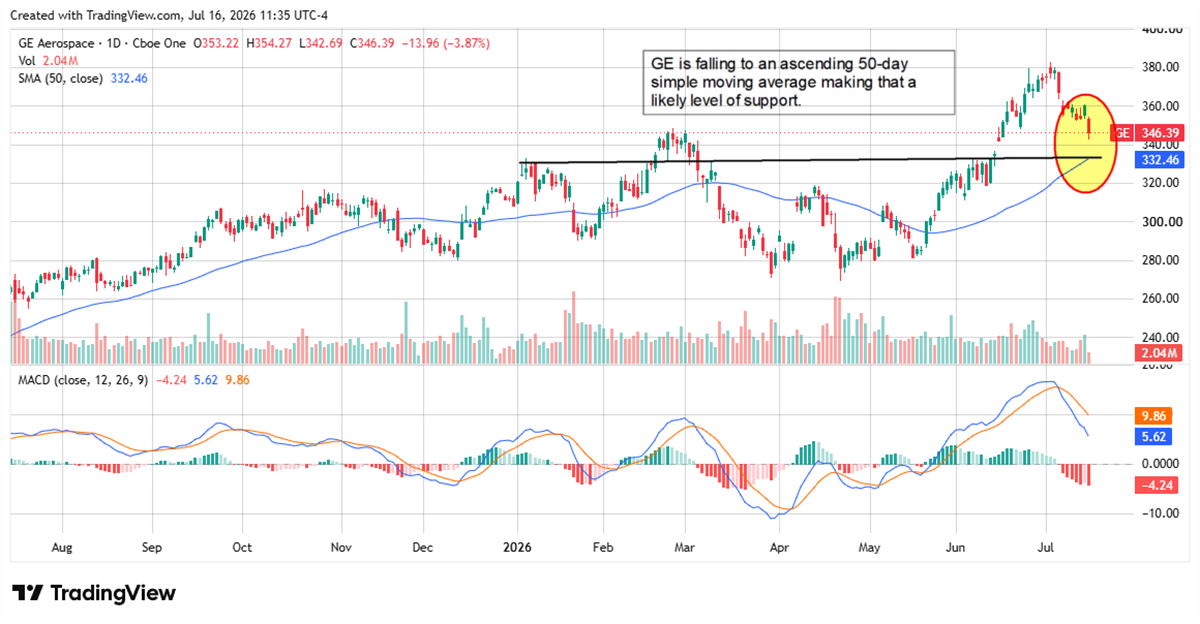
It’s possible that GE falls back a little more, but there’s likely to be a floor above a rising 50-day simple moving average. That means any dip may be short-lived, which is supported by analyst sentiment. The consensus price target for GE is $365.61, and since July, several analysts have raised their targets, with Jefferies offering the highest at $455.
Free cash flow also indicates that the dividend is safe and will likely grow again. Right now, that dividend is more of an afterthought, but it’s not an insignificant reason to make the stock a core holding.
Before you consider GE Aerospace, you'll want to hear this.
MarketBeat keeps track of Wall Street's top-rated and best performing research analysts and the stocks they recommend to their clients on a daily basis. MarketBeat has identified the five stocks that top analysts are quietly whispering to their clients to buy now before the broader market catches on... and GE Aerospace wasn't on the list.
While GE Aerospace currently has a Moderate Buy rating among analysts, top-rated analysts believe these five stocks are better buys.
View The Five Stocks Here
Discover the 10 Best High-Yield Dividend Stocks for 2026 and secure reliable income in uncertain markets. Download the report now to identify top dividend payers and avoid common yield traps.
Get This Free Report
