Brookfield Renewable Partners (NYSE:BEP - Get Free Report) TSE: BEP had its price target increased by analysts at National Bank Financial from $34.00 to $36.00 in a research report issued to clients and investors on Monday,BayStreet.CA reports. The firm presently has a "sector outperform" rating on the utilities provider's stock. National Bank Financial's price objective points to a potential upside of 9.39% from the company's current price.
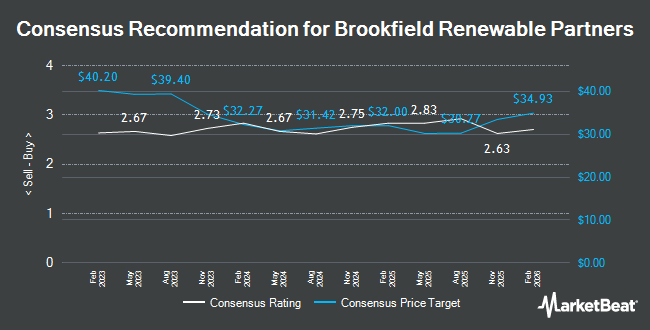
Other equities analysts have also issued reports about the company. Wall Street Zen lowered Brookfield Renewable Partners from a "hold" rating to a "sell" rating in a research report on Saturday. Barclays set a $28.00 price target on Brookfield Renewable Partners and gave the stock an "equal weight" rating in a research report on Friday, January 23rd. Morgan Stanley lifted their price objective on Brookfield Renewable Partners from $38.00 to $42.00 and gave the stock an "overweight" rating in a report on Monday, March 23rd. Canadian Imperial Bank of Commerce restated an "outperform" rating and set a $40.00 price objective (up from $37.00) on shares of Brookfield Renewable Partners in a report on Monday, April 20th. Finally, Zacks Research upgraded Brookfield Renewable Partners from a "hold" rating to a "strong-buy" rating in a report on Monday, April 6th. One equities research analyst has rated the stock with a Strong Buy rating, twelve have issued a Buy rating and four have given a Hold rating to the company. Based on data from MarketBeat, the company currently has an average rating of "Moderate Buy" and a consensus target price of $36.53.
View Our Latest Stock Report on BEP
Brookfield Renewable Partners Stock Down 1.3%
Brookfield Renewable Partners stock traded down $0.44 during midday trading on Monday, hitting $32.91. 703,604 shares of the company were exchanged, compared to its average volume of 747,495. The company's fifty day moving average price is $32.40 and its 200-day moving average price is $30.10. The company has a market cap of $9.98 billion, a PE ratio of -106.13 and a beta of 1.06. The company has a debt-to-equity ratio of 0.80, a current ratio of 0.57 and a quick ratio of 0.57. Brookfield Renewable Partners has a fifty-two week low of $22.17 and a fifty-two week high of $35.97.
Brookfield Renewable Partners (NYSE:BEP - Get Free Report) TSE: BEP last released its quarterly earnings results on Friday, May 1st. The utilities provider reported ($0.40) EPS for the quarter, missing the consensus estimate of ($0.36) by ($0.04). The company had revenue of $1.51 billion for the quarter, compared to analyst estimates of $1.50 billion. Brookfield Renewable Partners had a return on equity of 1.59% and a net margin of 8.28%. On average, research analysts predict that Brookfield Renewable Partners will post -1.18 EPS for the current fiscal year.
Institutional Investors Weigh In On Brookfield Renewable Partners
A number of institutional investors have recently made changes to their positions in BEP. BROOKFIELD Corp ON grew its stake in Brookfield Renewable Partners by 9.4% during the 4th quarter. BROOKFIELD Corp ON now owns 81,306,719 shares of the utilities provider's stock worth $2,192,842,000 after buying an additional 6,967,670 shares during the last quarter. State of Wisconsin Investment Board grew its stake in Brookfield Renewable Partners by 128.0% during the 4th quarter. State of Wisconsin Investment Board now owns 4,867,084 shares of the utilities provider's stock worth $131,265,000 after buying an additional 2,732,542 shares during the last quarter. Bank of Montreal Can grew its stake in Brookfield Renewable Partners by 20.3% during the 4th quarter. Bank of Montreal Can now owns 8,394,947 shares of the utilities provider's stock worth $226,859,000 after buying an additional 1,415,989 shares during the last quarter. Principal Financial Group Inc. grew its stake in Brookfield Renewable Partners by 16.2% during the 3rd quarter. Principal Financial Group Inc. now owns 10,127,549 shares of the utilities provider's stock worth $261,189,000 after buying an additional 1,414,837 shares during the last quarter. Finally, Morgan Stanley grew its stake in Brookfield Renewable Partners by 41.9% during the 4th quarter. Morgan Stanley now owns 4,029,046 shares of the utilities provider's stock worth $108,663,000 after buying an additional 1,189,130 shares during the last quarter. 63.16% of the stock is currently owned by institutional investors.
About Brookfield Renewable Partners
(
Get Free Report)
Brookfield Renewable Partners L.P. is a leading global owner, operator and developer of renewable power assets. Listed on the New York Stock Exchange under the ticker BEP, the partnership focuses on generating clean electricity from a diversified mix of hydroelectric, wind, solar and energy storage facilities. As part of the Brookfield Asset Management group, Brookfield Renewable leverages a long-term, asset-backed approach to investing in sustainable energy projects that support the transition to a low-carbon economy.
The company’s platform encompasses approximately 23,000 megawatts of installed capacity across four continents.
Read More
This instant news alert was generated by narrative science technology and financial data from MarketBeat in order to provide readers with the fastest reporting and unbiased coverage. Please send any questions or comments about this story to contact@marketbeat.com.
Before you consider Brookfield Renewable Partners, you'll want to hear this.
MarketBeat keeps track of Wall Street's top-rated and best performing research analysts and the stocks they recommend to their clients on a daily basis. MarketBeat has identified the five stocks that top analysts are quietly whispering to their clients to buy now before the broader market catches on... and Brookfield Renewable Partners wasn't on the list.
While Brookfield Renewable Partners currently has a Moderate Buy rating among analysts, top-rated analysts believe these five stocks are better buys.
View The Five Stocks Here
Click the link to see MarketBeat's list of seven stocks and why their long-term outlooks are very promising.
Get This Free Report
Like this article? Share it with a colleague.
Link copied to clipboard.
