Neo Ivy Capital Management raised its stake in shares of Lyft, Inc. (NASDAQ:LYFT - Free Report) by 331.4% in the 3rd quarter, according to the company in its most recent disclosure with the Securities and Exchange Commission (SEC). The fund owned 117,646 shares of the ride-sharing company's stock after purchasing an additional 90,376 shares during the quarter. Neo Ivy Capital Management's holdings in Lyft were worth $2,589,000 as of its most recent filing with the Securities and Exchange Commission (SEC).
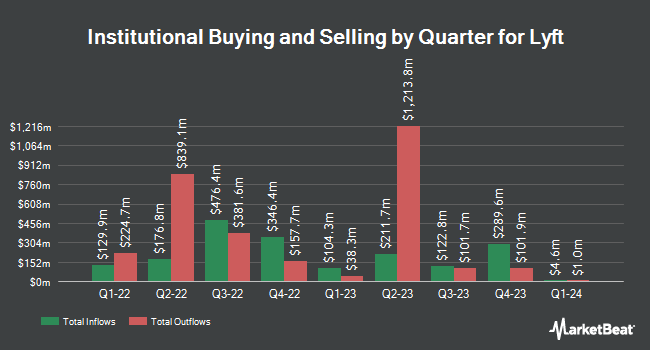
A number of other hedge funds and other institutional investors have also bought and sold shares of LYFT. Quent Capital LLC purchased a new stake in shares of Lyft during the 3rd quarter valued at $34,000. Abich Financial Wealth Management LLC bought a new stake in shares of Lyft during the 3rd quarter worth $50,000. CI Investments Inc. grew its position in Lyft by 39.1% in the third quarter. CI Investments Inc. now owns 2,321 shares of the ride-sharing company's stock worth $51,000 after acquiring an additional 653 shares in the last quarter. Tower Research Capital LLC TRC grew its position in Lyft by 410.6% in the second quarter. Tower Research Capital LLC TRC now owns 3,217 shares of the ride-sharing company's stock worth $51,000 after acquiring an additional 2,587 shares in the last quarter. Finally, Optiver Holding B.V. bought a new position in Lyft in the third quarter valued at $54,000. Hedge funds and other institutional investors own 83.07% of the company's stock.
Key Stories Impacting Lyft
Here are the key news stories impacting Lyft this week:
Insider Buying and Selling
In other Lyft news, CAO Stephen W. Hope sold 5,284 shares of Lyft stock in a transaction that occurred on Friday, February 27th. The stock was sold at an average price of $13.83, for a total value of $73,077.72. Following the transaction, the chief accounting officer directly owned 300,570 shares of the company's stock, valued at $4,156,883.10. The trade was a 1.73% decrease in their position. The sale was disclosed in a document filed with the Securities & Exchange Commission, which is available at the SEC website. Also, CEO John David Risher acquired 5,030 shares of the company's stock in a transaction dated Wednesday, December 10th. The shares were bought at an average cost of $19.80 per share, with a total value of $99,594.00. Following the purchase, the chief executive officer owned 11,802,296 shares of the company's stock, valued at approximately $233,685,460.80. This trade represents a 0.04% increase in their position. The SEC filing for this purchase provides additional information. Insiders have sold a total of 31,038 shares of company stock worth $416,841 in the last ninety days. Corporate insiders own 3.07% of the company's stock.
Lyft Stock Performance
NASDAQ LYFT opened at $13.25 on Friday. The company has a 50-day simple moving average of $16.55 and a two-hundred day simple moving average of $18.92. The company has a quick ratio of 0.65, a current ratio of 0.65 and a debt-to-equity ratio of 0.31. Lyft, Inc. has a 12-month low of $9.66 and a 12-month high of $25.54. The firm has a market cap of $5.27 billion, a price-to-earnings ratio of 1.94, a PEG ratio of 0.79 and a beta of 1.92.
Lyft announced that its board has approved a share buyback plan on Tuesday, February 10th that permits the company to buyback $1.00 billion in shares. This buyback authorization permits the ride-sharing company to repurchase up to 15.1% of its stock through open market purchases. Stock buyback plans are often a sign that the company's leadership believes its stock is undervalued.
Analysts Set New Price Targets
Several equities research analysts have issued reports on LYFT shares. Morgan Stanley set a $17.00 price target on Lyft in a research note on Wednesday, February 11th. KeyCorp reiterated a "sector weight" rating on shares of Lyft in a research report on Wednesday, February 11th. Royal Bank Of Canada decreased their price objective on Lyft from $27.00 to $22.00 and set an "outperform" rating on the stock in a report on Wednesday, February 11th. UBS Group restated a "neutral" rating on shares of Lyft in a research report on Monday, February 2nd. Finally, Wall Street Zen lowered Lyft from a "buy" rating to a "hold" rating in a research note on Saturday, November 8th. Ten research analysts have rated the stock with a Buy rating, twenty-two have assigned a Hold rating and two have issued a Sell rating to the company. According to data from MarketBeat, the company presently has a consensus rating of "Hold" and a consensus price target of $19.63.
Read Our Latest Stock Analysis on Lyft
About Lyft
(
Free Report)
Lyft, Inc NASDAQ: LYFT operates a peer-to-peer ridesharing platform that connects passengers with drivers through a mobile application. Since its founding in 2012, the company has expanded beyond traditional ride-hailing to include bike and electric scooter rentals, while also offering rental cars and public transit options in select markets. Lyft's platform uses GPS mapping and dynamic pricing algorithms to optimize driver-passenger matches and route efficiency.
Headquartered in San Francisco, California, Lyft primarily serves urban and suburban markets across the United States and Canada.
Read More
This instant news alert was generated by narrative science technology and financial data from MarketBeat in order to provide readers with the fastest reporting and unbiased coverage. Please send any questions or comments about this story to contact@marketbeat.com.
Before you consider Lyft, you'll want to hear this.
MarketBeat keeps track of Wall Street's top-rated and best performing research analysts and the stocks they recommend to their clients on a daily basis. MarketBeat has identified the five stocks that top analysts are quietly whispering to their clients to buy now before the broader market catches on... and Lyft wasn't on the list.
While Lyft currently has a Hold rating among analysts, top-rated analysts believe these five stocks are better buys.
View The Five Stocks Here
Nuclear energy is entering a new growth cycle as rising power demand, expanding data centers, and renewed policy support bring the sector back into focus. After strong gains in recent years, the most impactful phase of nuclear investment may still be ahead.
This report highlights seven nuclear energy stocks positioned across the value chain—combining near-term revenue with long-term upside as next-generation technologies scale. Click the link below to unlock the full list.
Get This Free Report
Like this article? Share it with a colleague.
Link copied to clipboard.
