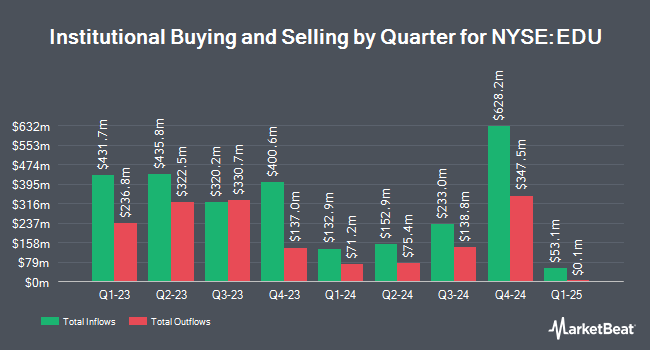
Schroder Investment Management Group lessened its holdings in New Oriental Education & Technology Group, Inc. (NYSE:EDU - Free Report) by 5.4% during the third quarter, according to the company in its most recent 13F filing with the Securities & Exchange Commission. The firm owned 610,087 shares of the company's stock after selling 35,134 shares during the quarter. Schroder Investment Management Group owned 0.36% of New Oriental Education & Technology Group worth $32,377,000 as of its most recent filing with the Securities & Exchange Commission.
Other hedge funds have also added to or reduced their stakes in the company. Factory Mutual Insurance Co. purchased a new position in shares of New Oriental Education & Technology Group in the third quarter worth about $2,505,000. OPTIMAS CAPITAL Ltd purchased a new stake in New Oriental Education & Technology Group during the 3rd quarter valued at about $1,974,000. Alkeon Capital Management LLC boosted its holdings in New Oriental Education & Technology Group by 101.3% during the 2nd quarter. Alkeon Capital Management LLC now owns 2,193,486 shares of the company's stock valued at $118,339,000 after acquiring an additional 1,104,000 shares during the period. Jump Financial LLC grew its position in New Oriental Education & Technology Group by 64.5% during the 2nd quarter. Jump Financial LLC now owns 171,108 shares of the company's stock worth $9,231,000 after acquiring an additional 67,108 shares during the last quarter. Finally, Campbell & CO Investment Adviser LLC purchased a new position in New Oriental Education & Technology Group in the 2nd quarter worth approximately $621,000.
Analysts Set New Price Targets
EDU has been the subject of a number of analyst reports. Weiss Ratings reissued a "hold (c+)" rating on shares of New Oriental Education & Technology Group in a research note on Monday, December 29th. New Street Research set a $68.00 target price on shares of New Oriental Education & Technology Group in a research note on Wednesday, January 28th. Zacks Research upgraded shares of New Oriental Education & Technology Group from a "hold" rating to a "strong-buy" rating in a report on Monday, February 2nd. China Renaissance raised shares of New Oriental Education & Technology Group from a "hold" rating to a "strong-buy" rating in a research report on Thursday, January 29th. Finally, HSBC raised shares of New Oriental Education & Technology Group from a "hold" rating to a "buy" rating in a report on Wednesday, January 28th. Two research analysts have rated the stock with a Strong Buy rating, four have issued a Buy rating and two have assigned a Hold rating to the stock. Based on data from MarketBeat.com, the company presently has an average rating of "Buy" and a consensus target price of $65.84.
Read Our Latest Stock Analysis on EDU
New Oriental Education & Technology Group Trading Up 1.1%
Shares of EDU stock opened at $53.72 on Thursday. The company's fifty day moving average price is $57.62 and its 200-day moving average price is $55.03. The stock has a market cap of $8.49 billion, a PE ratio of 22.76, a price-to-earnings-growth ratio of 0.91 and a beta of 0.28. New Oriental Education & Technology Group, Inc. has a 12 month low of $40.66 and a 12 month high of $64.97.
New Oriental Education & Technology Group (NYSE:EDU - Get Free Report) last issued its quarterly earnings results on Wednesday, January 28th. The company reported $0.45 earnings per share (EPS) for the quarter, topping the consensus estimate of $0.34 by $0.11. New Oriental Education & Technology Group had a net margin of 7.40% and a return on equity of 11.19%. The company had revenue of $1.19 billion during the quarter, compared to analyst estimates of $1.16 billion. During the same period last year, the business earned $0.22 EPS. New Oriental Education & Technology Group's quarterly revenue was up 14.7% compared to the same quarter last year. On average, sell-side analysts forecast that New Oriental Education & Technology Group, Inc. will post 2.75 earnings per share for the current fiscal year.
About New Oriental Education & Technology Group
(
Free Report)
New Oriental Education & Technology Group NYSE: EDU is one of China's leading providers of private educational services, specializing in language training, test preparation and consulting for overseas study. The company's offerings span a range of subjects, including English language instruction, preparatory courses for examinations such as the TOEFL, GRE and GMAT, and K-12 after-school tutoring. New Oriental's curriculum is delivered through a combination of in-person learning centers and digital platforms, enabling students across various regions to access its educational resources.
Founded in 1993 by Michael Yu Minhong in Beijing, New Oriental began as a small language school and quickly expanded its footprint.
See Also
Want to see what other hedge funds are holding EDU? Visit HoldingsChannel.com to get the latest 13F filings and insider trades for New Oriental Education & Technology Group, Inc. (NYSE:EDU - Free Report).
This instant news alert was generated by narrative science technology and financial data from MarketBeat in order to provide readers with the fastest reporting and unbiased coverage. Please send any questions or comments about this story to contact@marketbeat.com.
Before you consider New Oriental Education & Technology Group, you'll want to hear this.
MarketBeat keeps track of Wall Street's top-rated and best performing research analysts and the stocks they recommend to their clients on a daily basis. MarketBeat has identified the five stocks that top analysts are quietly whispering to their clients to buy now before the broader market catches on... and New Oriental Education & Technology Group wasn't on the list.
While New Oriental Education & Technology Group currently has a Moderate Buy rating among analysts, top-rated analysts believe these five stocks are better buys.
View The Five Stocks Here
Discover the 10 Best High-Yield Dividend Stocks for 2026 and secure reliable income in uncertain markets. Download the report now to identify top dividend payers and avoid common yield traps.
Get This Free Report
Like this article? Share it with a colleague.
Link copied to clipboard.
