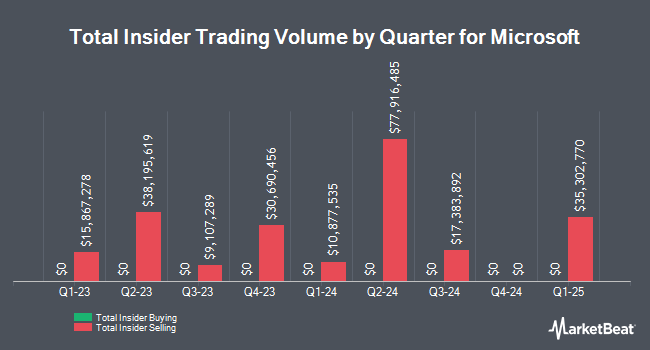
Microsoft Corporation (NASDAQ:MSFT - Get Free Report) CEO Satya Nadella sold 86,525 shares of the business's stock in a transaction on Tuesday, September 1st. The stock was sold at an average price of $501.46, for a total value of $43,388,826.50. Following the completion of the transaction, the chief executive officer directly owned 486,763 shares of the company's stock, valued at approximately $244,092,173.98. This trade represents a 15.09% decrease in their ownership of the stock. The transaction was disclosed in a legal filing with the Securities & Exchange Commission, which is accessible through the SEC website. The transaction was executed under a pre-arranged Rule 10b5-1 trading plan.
Microsoft Price Performance
Shares of MSFT traded down $4.20 during trading hours on Wednesday, reaching $496.82. 15,317,316 shares of the company traded hands, compared to its average volume of 36,380,363. The stock has a fifty day simple moving average of $436.21 and a 200 day simple moving average of $413.78. Microsoft Corporation has a fifty-two week low of $349.20 and a fifty-two week high of $553.72. The stock has a market capitalization of $3.69 trillion, a PE ratio of 27.66, a price-to-earnings-growth ratio of 1.63 and a beta of 1.11. The company has a quick ratio of 1.22, a current ratio of 1.23 and a debt-to-equity ratio of 0.07.
Microsoft (NASDAQ:MSFT - Get Free Report) last released its earnings results on Wednesday, July 29th. The software giant reported $4.74 earnings per share (EPS) for the quarter, beating analysts' consensus estimates of $4.24 by $0.50. The company had revenue of $90.01 billion for the quarter, compared to analyst estimates of $87.62 billion. Microsoft had a net margin of 40.31% and a return on equity of 31.98%. The firm's quarterly revenue was up 17.7% on a year-over-year basis. During the same period in the prior year, the firm earned $3.65 EPS. As a group, research analysts predict that Microsoft Corporation will post 19.59 EPS for the current fiscal year.
Microsoft Dividend Announcement
The company also recently announced a quarterly dividend, which will be paid on Thursday, September 10th. Investors of record on Thursday, August 20th will be given a dividend of $0.91 per share. The ex-dividend date is Thursday, August 20th. This represents a $3.64 dividend on an annualized basis and a yield of 0.7%. Microsoft's dividend payout ratio (DPR) is 20.27%.
Institutional Investors Weigh In On Microsoft
Several institutional investors and hedge funds have recently added to or reduced their stakes in MSFT. Markel Group Inc. lifted its holdings in Microsoft by 0.4% during the 1st quarter. Markel Group Inc. now owns 537,630 shares of the software giant's stock worth $199,014,000 after buying an additional 1,950 shares during the last quarter. Bessemer Group Inc. increased its holdings in shares of Microsoft by 8.4% in the 1st quarter. Bessemer Group Inc. now owns 6,921,677 shares of the software giant's stock valued at $2,562,197,000 after acquiring an additional 537,634 shares during the last quarter. Taylor Securities Services Inc. bought a new stake in shares of Microsoft in the 4th quarter valued at approximately $2,616,000. Werba Rubin Papier Wealth Management raised its position in shares of Microsoft by 15.7% during the 4th quarter. Werba Rubin Papier Wealth Management now owns 12,492 shares of the software giant's stock valued at $6,041,000 after acquiring an additional 1,698 shares in the last quarter. Finally, Harel Insurance Investments & Financial Services Ltd. lifted its stake in Microsoft by 138.8% during the first quarter. Harel Insurance Investments & Financial Services Ltd. now owns 1,356,359 shares of the software giant's stock worth $502,077,000 after purchasing an additional 788,297 shares during the last quarter. 71.13% of the stock is currently owned by institutional investors and hedge funds.
Wall Street Analysts Forecast Growth
Several research analysts have weighed in on MSFT shares. Sanford C. Bernstein set a $660.00 price target on Microsoft in a report on Monday, August 10th. DA Davidson reaffirmed a "buy" rating and issued a $550.00 price objective on shares of Microsoft in a research report on Thursday, July 30th. Wells Fargo & Company upped their target price on Microsoft from $650.00 to $700.00 and gave the company an "overweight" rating in a research note on Wednesday, August 12th. Arete Research upped their target price on Microsoft from $730.00 to $870.00 and gave the company a "buy" rating in a research note on Tuesday, May 5th. Finally, The Goldman Sachs Group reiterated a "buy" rating and set a $640.00 target price on shares of Microsoft in a research report on Thursday, July 30th. Forty-two equities research analysts have rated the stock with a Buy rating and five have issued a Hold rating to the company. According to data from MarketBeat.com, the company currently has a consensus rating of "Moderate Buy" and a consensus target price of $562.49.
Read Our Latest Report on MSFT
Key Microsoft News
Here are the key news stories impacting Microsoft this week:
- Positive Sentiment: Microsoft will begin disclosing Azure revenue in dollars each quarter and consolidate its internal reporting structure from three segments to two. The change should give investors a clearer comparison with Amazon Web Services and Google Cloud and may improve visibility into whether AI-related infrastructure spending is translating into cloud growth. Microsoft to start disclosing Azure quarterly revenue as company consolidates business units
- Positive Sentiment: Bank of America raised its Microsoft price target to $600 from $500, citing accelerating Azure growth, expanding Copilot adoption and improving efficiency from AI investments. The target implies meaningful additional upside and reinforces the bullish view of Microsoft’s enterprise AI platform. Investors Are Missing Microsoft’s Biggest AI Edge, Analyst Says
- Positive Sentiment: Microsoft’s AI infrastructure expansion continues through new data-center capacity, a long-term power agreement with Chevron and regional partnerships with HUMAIN. These initiatives could support Azure capacity and AI-product adoption, although they also increase capital requirements. Microsoft Signed a 20-Year AI Power Deal With Chevron
- Neutral Sentiment: The European Union’s second-highest court rejected Opera’s challenge to Microsoft Edge’s exemption from certain Digital Markets Act gatekeeper rules. The ruling removes one regulatory challenge for Edge, but its near-term financial effect appears limited. EU court rejects Opera challenge against Microsoft Edge exemption
- Negative Sentiment: Investors remain focused on whether Microsoft can earn attractive returns on its large AI capital expenditures. The scale of data-center spending raises depreciation and capacity-utilization risks if demand or monetization lags expectations. One Trillion-Dollar Question Could Determine Where Microsoft Stock Goes Next
- Negative Sentiment: Additional overhangs include concerns that OpenAI’s increasingly capable models could complicate Microsoft’s AI partnership and that a controversial Windows 11 feature may alienate gamers. Recent Xbox job cuts also highlight pressure on the gaming business. Why OpenAI’s smartest new model could become a headache for Microsoft stock
Microsoft Company Profile
(
Get Free Report)
Microsoft Corporation is a global technology company headquartered in Redmond, Washington. Founded in 1975 by Bill Gates and Paul Allen, Microsoft develops, licenses and supports a broad range of software products, services and devices for consumers, enterprises and governments worldwide. Its operations span personal computing, productivity software, cloud infrastructure, enterprise applications, developer tools and gaming.
Microsoft's product portfolio includes the Windows operating system and the Microsoft 365 suite of productivity and collaboration tools (Office apps, Outlook, Teams).
Featured Stories
This instant news alert was generated by narrative science technology and financial data from MarketBeat in order to provide readers with the fastest reporting and unbiased coverage. Please send any questions or comments about this story to contact@marketbeat.com.
Before you consider Microsoft, you'll want to hear this.
MarketBeat keeps track of Wall Street's top-rated and best performing research analysts and the stocks they recommend to their clients on a daily basis. MarketBeat has identified the five stocks that top analysts are quietly whispering to their clients to buy now before the broader market catches on... and Microsoft wasn't on the list.
While Microsoft currently has a Moderate Buy rating among analysts, top-rated analysts believe these five stocks are better buys.
View The Five Stocks Here
Robotics and automation are rapidly becoming essential infrastructure across healthcare, manufacturing, logistics, and many other industries. "Physical AI" is coming. Learn which seven companies are most positioned to benefit as intelligent robots enter the workforce.
Get This Free Report
Continue following MarketBeat
Add MarketBeat as your preferred source on Google to see our latest stories in your feed.
Like this article? Share it with a colleague.
Link copied to clipboard.
