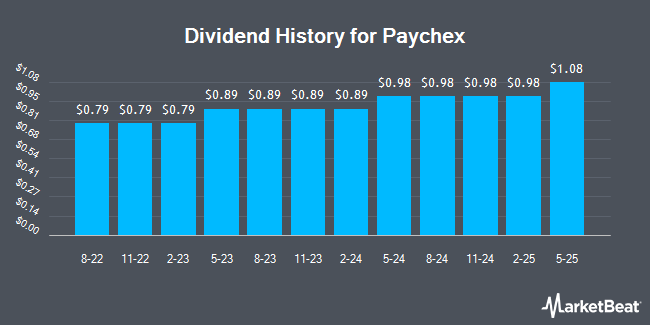
Paychex, Inc. (NASDAQ:PAYX - Get Free Report) declared a quarterly dividend on Friday, May 1st. Shareholders of record on Wednesday, May 13th will be given a dividend of 1.19 per share by the business services provider on Friday, May 29th. This represents a c) annualized dividend and a yield of 5.1%. The ex-dividend date of this dividend is Wednesday, May 13th. This is a 10.2% increase from Paychex's previous quarterly dividend of $1.08.
Paychex has increased its dividend by an average of 0.1%per year over the last three years and has raised its dividend every year for the last 3 years. Paychex has a payout ratio of 84.0% meaning its dividend is currently covered by earnings, but may not be in the future if the company's earnings fall. Equities analysts expect Paychex to earn $5.91 per share next year, which means the company should continue to be able to cover its $4.76 annual dividend with an expected future payout ratio of 80.5%.
Paychex Price Performance
PAYX stock opened at $93.93 on Monday. Paychex has a 52 week low of $85.45 and a 52 week high of $161.24. The company has a quick ratio of 1.26, a current ratio of 1.26 and a debt-to-equity ratio of 1.13. The company has a fifty day simple moving average of $92.50 and a two-hundred day simple moving average of $103.62. The firm has a market capitalization of $33.65 billion, a P/E ratio of 20.69 and a beta of 0.84.
Paychex (NASDAQ:PAYX - Get Free Report) last released its quarterly earnings data on Wednesday, March 25th. The business services provider reported $1.71 EPS for the quarter, beating the consensus estimate of $1.67 by $0.04. The business had revenue of $1.81 billion during the quarter, compared to analyst estimates of $1.78 billion. Paychex had a net margin of 25.84% and a return on equity of 48.52%. Paychex's quarterly revenue was up 19.9% compared to the same quarter last year. During the same quarter last year, the business earned $1.49 earnings per share. Analysts anticipate that Paychex will post 5.5 earnings per share for the current fiscal year.
Paychex declared that its Board of Directors has approved a stock repurchase plan on Friday, January 16th that permits the company to buyback $1.00 billion in outstanding shares. This buyback authorization permits the business services provider to purchase up to 2.5% of its stock through open market purchases. Stock buyback plans are generally a sign that the company's management believes its stock is undervalued.
About Paychex
(
Get Free Report)
Paychex, Inc, founded in 1971 by B. Thomas "Tom" Golisano and headquartered in Rochester, New York, is a provider of payroll, human resources, and benefits outsourcing solutions for small- and medium-sized businesses. The company's core services include payroll processing and tax filing, employee benefits administration, retirement services, and workers' compensation administration, designed to simplify back-office operations and help clients comply with regulatory and tax requirements.
Paychex offers an integrated technology platform, marketed under the Paychex Flex brand, which delivers cloud-based payroll, HR, time and attendance, and reporting tools.
Further Reading
This instant news alert was generated by narrative science technology and financial data from MarketBeat in order to provide readers with the fastest reporting and unbiased coverage. Please send any questions or comments about this story to contact@marketbeat.com.
Before you consider Paychex, you'll want to hear this.
MarketBeat keeps track of Wall Street's top-rated and best performing research analysts and the stocks they recommend to their clients on a daily basis. MarketBeat has identified the five stocks that top analysts are quietly whispering to their clients to buy now before the broader market catches on... and Paychex wasn't on the list.
While Paychex currently has a Reduce rating among analysts, top-rated analysts believe these five stocks are better buys.
View The Five Stocks Here
With the proliferation of data centers and electric vehicles, the electric grid will only get more strained. Download this report to learn how energy stocks can play a role in your portfolio as the global demand for energy continues to grow.
Get This Free Report
Like this article? Share it with a colleague.
Link copied to clipboard.
