Peabody Energy (NYSE:BTU - Get Free Report) was downgraded by stock analysts at Zacks Research from a "hold" rating to a "strong sell" rating in a report released on Tuesday,Zacks.com reports.
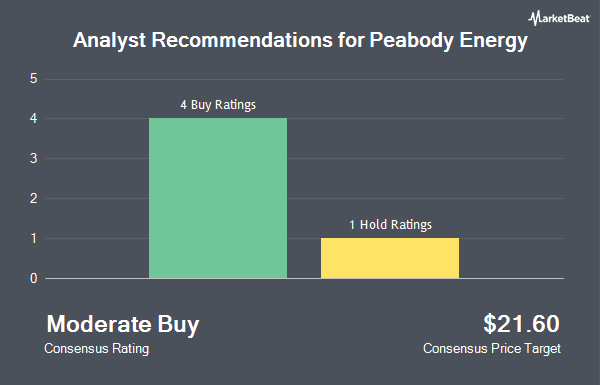
Other equities analysts also recently issued reports about the company. Jefferies Financial Group increased their target price on Peabody Energy from $42.00 to $44.00 and gave the stock a "buy" rating in a research note on Tuesday, January 20th. Wall Street Zen raised Peabody Energy from a "sell" rating to a "hold" rating in a research note on Friday, January 23rd. UBS Group cut their target price on Peabody Energy from $32.00 to $30.50 and set a "neutral" rating for the company in a research note on Wednesday. Weiss Ratings downgraded Peabody Energy from a "hold (c-)" rating to a "sell (d+)" rating in a research note on Friday, February 20th. Finally, B. Riley Financial downgraded Peabody Energy from a "buy" rating to a "neutral" rating and cut their target price for the stock from $42.00 to $30.00 in a research note on Thursday, April 30th. Two analysts have rated the stock with a Buy rating, two have assigned a Hold rating and two have assigned a Sell rating to the stock. According to data from MarketBeat, the stock presently has an average rating of "Hold" and a consensus target price of $34.13.
Check Out Our Latest Stock Analysis on Peabody Energy
Peabody Energy Stock Up 0.1%
BTU opened at $25.02 on Tuesday. The business has a 50 day moving average price of $31.80 and a two-hundred day moving average price of $31.47. The company has a quick ratio of 1.40, a current ratio of 1.87 and a debt-to-equity ratio of 0.09. The company has a market cap of $3.05 billion, a PE ratio of -25.27 and a beta of 0.35. Peabody Energy has a 52 week low of $12.58 and a 52 week high of $41.14.
Peabody Energy (NYSE:BTU - Get Free Report) last issued its earnings results on Tuesday, May 5th. The coal producer reported ($0.26) earnings per share (EPS) for the quarter, missing analysts' consensus estimates of $0.17 by ($0.43). The business had revenue of $973.30 million for the quarter, compared to analysts' expectations of $977.42 million. Peabody Energy had a negative return on equity of 2.80% and a negative net margin of 3.07%.The business's quarterly revenue was up 3.9% on a year-over-year basis. During the same period last year, the company posted $0.27 earnings per share. As a group, research analysts anticipate that Peabody Energy will post 2.13 EPS for the current year.
Insiders Place Their Bets
In related news, COO Darren Ronald Yeates sold 13,892 shares of the firm's stock in a transaction that occurred on Tuesday, February 10th. The stock was sold at an average price of $36.40, for a total value of $505,668.80. Following the completion of the transaction, the chief operating officer directly owned 113,440 shares of the company's stock, valued at $4,129,216. This trade represents a 10.91% decrease in their position. The transaction was disclosed in a document filed with the SEC, which is available at this hyperlink. 0.51% of the stock is owned by insiders.
Hedge Funds Weigh In On Peabody Energy
Several hedge funds have recently bought and sold shares of the company. Signaturefd LLC increased its stake in Peabody Energy by 11.6% in the 4th quarter. Signaturefd LLC now owns 2,625 shares of the coal producer's stock valued at $78,000 after purchasing an additional 272 shares in the last quarter. Maryland State Retirement & Pension System increased its stake in Peabody Energy by 2.0% in the 4th quarter. Maryland State Retirement & Pension System now owns 17,838 shares of the coal producer's stock valued at $530,000 after purchasing an additional 357 shares in the last quarter. Smartleaf Asset Management LLC increased its stake in Peabody Energy by 24.0% in the 3rd quarter. Smartleaf Asset Management LLC now owns 2,487 shares of the coal producer's stock valued at $67,000 after purchasing an additional 481 shares in the last quarter. Nisa Investment Advisors LLC increased its stake in Peabody Energy by 21.8% in the 3rd quarter. Nisa Investment Advisors LLC now owns 2,716 shares of the coal producer's stock valued at $72,000 after purchasing an additional 487 shares in the last quarter. Finally, Oregon Public Employees Retirement Fund increased its stake in Peabody Energy by 1.8% in the 4th quarter. Oregon Public Employees Retirement Fund now owns 27,849 shares of the coal producer's stock valued at $827,000 after purchasing an additional 500 shares in the last quarter. 87.44% of the stock is owned by hedge funds and other institutional investors.
More Peabody Energy News
Here are the key news stories impacting Peabody Energy this week:
- Positive Sentiment: Company reported stronger-than-expected thermal coal volumes and seaborne thermal pricing benefits; Centurion mine progressing toward full longwall production, which could support future cash flow. Peabody Reports Results for the Quarter Ended March 31, 2026
- Positive Sentiment: Board declared a quarterly dividend of $0.075/share (ex-dividend May 19, payable June 8), offering a ~1.2% yield and signaling cash-return priority despite the quarterly loss. Peabody Board Declares Dividend on Common Stock
- Positive Sentiment: Some analysts/coverage see value after the pullback and published bullish takes that argue the shares are attractive at current levels. Seeking Alpha — There Is Value At This Price
- Neutral Sentiment: Full Q1 earnings call transcripts and filings were published (useful for investors wanting detail on volumes, cost trends and outlook). Q1 2026 Earnings Call Transcript
- Neutral Sentiment: Valuation pieces assessing the stock after recent weakness provide context for upside/downside scenarios and investor arguments on fair value. Yahoo — Assessing Peabody Energy Valuation
- Negative Sentiment: Q1 results showed a loss of $0.26/share versus the consensus of $0.17 (a sizable miss) and revenue slightly under estimates; net income swung negative year-over-year — the EPS miss is the primary near-term driver of negative sentiment. Zacks — Q1 Loss, Beats Revenue Estimates
- Negative Sentiment: UBS cut its price target from $32.00 to $30.50 and set a "neutral" rating, a visible analyst downgrade that increases near-term selling pressure. Benzinga — UBS Lowers Price Target
- Negative Sentiment: Market headlines noted an immediate drop after the Q1 release despite some in-line/offsetting items, reflecting investor disappointment over the EPS miss and forward uncertainty. MSN — Q1 In Line With Expectations But Stock Drops
Peabody Energy Company Profile
(
Get Free Report)
Peabody Energy Corporation is one of the world's largest private-sector coal companies, engaged primarily in the production and sale of metallurgical and thermal coal. The company's operations span surface and underground mines, serving utilities, steel mills and other industrial customers that rely on coal as an essential component in power generation and steelmaking. Peabody's product portfolio includes high-energy thermal coal for electricity generation and low-volatile metallurgical coal used in steel production, reflecting its diverse end-market reach.
Founded in 1883, Peabody Energy has grown from a regional mining concern into a global energy supplier.
Featured Articles
This instant news alert was generated by narrative science technology and financial data from MarketBeat in order to provide readers with the fastest reporting and unbiased coverage. Please send any questions or comments about this story to contact@marketbeat.com.
Before you consider Peabody Energy, you'll want to hear this.
MarketBeat keeps track of Wall Street's top-rated and best performing research analysts and the stocks they recommend to their clients on a daily basis. MarketBeat has identified the five stocks that top analysts are quietly whispering to their clients to buy now before the broader market catches on... and Peabody Energy wasn't on the list.
While Peabody Energy currently has a Hold rating among analysts, top-rated analysts believe these five stocks are better buys.
View The Five Stocks Here
Wondering what the next stocks will be that hit it big, with solid fundamentals? Click the link to see which stocks MarketBeat analysts could become the next blockbuster growth stocks.
Get This Free Report
Like this article? Share it with a colleague.
Link copied to clipboard.
