Constellation Energy Today
CEG
Constellation Energy
$251.79 -7.13 (-2.75%) As of 10:04 AM Eastern
This is a fair market value price provided by Massive. Learn more. - 52-Week Range
- $228.63
▼
$412.70 - Dividend Yield
- 0.68%
- P/E Ratio
- 24.43
- Price Target
- $353.14
Constellation Energy (NYSE: CEG) is down nearly 2% despite posting a strong Q1 2026 earnings report. This comes amid a broader market sell-off on news that the U.S. and Iran remain far apart on a peace deal. That puts Constellation Energy’s valuation in focus. CEG trades at about 40x earnings, a premium to both itself and the broader market.
However, Constellation Energy may be worth that premium. The Q1 report underscored its vital role in the artificial intelligence (AI) buildout. The company is the nation’s largest nuclear power operator, which continues to anchor the long-term growth case for CEG.
Earnings Beat Headlined by Calpine Contribution
For the three months ended March 31, 2026, Constellation posted GAAP net income of $4.49 per share, a dramatic rebound from just 38 cents per share in the year-ago quarter. On an adjusted basis, the company earned $2.74 per share, up from $2.14 in Q1 2025, a 28% year-over-year increase.
The January completion of the $16.4 billion Calpine acquisition added a meaningful earnings contribution. This addition brings a vast natural gas generation fleet to complement Constellation's nuclear backbone.
However, offsetting those gains were elevated costs tied to serving load during Winter Storm Fern, lower zero-emission credit (ZEC) revenues, and a higher number of planned nuclear refueling outage days compared to the prior year.
Despite the noise, management affirmed its full-year 2026 adjusted operating earnings guidance of $11 to $12 per share, a signal of confidence heading into the back half of the year.
Nuclear Operations Remain Best-in-Class
Constellation's nuclear fleet, the largest in the United States, continued to perform at an elite level. The fleet posted a 92.3% capacity factor in Q1, producing 40 terawatt-hours (TWhs) of carbon-free electricity, while completing two refueling outages with an average duration of just 23 days. The natural gas and cogeneration fleet—now substantially expanded through Calpine—contributed an additional 23 TWhs with a 47.1% capacity factor.
The Data Center and Policy Catalysts
Perhaps more important than the quarterly numbers is the strategic setup for the next three years. Constellation is squarely positioned at the intersection of two mega-trends: surging AI-driven power demand and a nuclear renaissance backed by federal production tax credits (PTCs).
On the demand side, hyperscaler capital expenditure came in at $130 billion. That number is forecast to hit $710 billion in 2026. Constellation has already signed 780 megawatts of powered land deals in ERCOT, with exclusivity on an incremental 380 MWs. The company also believes it has available sites to replicate similar transactions at an EPS impact of 20 cents to 50 cents per 1,000 MWs contracted.
On the policy side, the PJM Reliability Backstop Procurement framework is coming into focus. A stakeholder vote is expected this month, with PJM filing its proposal at FERC in June. If the bilateral contracting phase begins in September as projected, it will unlock data center contracting opportunities that Constellation's presentation flagged as a key near-term catalyst.
The good news continues. Management also submitted 5,000 MWs of new capacity, spanning nuclear uprates, natural gas, and battery storage, to the PJM framework, positioning the company to capture premium pricing from hyperscalers hungry for firm, clean power.
Capital Allocation: Buybacks and a BBB+ Balance Sheet
Constellation deployed approximately $335 million in share repurchases year-to-date and has $4.7 billion remaining under its buyback authorization—recently upped to $5 billion as a sign of management's conviction. That means the company has returned roughly $2.7 billion to shareholders by repurchasing about 18.5 million shares since its separation from Exelon. The company targets 10% annual dividend growth alongside continued buybacks.
Both Constellation and Calpine carry BBB+/Baa1 investment-grade credit ratings with stable outlooks, giving the company access to capital at competitive rates as it funds $3.9 billion in growth projects.
Momentum Still Favors the Bulls
CEG traded as high as $418 last November before a sharp correction of approximately 40% that pushed the stock near $248 in early February 2026. Since then, the stock has staged a recovery, though it remains below its 50-day moving average of $301.31, with Monday's close at $297.75 sitting just beneath that key level.
The MACD indicator tells a more constructive story: the signal line has crossed above zero, and the histogram is trending positive, suggesting the momentum of the February-to-May recovery remains intact. A clean reclaim of the $301 50-day moving average would be technically significant, potentially opening a path back toward the $325–$350 resistance zone.
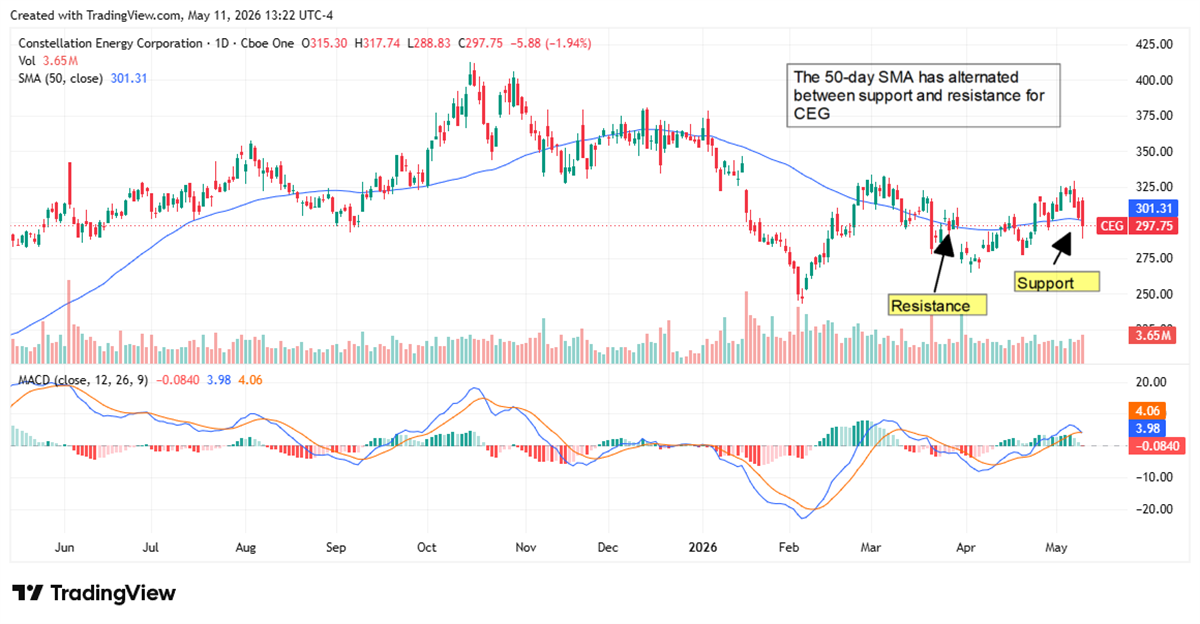
Yet even at that resistance zone, CEG would still be trading below its consensus price target of around $379.85, which is about 25% below recent prices.
The Road to $11+ EPS
Looking out to 2029, management targets base earnings per share of $11.40 to $11.90, implying roughly 20% compound annual growth in base earnings from 2026. That figure deliberately excludes upside from incremental nuclear PPAs, expanded commercial margins, higher gas plant utilization, and additional capital allocation, each of which could add meaningfully to the final tally.
With 147 million MWhs of annual nuclear generation available and approximately 93% within the PJM footprint, Constellation holds the keys to the clean, firm power that data center developers increasingly need.
For investors, the thesis is straightforward: own the infrastructure that cannot be replicated, and collect a growing stream of contracted earnings while the AI power build plays out over the next decade.
Before you consider Constellation Energy, you'll want to hear this.
MarketBeat keeps track of Wall Street's top-rated and best performing research analysts and the stocks they recommend to their clients on a daily basis. MarketBeat has identified the five stocks that top analysts are quietly whispering to their clients to buy now before the broader market catches on... and Constellation Energy wasn't on the list.
While Constellation Energy currently has a Moderate Buy rating among analysts, top-rated analysts believe these five stocks are better buys.
View The Five Stocks Here
The AI boom is creating opportunities across semiconductors, cloud computing, enterprise software, infrastructure, cybersecurity, and automation.
Inside this report, you’ll find 10 companies positioned to benefit as artificial intelligence moves from hype to real-world deployment and becomes a core growth driver for corporate America.
Get This Free Report
Continue following MarketBeat
Add MarketBeat as your preferred source on Google to see our latest stories in your feed.
