Oracle’s NYSE: ORCL 2025 and 2026 stock price sell-off is monumental, creating a generational opportunity for investors. While concerns persist, the critical takeaway is that a robust outlook improvement underpinned the 2025 stock price surge and is still in play. The likely outcome is that upcoming earnings releases will reaffirm that outlook, which includes a rapidly expanding backlog, underpinned by AI, worth over $520 billion as of the end of Q2 fiscal year 2026 (FY2026), providing a catalyst for a rebound. The question then becomes how high the stock price may rise, and the answer is substantial.
Oracle Today
$144.99 +2.69 (+1.89%) As of 10:36 AM Eastern
This is a fair market value price provided by Massive. Learn more. - 52-Week Range
- $114.50
▼
$322.54 - Dividend Yield
- 1.38%
- P/E Ratio
- 22.80
- Price Target
- $251.72
Analysts' sentiment, profit-taking, and insider selling contributed to Oracle’s stock price decline. Analysts trimmed targets in late 2025 and early 2026, undermining market sentiment amid rising debt fears. The trend suggests Oracle’s price is fairly valued below the broad consensus, which forecasts an 80% upside, but a move to the low end of the range is unlikely. The $135 low-end target is an outlier, more than eight months old, and recent targets are more aggressive. The average 2026 price target is $246, which is sufficient for a 50% upside from the critical moving averages.
In 2025, Oracle’s stock price increased by around 190% from its low to high, offering strong incentives for insiders, institutions, and retail investors to consider profit-taking and insider sales. Of those groups, insiders sold, though not as heavily as in prior quarters or years, while institutional sellers were offset by buyers, leaving the balance overall bullish. Short sellers, another risk, sold into the 2025 rally but not in sufficient quantities to pose problems, only 2% in January.
Oracle’s Ballooning Debt Causes Concerns: Look Past the Debt to Backlog Growth
The primary concern for investors is Oracle’s ballooning debt. 2025 and 2026 activity included debt and equity raises, which increased the load to over $108 billion and the share count by a modest single-digit amount. This is contrary to prior trends, which included steady, annualized share count reduction, but there is a method to the madness.
Oracle’s debt funds are supporting rapid data center expansion, modernization, and product development to meet growing demand. Details in the Q2 FY2026 report included a high triple-digit backlog increase attributed to hyperscaler demand, about five times the debt load, pointing not only to near-term gains driven by capacity but also to long-term gains driven by services.
Oracle MarketRank™ Stock Analysis
- Overall MarketRank™
- 100th Percentile
- Analyst Rating
- Moderate Buy
- Upside/Downside
- 76.5% Upside
- Short Interest Level
- Healthy
- Dividend Strength
- Moderate
- News Sentiment
- 0.38

- Insider Trading
- Selling Shares
- Proj. Earnings Growth
- 36.62%
See Full AnalysisThe takeaway for investors is that Oracle is well-capitalized in 2026 and will not need additional capital for several years, if at all, while debt coverage is ample, and the growth outlook is robust. With data centers slated to come online this year and over the next three years, Oracle is well-positioned to cash in on its backlog while meeting or exceeding targets. Until then, it carries an investment-grade debt rating and can continue paying its dividend while investing in growth.
As it is, analysts forecast a high-teens to low-20% compound annual earnings growth rate (CAGR) through the middle of the next decade. In this scenario, Oracle stock trades below 5x its 2035 consensus forecast, suggesting a solid triple-digit advance over the coming years. Assuming Oracle’s price advances to align with the broad market average valuation relative to current-year earnings, its price could rise by at least 400%. Assuming Oracle attracts a premium to trade alongside blue-chip tech peers, gains could reach 700% by 2035.
Oracle’s Catalysts: Results, Guidance, Cash Flow
Oracle is set up to produce a bullish catalyst with its Q3 FY2026 release, scheduled for early March. Analysts forecast revenue and earnings to accelerate, with top-line growth of nearly 20% and earnings slightly slower, and sentiment is mixed. While numerous analysts have raised their estimates since the last report, more analysts have lowered theirs, suggesting underestimation amid robust industry trends.
The likely outcome is that Oracle exceeds its estimates by a significant margin, but the real market-moving news will be the guidance. The market wants to see the backlog grow and more visibility into long-term cash flow; if it doesn’t get what it wants, Oracle’s stock price could wallow near mid-February lows until a more potent catalyst emerges.
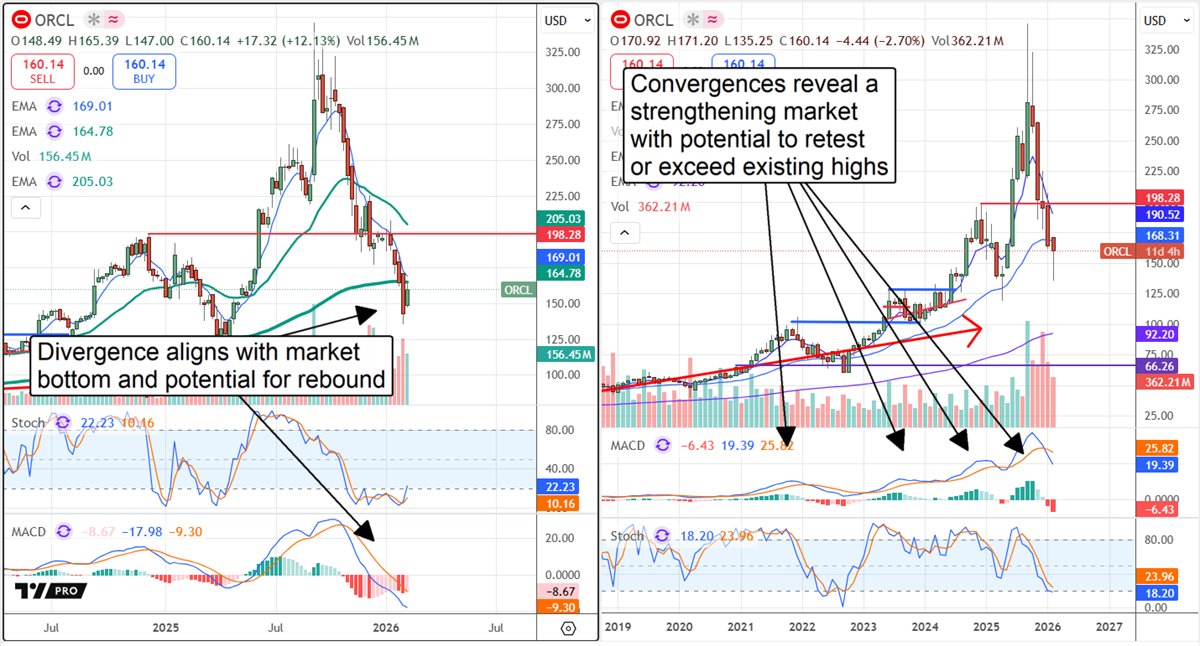
The stock price action is sketchy, certainly bringing to mind the rule about falling knives and catching them. However, the early February action aligns with a bottom, as evidenced by significant divergences on the weekly chart. They suggest this market is overextended, like a rubber band ready to snap back. The snapback will be vigorous, potentially exceeding all-time highs, as evidenced by the monthly chart. It reveals convergences in price action that have been strengthening since late 2020, when it became clear that Oracle’s shift to cloud-based data management operations and AI went hand in hand like peanut butter and chocolate.
Before you consider Oracle, you'll want to hear this.
MarketBeat keeps track of Wall Street's top-rated and best performing research analysts and the stocks they recommend to their clients on a daily basis. MarketBeat has identified the five stocks that top analysts are quietly whispering to their clients to buy now before the broader market catches on... and Oracle wasn't on the list.
While Oracle currently has a Moderate Buy rating among analysts, top-rated analysts believe these five stocks are better buys.
View The Five Stocks Here
A strong long-term portfolio starts with companies that can survive recessions, inflation, changing consumer habits, and shifting market leadership.
This report names seven blue-chip stocks across technology, retail, consumer staples, healthcare, networking, sporting goods, and utilities that offer investors a mix of stability, income, growth, and staying power.
Get This Free Report
Continue following MarketBeat
Add MarketBeat as your preferred source on Google to see our latest stories in your feed.
Like this article? Share it with a colleague.
Link copied to clipboard.
