While Federal Reserve officials debate (and debate) whether to raise interest rates in September, their counterparts at the European Central Bank have already gone full Leroy Jenkins. The ECB’s Governing Council raised each of its three benchmark rates by 25 basis points during its June meeting for the first time since 2023, and then hiked again to 2.5% on Sept. 10 after a hold in July. The ECB is the only major Western central bank to hike in the current cycle, and leadership argues the hikes are necessary to curb rising inflation expectations driven by the Iran War energy shock.
A hiking cycle during a supply shock carries credit risks that one in a demand-driven shock does not, and investors should be aware of that specter hanging over the banking sector. But the Euro Stoxx Bank index has doubled over the last two years, and many of Europe’s largest banks are increasing 2026 net interest income (NII) guidance in response to higher projected rates. Who benefits most? Eurozone banks with floating-rate loans and deposit beta, and the following three firms are well-positioned to profit from an ECB hiking cycle.
Banco Santander: Variable Mortgages Provide Upside Potential
Interest rates get plenty of attention in the U.S., but changes in the short-term Federal funds rate rarely affect consumers' day-to-day lives. That’s not the case in Europe, where floating rate mortgages are much more common. In an April 2026 survey from Spain’s Instituto Nacional de Estadística, more than 37% of mortgages originated in the period were variable-rate, up from 30% in August 2022 when the benchmark rate was peaking. Floating-rate mortgages are linked to the Euribor index and will reprice within months following ECB hikes.
Banco Santander S.A. NYSE: SAN is one of the biggest mortgage lenders in the EU, and more than 34% of its loans are residential mortgages. As of Q2 2026, more than 41% of its mortgage book is floating-rate, creating significant interest income upside during a hiking cycle.
Analysts raised their 2026 NII consensus estimate for Santander by 1.9%, and the bank's efficiency ratio has improved to 42.8%.
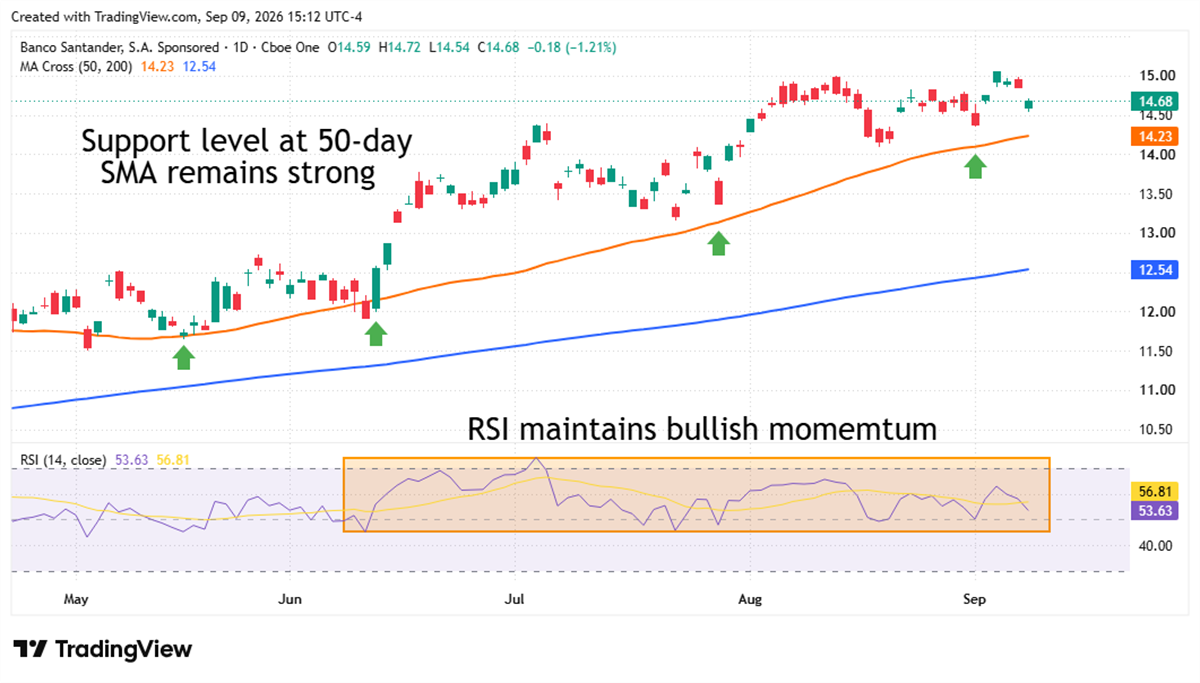
SAN shares have gained more than 20% in the last three months, and could be nearing a key entry point for new positions. The 50-day moving average has kept the stock in an uptrend for nearly two years now, acting as bear repellent whenever sellers coalesce. Now the share price is once again approaching this level, and with the Relative Strength Index (RSI) still showing healthy momentum, it could be another opportunity for dip buyers.
BBVA: Same Mortgage Dynamics, Bigger NII Upside
Banco Bilbao Vizcaya Argentaria S.A. NYSE: BBVA is another Iberian bank with tremendous upside thanks to its mortgage book and more strictly Euro-denominated business. Like Santander, BBVA has a significant variable-rate mortgage book (38% floating vs 62% fixed as of Q2 2026) with a very low-risk lending profile.
The bank posted results above expectations on both earnings per share and revenue in fiscal Q2 2026, and management raised its group return on tangible equity (ROTE) guidance to approximately 21%.
The 2026 NII consensus estimate for BBVA was also revised up 2.3%—the largest upgrade among banks directly exposed to ECB rate moves.
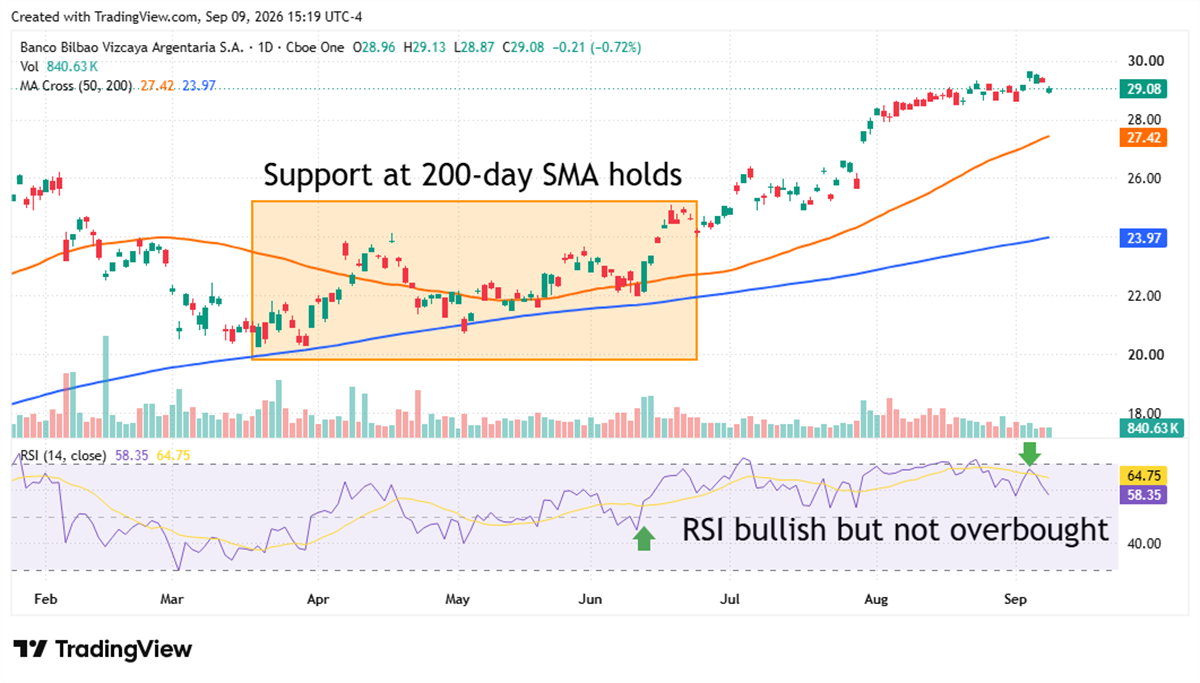
BBVA shares erased all of their 2026 gains by spring, and nearly dipped into the trouble zone below the 200-day moving average more than once. But now the stock has ripped over 30% higher in the last three months, and the trend is pointing upward again. The RSI has also retreated from its Overbought reading, which may entice buyers to resume pushing the price up.
Deutsche Bank: Deposit Beta Upside Without the Mortgage Book
Deutsche Bank AG NYSE: DB was the punchline of many jokes in the wake of the Global Financial Crisis, but the German bank is finally getting its laughs in after a more than 200% surge over the last five years. Unlike the two previous examples, DB doesn’t have a significant floating-rate mortgage portfolio. Instead, it has a sticky deposit base that’s growing through M&A.
Just not its own M&A. The Italian-based UniCredit S.p.A. OTCMKTS: UNCRY has plans to close its Commerzbank merger by the end of Q4 2026, which could be advantageous for DB’s deposit beta. A company closing a merger is unlikely to start rate promotion wars, and the integration could be more protracted than management anticipates. This leaves one of its biggest deposit competitors on standby and allows DB to keep growing without offering rate promotions.
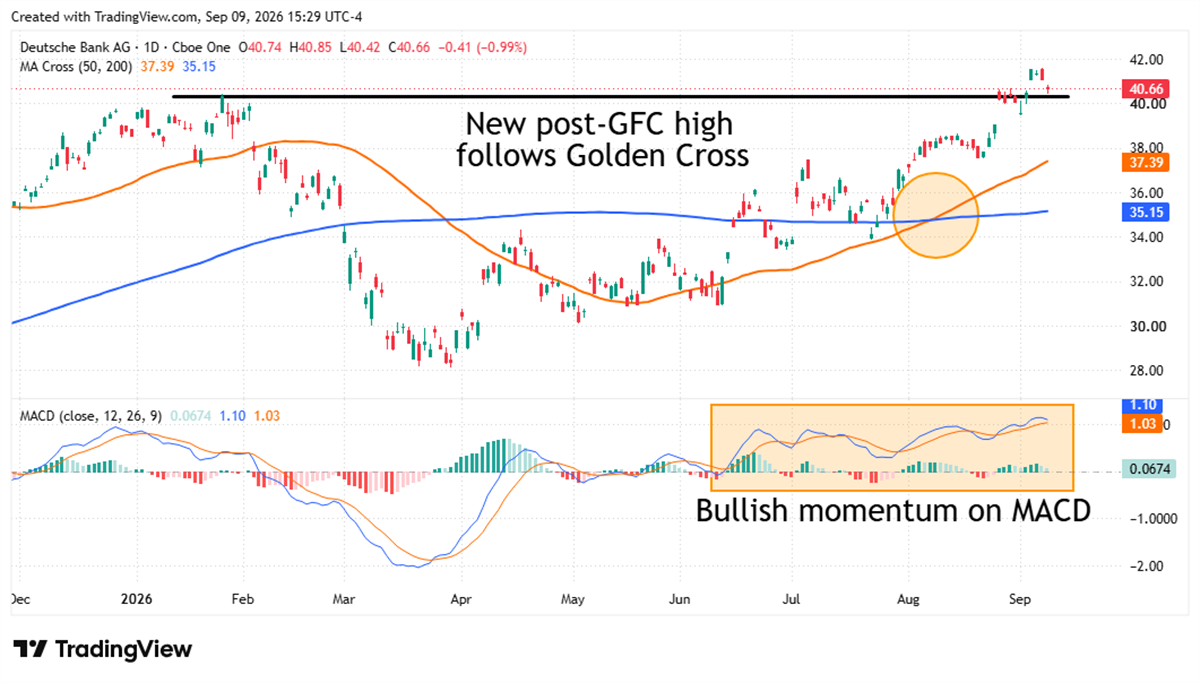
DB shares are also up 30% in the last three months, and have recently notched a new high in the post-GFC world. The MACD indicator shows bullish momentum at its highest point of the year, and a Golden Cross points to an upward long-term trend again.
Before you consider Banco Santander, you'll want to hear this.
MarketBeat keeps track of Wall Street's top-rated and best performing research analysts and the stocks they recommend to their clients on a daily basis. MarketBeat has identified the five stocks that top analysts are quietly whispering to their clients to buy now before the broader market catches on... and Banco Santander wasn't on the list.
While Banco Santander currently has a Moderate Buy rating among analysts, top-rated analysts believe these five stocks are better buys.
View The Five Stocks Here
Discover the 10 Best High-Yield Dividend Stocks for 2026 and secure reliable income in uncertain markets. Download the report now to identify top dividend payers and avoid common yield traps.
Get This Free Report
Continue following MarketBeat
Add MarketBeat as your preferred source on Google to see our latest stories in your feed.
Like this article? Share it with a colleague.
Link copied to clipboard.
