Halliburton Today
$33.66 +0.68 (+2.05%) As of 03:59 PM Eastern
This is a fair market value price provided by Massive. Learn more. - 52-Week Range
- $24.12
▼
$43.59 - Dividend Yield
- 2.02%
- P/E Ratio
- 17.62
- Price Target
- $44.05
The worst takeaway from
Halliburton’s NYSE: HAL Q3 report was weaker free cash flow alongside higher capital expenditures (CapEx) and its impact on free cash flow (FCF). While FCF is down sequentially and year over year (YOY), this self-inflicted wound comes as Halliburton spends on repositioning, equipment movement, and staging for success. The best takeaway from Halliburton’s
Q3 release is its numerous contract wins and project advancements that position it for a multiyear upcycle. Investment in the Mediterranean, Latin America, Asia, and the Middle East includes multiyear development agreements that will
drive business across both of Halliburton’s core segments.
Between then and now, management expects margins to recover, and capital returns will flow. Management shows its confidence through the dividend and share buybacks, which FCF did not cover. The takeaway is that Halliburton will likely maintain dividends and buybacks as margins recover and increase capital returns over the coming years. As it stands, the share count fell more than 2% YOY, adding to shareholder returns beyond the dividend. The dividend yields a little more than 2%, has a payout ratio below 30% of adjusted earnings, and should grow over time. The company doesn’t make annual increases but tends to lift payments as cash flow allows.
Halliburton Outperforms in Q3: Provides Optimistic Long-Term Forecast
Halliburton struggled in Q3, with weakness in North America offset by strengths abroad, but performed better than analysts had expected. Revenue rose 1.8% YOY to $5.7 billion, about 2% above expectations. International revenue increased 3% sequentially, offsetting a 5% sequential decline in North America. In the International segment, Latin America and Europe/Africa were flat sequentially, while the Middle East/Asia grew 8%, supported by increased activity in Saudi Arabia and Kuwait. Segmentally, Completion and Production revenue fell 4% YOY, while Drilling and Evaluation increased by 4%.
Margin news is the sore spot in Q3, but one easily overlooked, given the cause and the impact on the outlook and performance relative to expectations. Margin contracted year over year but improved sequentially, leaving the company in a better position than expected while advancing strategy. The key detail is that adjusted earnings per share came in at 60 cents, two cents better than expected, leaving the capital return outlook fundamentally unchanged.
Execs did not provide Q4 guidance, instead focusing on the macro conditions and initial outlook for next year. They target mid-single-digit revenue growth and operating margins of about 15% in 2027, up from roughly 13%, and they may be cautious in their estimates. The Middle East is only one source of oilfield demand; Russia, Ukraine, Venezuela, and offshore Latin America also need development.
Analysts and Institutions Put a Floor in Halliburton’s Price Action
Halliburton MarketRank™ Stock Analysis
4.946921443735 of 5 stars- Overall MarketRank™
- 99th Percentile
- Analyst Rating
- Moderate Buy
- Upside/Downside
- 30.9% Upside
- Short Interest Level
- Healthy
- Dividend Strength
- Moderate
- News Sentiment
- 0.54

- Insider Trading
- Selling Shares
- Proj. Earnings Growth
- 24.79%
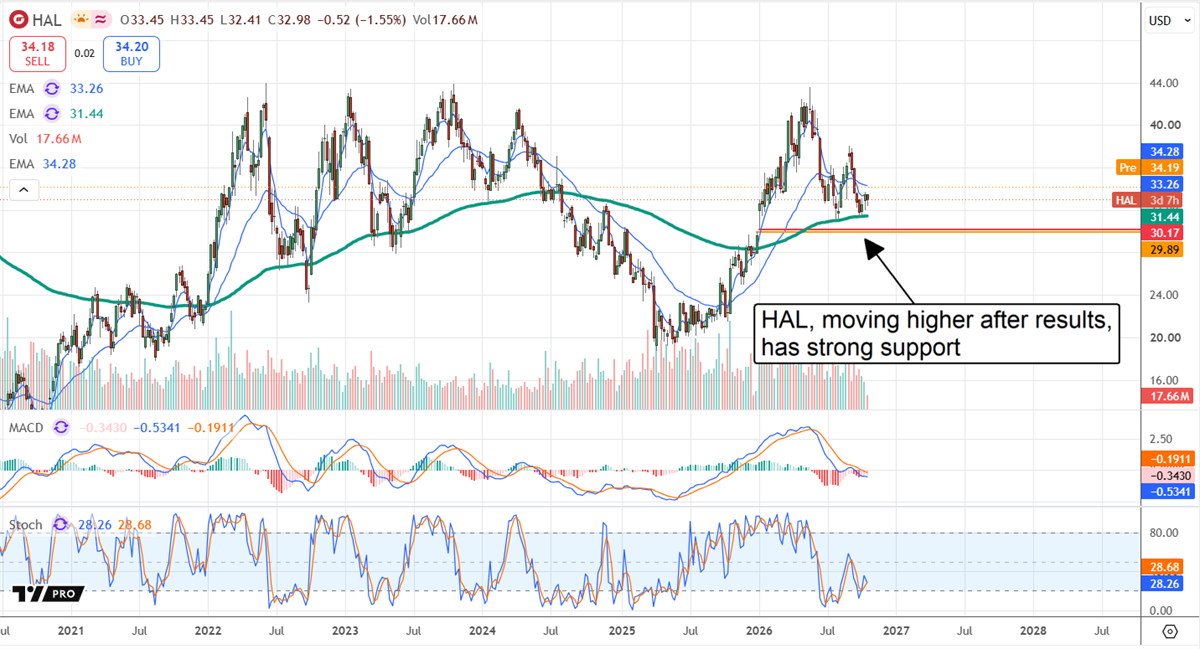
See Full AnalysisHalliburton stock struggled in the first three quarters of 2026, surging about 50% in the first half only to give up those gains by the end of Q3. The narrative, however, is that this market is establishing a support base and gaining traction in Q4. Analyst trends reflect steady coverage, a
firm Moderate Buy consensus rating, bullish bias, and an uptrend in the price targets. Consensus puts HAL above $44, a fresh long-term high when reached, while the trend leads to the high-end range, another $9 or 20% higher.
Institutions, meanwhile, have accumulated for eight consecutive quarters, with reported institutional buying outpacing selling and providing a solid support base, as institutions now own about 85% of the shares. The likely outcome is that analysts' trends continue to firm, driven by upcoming results and margin improvement, while institutions continue to accumulate on the dividend and buyback outlook.
As tepid as the early 2026 price action has been, it aligns with a market in reversal and shows support at a critical level. That level aligns with prior congestion zones, a breakout and a price gap that reveals shifting market dynamics. The 150-week exponential moving average (EMA) strengthens the support zone, reflecting buy-and-hold activity from investors such as institutional groups, and likely serves as a launchpad for rallies. Resistance may appear at $34, $40, and $44, with $44 as the key target, opening the door to a much larger move if it breaks.
Halliburton’s biggest risk is the transition to cleaner, greener energy and its impact on oilfield demand. However, this risk is also a catalyst, driving energy companies to seek better, more efficient technologies, including natural gas. Halliburton is absolutely critical to unlocking natural gas from shale formations, helping energy companies drill wells and bring gas into production. Other risks include exposure to the North American market, a risk that gets smaller with each new international contract.
Before you consider Halliburton, you'll want to hear this.
MarketBeat keeps track of Wall Street's top-rated and best performing research analysts and the stocks they recommend to their clients on a daily basis. MarketBeat has identified the five stocks that top analysts are quietly whispering to their clients to buy now before the broader market catches on... and Halliburton wasn't on the list.
While Halliburton currently has a Moderate Buy rating among analysts, top-rated analysts believe these five stocks are better buys.
View The Five Stocks Here
With the proliferation of data centers and electric vehicles, the electric grid will only get more strained. Download this report to learn how energy stocks can play a role in your portfolio as the global demand for energy continues to grow.
Get This Free Report
Continue following MarketBeat
Add MarketBeat as your preferred source on Google to see our latest stories in your feed.

