Lemonade Today
$39.59 -1.89 (-4.55%) As of 11/6/2026 03:59 PM Eastern
This is a fair market value price provided by Massive. Learn more. - 52-Week Range
- $39.11
▼
$99.90 - Price Target
- $61.13
Lemonade’s NASDAQ: LMND Q3 results reflect an accelerating growth story on the cusp of a major inflection. That is, from a cash-burning start-up insurance company, still reporting GAAP losses, to one approaching profitability, and the inflection is at hand. With the forecast to produce its first positive adjusted EBITDA in Q4, the narrative today is execution, and execution is driving results pointing to sustained growth and margin improvements.
The driver is two-pronged: an increasing client base and penetration, compounded by improving efficiency. The net result is massive-scale leverage, expected to improve over time as in-force premium (IFP) growth outpaces acquisition costs. Operating leverage means cash flow, and in the insurance industry, cash flow could eventually support capital returns, the end-game for investors.
Lemonade Outperforms in Q3: Offers Sweet Guidance for Q4
Lemonade had a strong quarter, with revenue growing 72.8%, outpacing the consensus estimate by about 4% and more than doubling gross earned premium (GEP) growth. IFP growth came in at 34%, driven by 23% customer growth and a 9% increase in premium per customer. Annual dollar retention, a measure of premium retention, also improved, increasing by one percentage point to 86%.
Margin news is the catalyst, as strong as the earnings and client acquisition outlook is. Lemonade has been producing positive adjusted free cash flow for several quarters, extending the trend to six in Q3, and is tracking toward profitability. GAAP losses came in at 56 cents per share and widened from 51 cents last year, outperforming by two cents and expected to improve over the coming quarters as the company scales; its strengths (driven by its AI platform) include the ability to onboard massive numbers of new clients without adding employee headcount.
Fourth-quarter guidance is the bullish catalyst, with Q4 results due in early 2027. Management not only guided for positive adjusted EBITDA, the first time in company history, but has the capacity to meet its targets. Several trends support the outlook, including increasing client count, penetration, IFP, and GEP, despite higher costs. The likely outcome is that the company follows through on its guidance, potentially outpacing its own estimate and triggering another bullish response in its market.
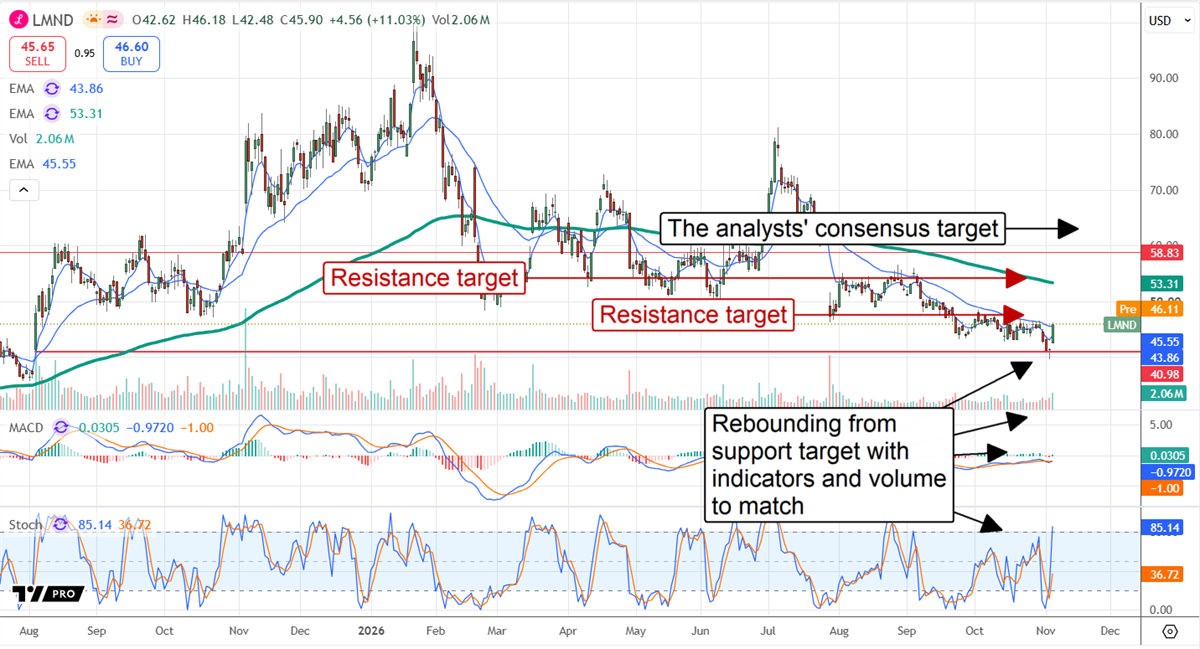
Lemonade Market Rebounds Ahead of Release, Accelerates Afterward
Lemonade’s stock price surged more than 10% ahead of the release, but fell 9.6% following the earnings report, putting the potential bottom in question. The earlier move suggested support at a 52-week low and prior price gap, a technically strong support target, with upside movement reinforced by indicators such as MACD, stochastic, trading volume, and short interest.
MACD and stochastic had suggested an oversold market, with bears losing control and bulls gaining it, although the post-earnings decline weakens that outlook. Volume is a key factor, rising during both the rebound and subsequent sell-off, suggesting heightened trading activity rather than confirming a bullish reversal.
Short-sellers, specifically, are a strong force in this market through potential short-covering. Short interest topped 17% in mid-October, helping the stock's downtrend, but covering is now a factor to consider and could contribute to future volume spikes. Short selling may continue influencing price action over the next quarter, so a massive upswing may not unfold yet, but covering could accelerate as subsequent reports are released.
Upside May Be Capped, Near-Term: Catalysts Lie Ahead to Clear the Way
Technical resistance targets include late-July lows near $47.25 and the long-term 150-day exponential moving average, which aligns with a congestion zone in the mid-$50s. A move to either may trigger a bearish response; the stronger likely to come from the EMA, but there are risks for short-sellers, too. Institutions own a solid 80% of the stock and have bought on balance over the past year. Buying has been sporadic, with accumulation spikes tied to price dips, but may steady into a more persistent tailwind now that profitability is at hand.
Lemonade Stock Forecast Today
12-Month Stock Price Forecast:$61.1354.39% UpsideHoldBased on 9 Analyst Ratings | Current Price | $39.59 |
|---|
| High Forecast | $92.00 |
|---|
| Average Forecast | $61.13 |
|---|
| Low Forecast | $44.00 |
|---|
Lemonade Stock Forecast DetailsAnalyst trends are tepid, unsurprising for a small-cap stock with no GAAP profits, but align with the stock price outlook. The nine analysts MarketBeat tracks give LMND a Hold consensus rating, with four Buy ratings, four Hold ratings, and one Sell rating. The average price target of $61.13 suggests substantial upside from recent trading levels. This puts the stock well above the nearest technical targets, which may be reached in 2026 or early 2027. The question is when the analyst will shift into a more bullish posture, with increased coverage and improved ratings, and Q4 profitability may be the trigger.
Lemonade’s primary risks are operational and technology. It relies heavily on AI and bots across the business, which raises risks including profiling, unfair denials, and poor customer relations. Customers complain there are too few humans to handle complex claims, leading to a higher-than-average complaint index score. Operationally, results can be affected by underwriting changes involving higher-risk properties, such as those with aging roofs or riskier locations.
Before you consider Lemonade, you'll want to hear this.
MarketBeat keeps track of Wall Street's top-rated and best performing research analysts and the stocks they recommend to their clients on a daily basis. MarketBeat has identified the five stocks that top analysts are quietly whispering to their clients to buy now before the broader market catches on... and Lemonade wasn't on the list.
While Lemonade currently has a Hold rating among analysts, top-rated analysts believe these five stocks are better buys.
View The Five Stocks Here
MarketBeat just released its list of the 7 hottest IPOs expected to hit Wall Street in 2026. See which companies are preparing to go public and why investors are watching closely.
Get This Free Report
Continue following MarketBeat
Add MarketBeat as your preferred source on Google to see our latest stories in your feed.
