Palantir Technologies NASDAQ: PLTR is not known to shy away from controversial topics. However, as it relates to the frontier large language models (e.g., Anthropic, OpenAI), Palantir had been pulling its punches.
Palantir Technologies Today
PLTR
Palantir Technologies
$136.84 +4.30 (+3.24%) As of 03:00 PM Eastern
This is a fair market value price provided by Massive. Learn more. - 52-Week Range
- $106.37
▼
$207.52 - P/E Ratio
- 154.47
- Price Target
- $190.85
That changed in a recent interview that Palantir co-founder and CEO Alex Karp gave to CNBC. In the interview, Karp said what the company’s business model has been saying for years. That is, the real AI trade isn't the foundation model layer; it's the application/integration layer that sits on top of it.
In the interview, Karp remarked that enterprises want to "own the means of production" instead of "transferring their alpha" to OpenAI or Anthropic. In plain English, Karp was warning that an enterprise's competitive edge (i.e., its alpha) is its data.
If that data runs through another company’s API, they are renting a moat, not building one.
The real danger comes if those companies use the data they acquire to work against the enterprises with which they’re doing business. According to Karp, that is not a concern with Palantir.
How Frontier AI Models Could Become Enterprise Competitors
When an enterprise company pays a frontier model company, they’re buying the opportunity to bolt, in industry terms, a chatbot onto their workflow. The value and pricing power flow to the model maker. In the process, the enterprise loses its exclusive ownership of that data.
With Palantir, a company is buying the company’s Ontology/AIP to embed AI directly into its own proprietary data and decision-making. The value of that data stays in-house.
The threat Karp is describing isn't hypothetical. Enterprises that route their proprietary data through a frontier model risk handing over their know-how, their trade secrets, and their competitive edge to a company that may eventually compete with them directly.
That risk is becoming harder to ignore. For an enterprise, real data safety means maintaining control over its own data, model weights, and compute resources. Without that control, a frontier lab can absorb a company's proprietary knowledge and repurpose it into its own product.
Anthropic's expansion into vertical-specific offerings illustrates the pattern. Categories once served by independent developers building on top of Anthropic's models are increasingly being served by Anthropic itself. The model maker sees where value is created on top of its platform, then moves in to capture it directly.
The logic is straightforward: a company with a dominant model can use that position to expand into adjacent, high-value verticals over time. It's the same dynamic Karp is pointing out. If enterprises hand over proprietary data, they may be arming their own future competitor.
Is Alex Karp Defending Palantir or Highlighting a Real AI Risk?
Critics of Karp’s statement are claiming that Karp is simply talking his book. The frontier models have been seen by some as a direct threat to Palantir’s business. Michael Burry went so far as to say that Anthropic was “eating Palantir’s lunch.”
The criticism gathers more steam with PLTR down 25% in 2026 and approximately 35% from its all-time closing high around $207 in November 2025. The thinking is that Karp is trying to prop up the stock by discrediting the competition.
However, the crux of Karp’s argument is what many analysts have been saying for months. Palantir operates at a different layer of the AI stack. Its role is to orchestrate the application layer via its Ontology, which is agnostic of whatever large language model (LLM) enterprises choose to use.
A more relevant critique is that foundation model companies are moving downstream too (custom GPTs, enterprise tooling), so the "layer" distinction may blur over time. However, Palantir’s earnings reports to date don’t indicate that the company is losing business. In fact, the opposite is true.
Can Palantir's Long-Term Growth Outlook Justify PLTR's Valuation?
Palantir will continue to face concerns about its valuation. No matter how much the company grows, many investors believe that there’s too much future growth priced into PLTR.
So far, betting against that future growth hasn’t been a good bet. But what comes next? According to Karp in the interview, Palantir has “...more business than we can supply. [...] 2 years out, you can see 15 ... 18 billion dollars of free cashflow.”
That will fire up the skeptics. However, in 2022, Karp announced a 2025 revenue target of $4.5 billion. In 2025, the company’s full-year revenue was $4.475 billion. Like it or not, Karp has a history of backing up forecasts that first look audacious.
That makes the case for owning PLTR for the long haul. However, in the near term, PLTR's chart tells a story of stalled momentum, not full recovery. The stock still trades below its 200-day EMA of $143.43. That’s a level that continues to cap upside as resistance.
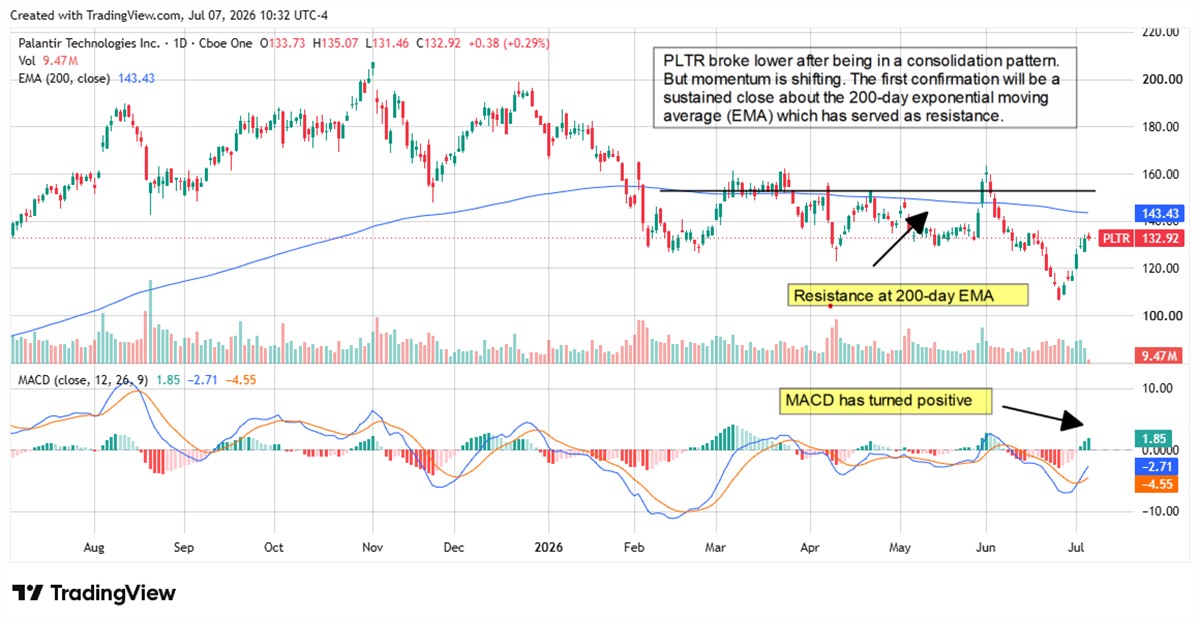
There are signs of stabilization: the MACD has turned positive after months in negative territory, signaling early bullish momentum following the June lows near $106. But until PLTR reclaims its 200-day EMA, the longer-term trend remains bearish. Karp's comments may be fueling sentiment, but the charts show a stock still searching for confirmation.
Before you consider Palantir Technologies, you'll want to hear this.
MarketBeat keeps track of Wall Street's top-rated and best performing research analysts and the stocks they recommend to their clients on a daily basis. MarketBeat has identified the five stocks that top analysts are quietly whispering to their clients to buy now before the broader market catches on... and Palantir Technologies wasn't on the list.
While Palantir Technologies currently has a Moderate Buy rating among analysts, top-rated analysts believe these five stocks are better buys.
View The Five Stocks Here
Looking to profit from the electric vehicle mega-trend? Click the link to see our list of which EV stocks show the most long-term potential.
Get This Free Report
