Philip Morris International Today
PM
Philip Morris International
$192.20 -2.10 (-1.08%) As of 12:16 PM Eastern
This is a fair market value price provided by Massive. Learn more. - 52-Week Range
- $142.11
▼
$199.78 - Dividend Yield
- 3.06%
- P/E Ratio
- 27.06
- Price Target
- $201.44
The economy isn’t the stock market, but there are times when the two align. That's one way to look at
Philip Morris' NYSE: PM Q2 2026 earnings report. The company delivered a beat on revenue and earnings, driven by strength in its smoke-free business and better-than-expected performance in its legacy nicotine products.
This shouldn’t be a surprise in an uneven economy. Philip Morris sells nicotine products in a category where demand has historically remained resilient, even when consumers are under pressure.
PM climbed after the report, even though the company lowered its earnings-per-share (EPS) outlook for the full year and the current quarter. The company, however, reiterated its outlook for organic revenue growth of 5% to 7%.
Philip Morris Earnings Beat Keeps Growth Story Intact
The headline numbers were solid. Revenue of $11.19 billion beat analysts’ expectations for $10.61 billion and was higher than the $10.14 billion in Q2 2025. Adjusted EPS of $2.20 was also above the estimate of $2.04 and above the $1.91 adjusted EPS from the prior year quarter.
A closer look at the EPS guidance may explain why investors are looking past the report. Philip Morris guided to adjusted EPS between $8.26 and $8.41 per share. That’s down 10 cents from both ends on its prior guidance of $8.26 to $8.51. However, even at the low end, it marks a 7.5% year-over-year (YOY) increase.
That's stronger growth than some models have factored in, suggesting the stock is undervalued. On the other hand, PM is up 20% year-to-date, and skeptics may believe that much of that future earnings growth is priced in.
Smoke-Free Products Keep Doing the Heavy Lifting
The quarter's real story is how much of that growth is coming from products that didn't exist in Philip Morris's portfolio a decade ago. International smoke-free net revenue grew 13.7% organically in the first half, with gross profit up 16.9% and gross margin expanding 190 basis points to 70%.
That's significantly more profitable than its legacy cigarette business, even though combustibles are hardly fading. International combustible gross profit still grew 6.1% organically in H1, with pricing power alone contributing 9.2% growth in the category.
IQOS remains the anchor of that smoke-free push, now sold in 80 markets, with the heated tobacco unit adjusted in-market sales growth of 11.3% in H1, excluding Japan and Poland, two markets facing temporary headwinds. Management pointed to a Kantar BrandZ ranking as one of 2026's most valuable global brands as evidence the platform still has room to run. Meanwhile, VEEV, the company's e-vapor brand, posted 72% shipment growth and became the top closed-pod brand in Europe with a 21.3% share, overtaking both of its nearest competitors during the past year.
ZYN, the nicotine pouch brand at the center of Philip Morris's U.S. growth story, shipped 2.9 billion pouches in Q2, up 25% sequentially from Q1, with a U.S. retail value share of 57.1%. The company is leaning further into that momentum, launching a ZYN Ultra range and new flagship dry flavors in June, with additional nicotine-strength variants due in Q3, backed by a new "When it clicks" ad campaign. ZYN also holds the first and only Modified Risk Tobacco Product authorization in its category, covering 20 SKUs, which the company is using as a differentiator against competitors.
Pricing Power Adds to the Growth Story
Of the 9.8% net revenue growth in the first half of 2026, pricing across both combustibles and smoke-free products contributed 5.9 percentage points. A favorable mix shift toward smoke-free products added another two points internationally.
That means roughly 80% of organic revenue growth is coming from the company charging more and selling a richer mix of products, not simply moving more volume. Total shipment volume was essentially flat in the half at 389.4 billion units, though it returned to positive growth in Q2, up 2.5% year-over-year, with SFP shipments climbing 7.5% in the quarter.
Philip Morris International MarketRank™ Stock Analysis
- Overall MarketRank™
- 82nd Percentile
- Analyst Rating
- Moderate Buy
- Upside/Downside
- 3.1% Upside
- Short Interest Level
- Healthy
- Dividend Strength
- Strong
- News Sentiment
- 0.91

- Insider Trading
- N/A
- Proj. Earnings Growth
- 10.04%
See Full AnalysisThis is an important distinction for anyone modeling out the next few years. Pricing power historically compounds more reliably than volume growth for tobacco and nicotine companies, since regulatory and health pressures tend to cap unit growth over the long run. Philip Morris's own guidance for 2026 reflects revenue and EPS that model above the flat-to-low-single-digit volume trends the industry has seen for years.
Management also reiterated its targeting a sixth consecutive year of currency-neutral volume growth, a streak that would have seemed unlikely for a cigarette company a decade ago.
On the U.S. side specifically, sequential improvement was notable, with net revenues climbing 38% from Q1 to Q2 and adjusted gross profit up 46% over the same period, even as the company continues to invest heavily in ZYN's portfolio expansion. Management framed this as an early step in what it called a "substantial U.S. smoke-free opportunity," suggesting more investment — and potentially more short-term margin pressure — is still to come as new product variants roll out through Q3.
Investors should also note management's continued commitment to shareholder returns even amid this reinvestment phase. The company projected roughly $13.5 billion in operating cash flow for the year, underscoring that the company’s growth investments aren't coming at the expense of the balance sheet.
Is Philip Morris Stock Ready to Break Out After Earnings?
Investors may feel like it’s Groundhog Day as PM stock is at a level that has provided resistance over the last two years. This pattern of retracing a path back to a level of resistance is usually a bullish sign, but it requires patience, which PM shareholders have had to have.
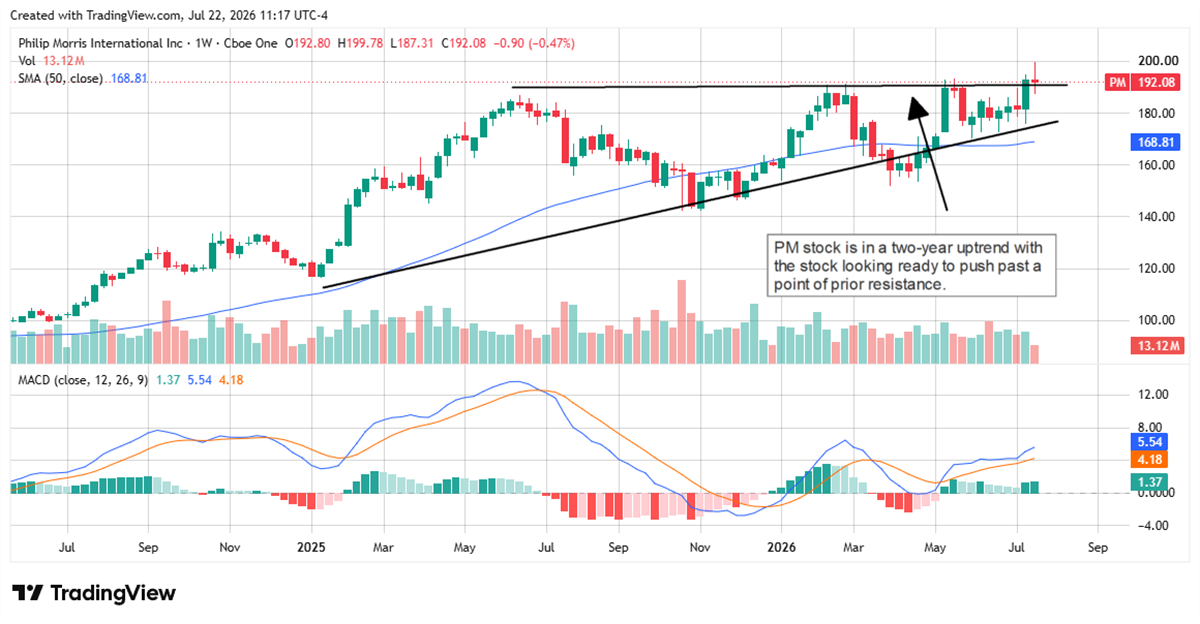
Nevertheless, the stock looks ready to break out, and at least one analyst agrees. BTIG Research initiated coverage of Philip Morris on July 21, setting a price target of $216. That’s well above the consensus price target of $197.
Investors in Philip Morris also get to enjoy the company’s dividend, which has a yield of 3.03% as of July 21 and has increased its payout for 17 consecutive years. This was the fourth consecutive quarter at the prior payout rate, so it’s likely that there will be an increase in the next quarter or two.
Before you consider Philip Morris International, you'll want to hear this.
MarketBeat keeps track of Wall Street's top-rated and best performing research analysts and the stocks they recommend to their clients on a daily basis. MarketBeat has identified the five stocks that top analysts are quietly whispering to their clients to buy now before the broader market catches on... and Philip Morris International wasn't on the list.
While Philip Morris International currently has a Moderate Buy rating among analysts, top-rated analysts believe these five stocks are better buys.
View The Five Stocks Here
MarketBeat just released its list of the 7 hottest IPOs expected to hit Wall Street in 2026. See which companies are preparing to go public and why investors are watching closely.
Get This Free Report
