Johnson & Johnson Today
JNJ
Johnson & Johnson
$248.29 -15.44 (-5.85%) As of 03:42 PM Eastern
This is a fair market value price provided by Massive. Learn more. - 52-Week Range
- $184.66
▼
$281.07 - Dividend Yield
- 2.16%
- P/E Ratio
- 28.83
- Price Target
- $276.22
Johnson & Johnson’s NYSE: JNJ stock price can trend higher and reach fresh highs repeatedly over the coming years because of its robust pipeline, including the recently approved OTTAVA surgical system. It is the first of its kind, a table-top integrated robotic device approved for limited but expanding use in the United States. Though it makes up a small portion of revenue today, it is central to the long-term outlook, which includes a slow acceleration to double-digit top-line growth and widening margins.
OTTAVA’s approval is a game-changer for JNJ, transforming it from a legacy medtech into a next-gen innovator capable of claiming share in high-growth markets. It places the company in direct competition with robotics leader Intuitive Surgical NASDAQ: ISRG, shifting the growth engine to its MedTech segment even as the pharmaceutical segment is expected to sustain steady growth.
To put the opportunity into perspective, Intuitive Surgical is expected to bring in nearly $12 billion in 2026 revenue, equivalent to roughly 12% of J&J's projected annual sales. This highlights the potential size of the robotic surgery opportunity.
Johnson & Johnson Grows in Q3: Talc Headwinds May Clear
Johnson & Johnson had a decent Q3, with revenue growing by 5.9% to $25.4 billion. The top line was in line with expectations and not a catalyst for rallies, but sufficient to sustain the stock's outlook. Within this, operational growth came in slightly higher at 6%, led by a 6.1% increase in adjusted operational growth, underpinned by improvement in both primary segments. Innovative Medicine led with an 8% gain, while MedTech grew more slowly at 2.5%. Regionally, growth was stronger in the United States, up by 9.1%, compared with a 1.9% gain internationally.
Margin news was mixed, including the impacts of one-offs and a proposed settlement to talc litigation. Key details include a 6.8% decline in adjusted net income, negative free cash flow, and a 7.5% decline in adjusted earnings per share (EPS). Though EPS declined, it still beat expectations, outpacing MarketBeat’s analyst consensus by more than a nickel.
The proposed settlement would relieve a major market headwind. The cost is enormous, but well within the company’s grasp; the question is whether it gets accepted or the issues remain unresolved.
Company guidance provided more good news and reasons for investor confidence. Johnson & Johnson upped the midpoint for full-year revenue and earnings, though marginally, to levels above consensus forecasts. The move reflects inherent momentum and sets the stage for another solid year in 2027. Looking ahead, consensus forecasts 7% growth in 2027 and a wider margin.
Analysts Reflect Optimism: JNJ’s Uptrend Is Intact
Numerous analysts reaffirmed their price targets and sentiment ratings immediately after the release, reinforcing the Moderate Buy rating, bullish bias, and price target uptrend, pointing to the high end of the range. Consensus forecasts only modest upside as of mid-October, but the trend's direction matters, suggesting fresh all-time highs and up to 30% upside over the next 12 months.
Negative free cash flow is a red flag, but not a major concern as of Q4 2026. The primary cause was merger and acquisition activity that underpins the pipeline and growth trajectory. The more critical details are in the balance sheet and cash flow, which are healthy and can handle the activity. Free cash flow should improve as soon as the current quarter, enabling the company to maintain balance sheet health while paying its dividend. The dividend is a catalyst for buying, as JNJ is a Dividend King that pays about 50% of its earnings and grows its distribution at a mid-single-digit CAGR.
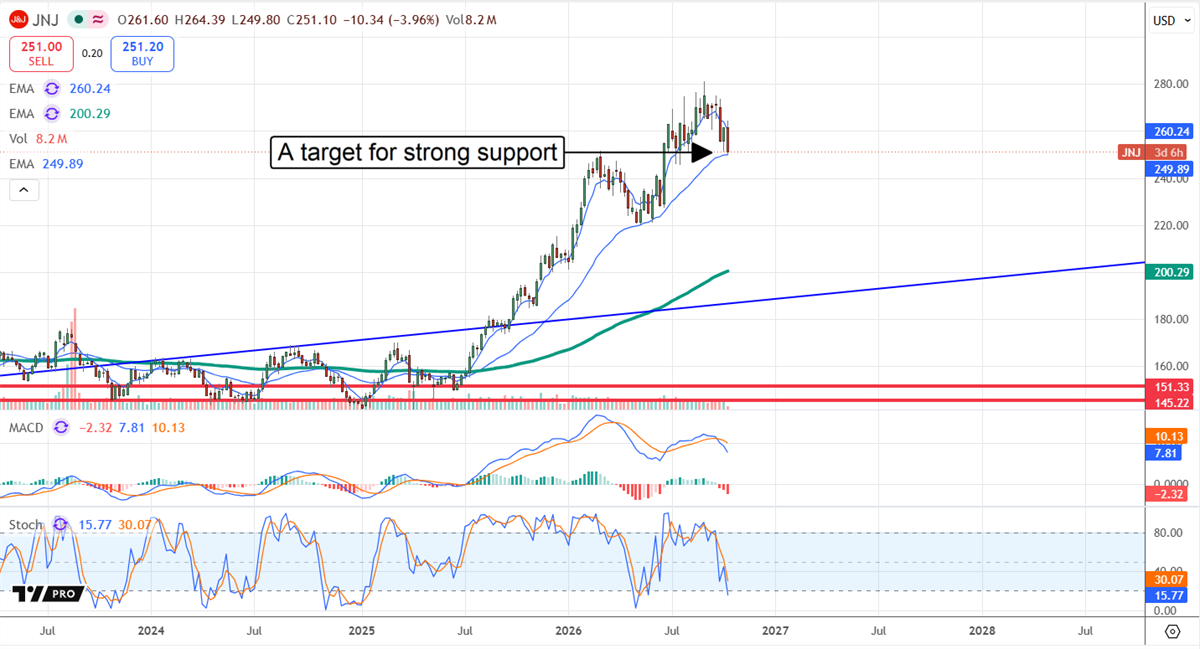
The chart price action was tepid following the release, given the light revenue figure and negative free cash flow. However, the market reverted to a recent breakout point, likely a strong support level and a trigger for bullish activity that may signal a buying opportunity by year’s end. In that scenario, JNJ’s shares are on track to reach fresh highs by early to mid-2027; if no signal emerges, JNJ’s shares might correct to the $220 to $240 region before rebounding.
Aside from talc, JNJ’s biggest risk is upcoming patent cliffs. It already faces a headwind from Stelara, and others are coming over the next few years. The pipeline is robust, including positive Phase 3 trials released in Q3, but there is no guarantee on the timing or monetization of these assets. Assuming the company meets its consensus targets, valuation metrics suggest the stock price could more than double over the next decade.
Before you consider Johnson & Johnson, you'll want to hear this.
MarketBeat keeps track of Wall Street's top-rated and best performing research analysts and the stocks they recommend to their clients on a daily basis. MarketBeat has identified the five stocks that top analysts are quietly whispering to their clients to buy now before the broader market catches on... and Johnson & Johnson wasn't on the list.
While Johnson & Johnson currently has a Moderate Buy rating among analysts, top-rated analysts believe these five stocks are better buys.
View The Five Stocks Here
Looking to profit from the electric vehicle mega-trend? Click the link to see our list of which EV stocks show the most long-term potential.
Get This Free Report
Continue following MarketBeat
Add MarketBeat as your preferred source on Google to see our latest stories in your feed.
Like this article? Share it with a colleague.
Link copied to clipboard.
