Carvana NYSE: CVNA delivered a genuinely impressive Q1 2026 earnings report that included a record number of units sold.
Carvana Today
$62.31 -3.89 (-5.88%) As of 06/26/2026 03:59 PM Eastern
- 52-Week Range
- $54.46
▼
$97.38 - P/E Ratio
- 37.90
- Price Target
- $93.14
However, in the two months following the report, CVNA is down approximately 15% despite favorable analyst sentiment. That includes a 10% drop on June 17 in sympathy with cost commentary from CarMax NYSE: KMX, even though Carvana's own unit economics are moving in the opposite direction.
After the company’s strong Q1 numbers, Carvana still has operational fuel left in the tank. For example, the company’s AI-driven reconditioning tools haven't been rolled out at most facilities, meaning further margin expansion is on the runway.
The company's new Stellantis NYSE: STLA hybrid hub model has also shown early traction. The Casa Grande franchise reportedly went from 30 to 50 units per month to more than 700 after Carvana took it over.
Why Is CVNA Under Pressure?
With all these positive factors driving the stock's outlook, why is CVNA under pressure? Some may say the issue is one of valuation. At 41x forward earnings, Carvana is priced like a technology stock. But the company’s innovative, online-only model has been disruptive to a market that wasn’t known for innovation. And, although the company doesn’t have a long history of profitability, the 41x figure is a discount to its historic average.
The company also cited the likelihood of lower gross profit per unit (GPU) in the coming quarter for a variety of reasons, including the year-over-year comparison to last year’s tariff anniversary. But that’s likely to be a one-time event and wouldn’t explain a sell-off that is now over 20% in 2026.
Carvana Is More Sensitive to Financing Conditions
The real impact on CVNA is likely coming from something outside of its control. Specifically, the near-term direction of U.S. monetary policy. The tone of Federal Reserve chair Kevin Warsh's statements on June 17 did not indicate that he means to move towards an accommodative stance anytime soon.
The CME FedWatch tool agrees. The odds of a rate cut for the rest of 2026 are not even given a percentage. This may not satisfy investors who want to sharpen their pencils and look for a mathematical reason to sell Carvana in the company’s financials. But before dismissing it, here’s something to consider.
For an auto retailer, interest rates matter because auto loan rates are among the stickiest in consumer credit. The average used car APR is well above 11%. Trade-ins increasingly carry negative equity. A consumer who barely qualifies at current rates gets squeezed harder if rates hold or rise
Something else to consider, Carvana's competitor CarMax recently delivered earnings and, despite beating estimates and growing penetration, saw net income drop nearly 12% to $185.6 million as it cut prices to defend volume. Its loan-loss reserve also climbed to 2.95% of loans, up from 2.78%, as the company leaned harder into Tier 2. This is a category of consumers with strong but not top-tier credit who usually qualify for rates that carry a cost premium.
The typical Carvana customer skews to a lower FICO score than CarMax and is more dependent on financing. When rates stay high, marginal buyers are the first to be disqualified, and those are disproportionately Carvana's customers. There's also a K-shaped wrinkle to consider. Upper-leg consumers are still spending, but they're prioritizing travel and experiences over big-ticket vehicle purchases.
That does give fundamental investors something to consider. Restrictive policy compresses growth multiples hardest. At a 41x forward multiple, Carvana needs growth to deliver.
If higher-for-longer rates take $1 of earnings per share (EPS) away from CarMax, it could take 10x off CVNA's multiple. That puts Carvana’s 5-for-1 split last quarter into a different light.
Analysts Remain Bullish, But Technicals Stay Weak
Institutional buying was down sharply in the last quarter, but since the company’s earnings report, analysts have been mostly bullish on CVNA. The Carvana analyst forecasts on MarketBeat show a consensus price target of $93.14 as of June 24, representing a significant gain for investors. However, investors may have to wait until after Carvana reports earnings next month to get a better picture of analyst sentiment.
The CVNA chart shows a stock that continues to be in a downtrend, with recent rallies failing to crack the 200-day simple moving average. A bigger concern for investors may be volume, which is down sharply. The MACD also remains below its signal line, with the histogram near zero. There’s simply no real conviction one way or the other, which amplifies short interest of around 7%, which in and of itself isn’t bearish.
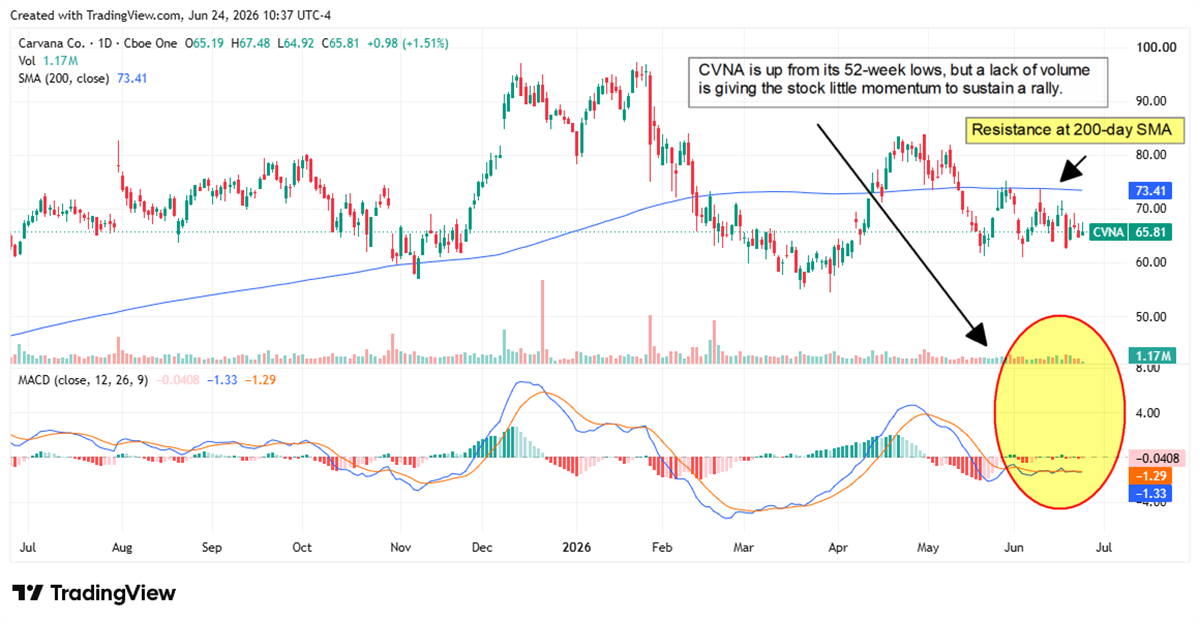
The next potential catalyst comes with Carvana's Q2 earnings report scheduled for July 29. Until then, CVNA is likely to stay tethered to macro signals rather than its own execution. The numbers say the company’s business model is working. The question is whether the Federal Reserve cooperates before the multiple compresses further.
Before you consider Carvana, you'll want to hear this.
MarketBeat keeps track of Wall Street's top-rated and best performing research analysts and the stocks they recommend to their clients on a daily basis. MarketBeat has identified the five stocks that top analysts are quietly whispering to their clients to buy now before the broader market catches on... and Carvana wasn't on the list.
While Carvana currently has a Moderate Buy rating among analysts, top-rated analysts believe these five stocks are better buys.
View The Five Stocks Here
The AI wave will soon hit public markets with Anthropic and OpenAI set to go public later this year. However, you don't have to wait to invest. This report shows seven AI stocks that you can buy today while the big model providers get ready to go public.
Get This Free Report
Like this article? Share it with a colleague.
Link copied to clipboard.
