Verizon Communications Today
VZ
Verizon Communications
$47.33 +0.95 (+2.04%) As of 03:10 PM Eastern
This is a fair market value price provided by Massive. Learn more. - 52-Week Range
- $38.39
▼
$51.68 - Dividend Yield
- 5.98%
- P/E Ratio
- 12.35
- Price Target
- $50.97
is an AI-enabler of first-class quality, and it isn’t getting enough attention. Its fiber optic networks are critical for AI connectivity, spanning all levels of the stack from data centers to devices. While not a semiconductor manufacturer, networker, or model builder, AI data can’t get where it needs to go without the long-haul and metropolitan fiber networks on which Verizon’s business is built. It is the data highway hyperscalers need, and the deal with
Alphabet NASDAQ: GOOGL is the proof.
Verizon CEO Dan Schulman unveiled an industry-unlocking event when he announced that Alphabet would rent its dark fiber. Worth more than $1 billion in revenue, it is expected to be the first of many such deals as hyperscalers rush to lock in long-distance fiber-optic capacity.
The impact on Verizon’s revenue, cash flow, and earnings will be monumental, as the dark fiber networks already exist, as they are leftover, unused capacity dating back to the DotCom boom. The takeaway is that Verizon is unlocking unused assets in a high-margin fashion, with little to no start-up costs and Google footing the hardware bill; it will buy the machines to power the system and transmit the data while Verizon collects rent fees.
Verizon Improves Capital Position and Capacity for Capital Return
The dark fiber rent fees equate to growth, margin improvement, and a strengthened capital position, with Verizon already on track for balance sheet improvement and paying attractive dividends. Distributions annualize to roughly 6% with shares trading near late-July highs, more than 3x the S&P 500 average, with distributions expected to grow over time. As it stands, Verizon will be included in key indices such as the Dividend Achievers, a listing of stocks with at least 25 years of annual distribution increases, within the next few years, and share buybacks are also in play.
Verizon’s management revealed confidence in the turnaround, cash flow position, and future growth by accelerating buybacks in Q2. Quarterly activity aided an approximate 1.35% trailing 12-month reduction in share count, with the annual target lifted to $4.5 billion. The likely outcome is that VZ continues to buy back shares at a semi-aggressive pace, improving shareholder leverage, and may accelerate activity again in future quarters.
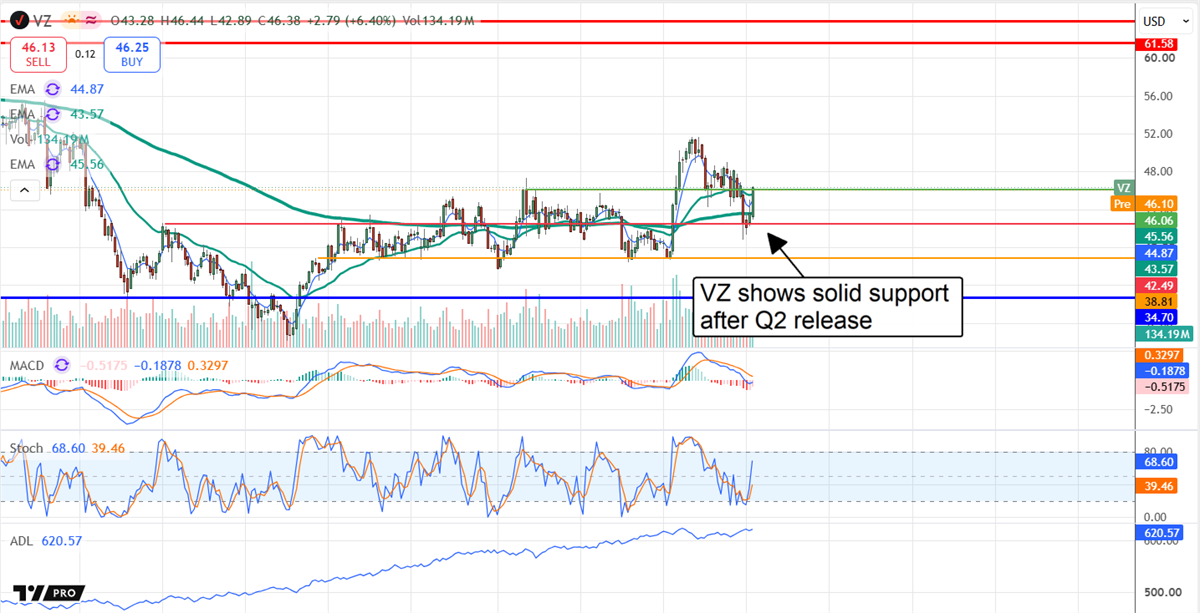
Analysts were not prompted to raise price targets or upgrade, but they responded with optimism, citing core strengths and margin improvements. The Alphabet deal is seen as a positive, but not yet transformational change, as the billion-dollar price tag is an incremental increase to the projected $140+ billion in 2027 revenue. Either way, the group remains supportive, rating the stock as a consensus of Hold with 45% Buy-side bias and price targets limiting downside risk. Institutions also limit downside risk in Q3 2026, owning more than 60% of the stock and buying at a pace of $2 to $1.
Verizon’s Improving Cash Flow Could Accelerate Debt Reduction
Verizon carries a fair amount of debt, which is one reason for analyst caution. The company’s debt load impairs cash flow and capital returns, but is expected to improve in the upcoming quarters. Underpinned by CEO Schulman’s turnaround efforts, improving service revenue, and reduced device subsidies are already driving double-digit cash-flow improvement that can be focused on debt reduction. With hyperscalers now leasing out dark fiber capacity, the odds are high that debt will fall more quickly than anticipated. In this scenario, VZ provides a catalyst for sell-side support, potentially prompting analysts to adopt a more bullish posture by year’s end.
Verizon Communications MarketRank™ Stock Analysis
- Overall MarketRank™
- 93rd Percentile
- Analyst Rating
- Hold
- Upside/Downside
- 6.6% Upside
- Short Interest Level
- Healthy
- Dividend Strength
- Strong
- News Sentiment
- 0.81

- Insider Trading
- N/A
- Proj. Earnings Growth
- 5.40%
See Full AnalysisThe
Q2 results were mixed, reflecting the impacts of turnaround efforts. Revenue contracted by 0.7%, underpinned by a 20% decline in equipment sales linked to reduced promotional activity. The top line underperformed expectations by a significant margin, which is bad news, but is offset by margin improvement, the good news.
The goal of reduced promotions is to shift focus to consumer quality (and satisfaction), which is reflected in margins. Services revenue grew across the board, helping drive cash flow and free cash flow improvements, as well as bottom-line outperformance despite top-line weakness. Free cash flow, the critical detail, grew by 16% in the first half, accelerating to over 24% in the second quarter and is expected to improve as the year progresses.
Guidance is a catalyst for this market. The company lifted its margin, cash flow, and earnings targets to above-consensus levels and may underestimate future strength. Verizon is inflecting into a structural shift, with service revenues accelerating, margins expanding, and secular tailwinds in AI. Additionally, the new bundled plans are resonating with consumers, reducing churn and overall costs while solidifying the revenue base.
Before you consider Verizon Communications, you'll want to hear this.
MarketBeat keeps track of Wall Street's top-rated and best performing research analysts and the stocks they recommend to their clients on a daily basis. MarketBeat has identified the five stocks that top analysts are quietly whispering to their clients to buy now before the broader market catches on... and Verizon Communications wasn't on the list.
While Verizon Communications currently has a Hold rating among analysts, top-rated analysts believe these five stocks are better buys.
View The Five Stocks Here
The space race is growing fast, and you don’t have to have gotten in early on SpaceX to profit. This report shows seven space stocks you can buy today that may grow as rockets, satellites, defense, space internet, and new space technology become more important.
Get This Free Report
Like this article? Share it with a colleague.
Link copied to clipboard.
