Air Canada (TSE:AC - Get Free Report) was downgraded by equities researchers at Jefferies Financial Group from a "hold" rating to an "underperform" rating in a research report issued on Monday, BayStreet reports. They presently have a C$19.00 target price on the stock, down from their prior target price of C$26.00. Jefferies Financial Group's price objective suggests a potential downside of 10.88% from the stock's previous close.
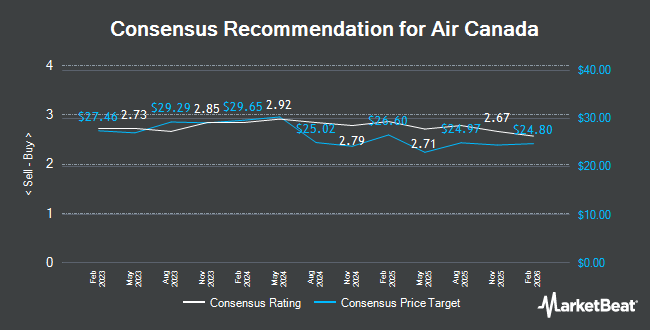
Other equities analysts also recently issued research reports about the company. National Bank Financial cut their target price on Air Canada from C$40.00 to C$37.00 and set an "outperform" rating for the company in a research report on Thursday. Scotiabank reduced their target price on shares of Air Canada from C$37.50 to C$33.00 and set a "sector outperform" rating on the stock in a research note on Thursday. Royal Bank Of Canada upped their target price on shares of Air Canada from C$28.00 to C$37.00 and gave the stock an "outperform" rating in a report on Thursday, August 13th. ATB Cormark Capital Markets increased their target price on shares of Air Canada from C$32.00 to C$45.00 and gave the stock an "outperform" rating in a research report on Thursday, August 13th. Finally, Canadian Imperial Bank of Commerce increased their target price on shares of Air Canada from C$26.00 to C$40.00 in a research report on Friday, August 14th. Seven analysts have rated the stock with a Buy rating, three have given a Hold rating and one has given a Sell rating to the stock. According to data from MarketBeat.com, the company has a consensus rating of "Moderate Buy" and a consensus price target of C$33.04.
Get Our Latest Report on AC
Air Canada Price Performance
TSE AC traded down C$0.67 on Monday, reaching C$21.32. The company's stock had a trading volume of 2,610,168 shares, compared to its average volume of 2,929,037. Air Canada has a 52 week low of C$16.45 and a 52 week high of C$31.45. The company has a current ratio of 0.60, a quick ratio of 1.05 and a debt-to-equity ratio of 478.10. The firm has a market cap of C$5.39 billion, a PE ratio of 16.27, a price-to-earnings-growth ratio of 0.02 and a beta of 1.86. The business has a 50-day moving average price of C$27.19 and a 200 day moving average price of C$23.61.
Air Canada (TSE:AC - Get Free Report) last announced its quarterly earnings results on Tuesday, August 11th. The company reported C$0.40 EPS for the quarter. Air Canada had a net margin of 1.82% and a return on equity of 16.92%. The firm had revenue of C$6.27 billion during the quarter. Sell-side analysts expect that Air Canada will post 2.58 EPS for the current year.
Air Canada Company Profile
(
Get Free Report)
Air Canada is Canada's largest airline, the country's flag carrier and a founding member of Star Alliance, the world's most comprehensive air transportation network. Headquartered in Montréal, Air Canada provides scheduled service directly to more than 180 airports in Canada, the United States and Internationally on six continents. It holds a Four-Star ranking from Skytrax. Air Canada's Aeroplan program is Canada's premier travel loyalty program, with more than 10 million members worldwide. Members can earn or redeem points on the world's largest airline partner network of more than 50 airlines, plus through an extensive range of merchandise, hotel and car rental partners.
See Also
This instant news alert was generated by narrative science technology and financial data from MarketBeat in order to provide readers with the fastest reporting and unbiased coverage. Please send any questions or comments about this story to contact@marketbeat.com.
Before you consider Air Canada, you'll want to hear this.
MarketBeat keeps track of Wall Street's top-rated and best performing research analysts and the stocks they recommend to their clients on a daily basis. MarketBeat has identified the five stocks that top analysts are quietly whispering to their clients to buy now before the broader market catches on... and Air Canada wasn't on the list.
While Air Canada currently has a Moderate Buy rating among analysts, top-rated analysts believe these five stocks are better buys.
View The Five Stocks Here
A strong long-term portfolio starts with companies that can survive recessions, inflation, changing consumer habits, and shifting market leadership.
This report names seven blue-chip stocks across technology, retail, consumer staples, healthcare, networking, sporting goods, and utilities that offer investors a mix of stability, income, growth, and staying power.
Get This Free Report
Continue following MarketBeat
Add MarketBeat as your preferred source on Google to see our latest stories in your feed.
Like this article? Share it with a colleague.
Link copied to clipboard.

