United Community Bank decreased its position in shares of NVIDIA Corporation (NASDAQ:NVDA - Free Report) by 37.6% during the 2nd quarter, according to its most recent filing with the Securities and Exchange Commission (SEC). The institutional investor owned 13,860 shares of the computer hardware maker's stock after selling 8,345 shares during the quarter. NVIDIA accounts for about 0.9% of United Community Bank's holdings, making the stock its 23rd biggest position. United Community Bank's holdings in NVIDIA were worth $2,773,000 at the end of the most recent reporting period.
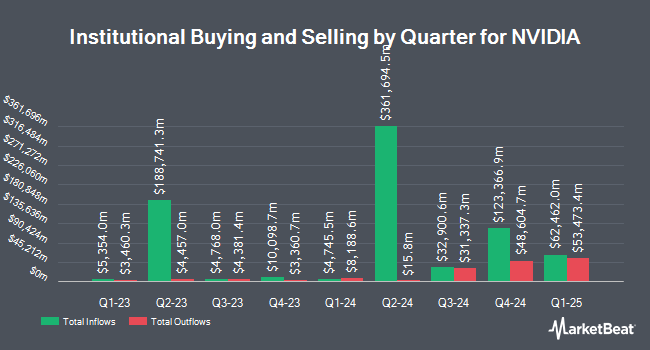
Other institutional investors have also modified their holdings of the company. Bank of America Corp DE boosted its position in NVIDIA by 2.2% during the second quarter. Bank of America Corp DE now owns 195,366,864 shares of the computer hardware maker's stock worth $39,090,956,000 after purchasing an additional 4,165,875 shares in the last quarter. Amundi increased its position in shares of NVIDIA by 10.4% in the first quarter. Amundi now owns 133,768,018 shares of the computer hardware maker's stock valued at $23,329,141,000 after buying an additional 12,575,177 shares in the last quarter. Dimensional Fund Advisors LP increased its position in shares of NVIDIA by 0.6% in the first quarter. Dimensional Fund Advisors LP now owns 94,521,253 shares of the computer hardware maker's stock valued at $16,479,126,000 after buying an additional 555,221 shares in the last quarter. Deutsche Bank AG increased its position in shares of NVIDIA by 2.3% in the second quarter. Deutsche Bank AG now owns 91,954,159 shares of the computer hardware maker's stock valued at $18,399,108,000 after buying an additional 2,045,101 shares in the last quarter. Finally, Jupiter Topco LLC acquired a new position in shares of NVIDIA during the 2nd quarter worth $16,156,076,000. Hedge funds and other institutional investors own 65.27% of the company's stock.
Key Headlines Impacting NVIDIA
Here are the key news stories impacting NVIDIA this week:
- Positive Sentiment: New RTX Spark laptops expand NVIDIA’s addressable market. Systems from ASUS, Dell, HP, Lenovo, Microsoft and MSI are now available starting at $2,599, combining Blackwell graphics, up to 128GB of memory and local AI capabilities. The launch could create a new consumer and developer revenue stream beyond data centers. NVIDIA RTX Spark PCs Available Today
- Positive Sentiment: Automotive and enterprise adoption continues. Volvo expanded its partnership with NVIDIA for automated-driving systems, while Adobe is integrating NVIDIA technology across Photoshop, Premiere and other creative tools. These agreements support longer-term demand for NVIDIA hardware and software. Volvo Cars expands automated driving partnership
- Positive Sentiment: Supply-chain investment and customer deployments remain strong. Taiwan is reportedly considering as much as $4 billion for Texas industrial parks serving NVIDIA suppliers, and customers continue deploying Blackwell systems. The developments reinforce demand, although they may take time to affect revenue. Taiwan Texas industrial parks
- Neutral Sentiment: NVIDIA is broadening its software and AI-model ecosystem. Paid offerings such as AI Enterprise and Mission Control, along with Nemotron open models and partnerships with AI startups, could make earnings less dependent on hardware. However, the articles provide no near-term financial contribution.
- Negative Sentiment: AI financing concerns are the main pressure. CoreWeave’s debt has reportedly traded at distressed yields, raising questions about whether highly leveraged customers can continue funding data-center expansion. Higher Treasury yields and inflation concerns are also making large AI projects more expensive. CoreWeave financing worries
- Negative Sentiment: Investors are questioning AI growth expectations. OpenAI’s reported $50 billion revenue run rate was below the roughly $68 billion previously anticipated, prompting concern that AI demand may mature more slowly. Microsoft’s development of custom Maia chips also highlights the risk of customers developing alternatives to NVIDIA GPUs. OpenAI revenue expectations
- Negative Sentiment: Reported insider selling adds a sentiment overhang. Recent data showed NVIDIA insiders made numerous sales and no open-market purchases over the past six months, though such transactions may reflect planned diversification rather than a change in business outlook.
NVIDIA Price Performance
NVDA opened at $214.13 on Monday. The company has a quick ratio of 3.85, a current ratio of 4.59 and a debt-to-equity ratio of 0.14. The firm has a market cap of $5.16 trillion, a P/E ratio of 27.07, a PEG ratio of 1.65 and a beta of 2.22. NVIDIA Corporation has a 52 week low of $164.27 and a 52 week high of $243.37. The business's fifty day simple moving average is $223.20 and its 200 day simple moving average is $211.42.
NVIDIA (NASDAQ:NVDA - Get Free Report) last posted its quarterly earnings data on Wednesday, August 26th. The computer hardware maker reported $2.22 EPS for the quarter, topping analysts' consensus estimates of $2.09 by $0.13. The firm had revenue of $96.22 billion during the quarter, compared to analysts' expectations of $92.27 billion. NVIDIA had a return on equity of 96.04% and a net margin of 63.66%. The firm's quarterly revenue was up 105.9% compared to the same quarter last year. During the same quarter last year, the business posted $1.05 EPS. As a group, equities research analysts anticipate that NVIDIA Corporation will post 9.30 EPS for the current fiscal year.
NVIDIA Announces Dividend
The company also recently declared a quarterly dividend, which was paid on Thursday, October 1st. Shareholders of record on Thursday, September 10th were paid a dividend of $0.25 per share. This represents a $1.00 annualized dividend and a dividend yield of 0.5%. The ex-dividend date of this dividend was Thursday, September 10th. NVIDIA's dividend payout ratio (DPR) is currently 12.64%.
NVIDIA declared that its Board of Directors has authorized a stock buyback plan on Monday, September 28th that allows the company to repurchase $150.00 billion in shares. This repurchase authorization allows the computer hardware maker to repurchase up to 2.8% of its stock through open market purchases. Stock repurchase plans are generally an indication that the company's board of directors believes its stock is undervalued.
Wall Street Analysts Forecast Growth
Several research firms recently commented on NVDA. Phillip Securities boosted their price objective on shares of NVIDIA from $285.00 to $300.00 and gave the stock a "buy" rating in a research report on Monday, August 31st. KeyCorp restated an "overweight" rating and set a $330.00 target price on shares of NVIDIA in a report on Monday, August 24th. Cantor Fitzgerald restated an "overweight" rating and set a $350.00 target price on shares of NVIDIA in a research report on Thursday, October 1st. UBS Group reaffirmed a "buy" rating on shares of NVIDIA in a report on Friday, October 9th. Finally, Deutsche Bank Aktiengesellschaft reaffirmed a "buy" rating on shares of NVIDIA in a report on Monday, August 31st. Five analysts have rated the stock with a Strong Buy rating, forty-nine have issued a Buy rating and one has assigned a Hold rating to the company's stock. According to data from MarketBeat, NVIDIA currently has a consensus rating of "Buy" and an average target price of $321.89.
Read Our Latest Report on NVDA
Insiders Place Their Bets
In other news, Director Mark A. Stevens sold 622,239 shares of the business's stock in a transaction that occurred on Friday, September 4th. The shares were sold at an average price of $231.62, for a total value of $144,122,997.18. Following the completion of the transaction, the director owned 2,336,531 shares of the company's stock, valued at $541,187,310.22. The trade was a 21.03% decrease in their ownership of the stock. The transaction was disclosed in a filing with the SEC, which is available at the SEC website. Also, EVP Timothy S. Teter sold 30,460 shares of the company's stock in a transaction that occurred on Monday, September 21st. The shares were sold at an average price of $222.80, for a total transaction of $6,786,488.00. Following the transaction, the executive vice president directly owned 2,687,660 shares in the company, valued at $598,810,648. The trade was a 1.12% decrease in their position. The SEC filing for this sale provides additional information. The transaction was executed under a pre-arranged Rule 10b5-1 trading plan. Insiders have sold 1,766,118 shares of company stock valued at $399,450,353 in the last ninety days. Insiders own 3.94% of the company's stock.
NVIDIA Company Profile
(
Free Report)
NVIDIA Corporation NASDAQ: NVDA is a technology company that designs graphics processing units (GPUs), accelerated computing platforms, networking products and related software. Its technologies support artificial intelligence, machine learning, scientific computing, data analytics, professional visualization and computer graphics.
The company's products include GeForce GPUs for gaming and personal computing, data center GPUs and systems for AI and high-performance computing, and networking solutions used to connect and manage large-scale computing infrastructure.
See Also
Want to see what other hedge funds are holding NVDA? Visit HoldingsChannel.com to get the latest 13F filings and insider trades for NVIDIA Corporation (NASDAQ:NVDA - Free Report).
This instant news alert was generated by narrative science technology and financial data from MarketBeat in order to provide readers with the fastest reporting and unbiased coverage. Please send any questions or comments about this story to contact@marketbeat.com.
Before you consider NVIDIA, you'll want to hear this.
MarketBeat keeps track of Wall Street's top-rated and best performing research analysts and the stocks they recommend to their clients on a daily basis. MarketBeat has identified the five stocks that top analysts are quietly whispering to their clients to buy now before the broader market catches on... and NVIDIA wasn't on the list.
While NVIDIA currently has a Buy rating among analysts, top-rated analysts believe these five stocks are better buys.
View The Five Stocks Here
A strong long-term portfolio starts with companies that can survive recessions, inflation, changing consumer habits, and shifting market leadership.
This report names seven blue-chip stocks across technology, retail, consumer staples, healthcare, networking, sporting goods, and utilities that offer investors a mix of stability, income, growth, and staying power.
Get This Free Report
Continue following MarketBeat
Add MarketBeat as your preferred source on Google to see our latest stories in your feed.

