Annex Advisory Services LLC lifted its holdings in Taiwan Semiconductor Manufacturing Company Ltd. (NYSE:TSM - Free Report) by 4.9% during the third quarter, according to its most recent Form 13F filing with the SEC. The firm owned 50,792 shares of the semiconductor company's stock after purchasing an additional 2,395 shares during the period. Annex Advisory Services LLC's holdings in Taiwan Semiconductor Manufacturing were worth $23,171,000 as of its most recent filing with the SEC.
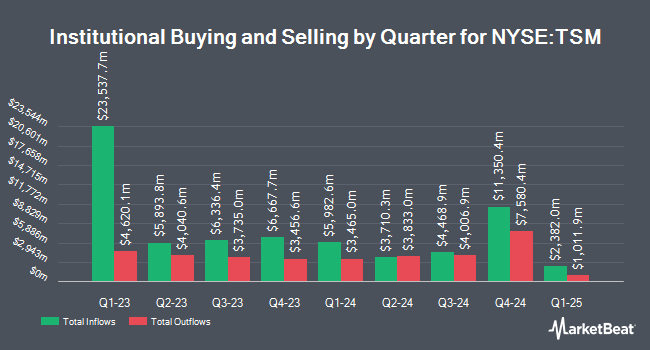
Other large investors have also made changes to their positions in the company. BFI Infinity Ltd. acquired a new position in Taiwan Semiconductor Manufacturing during the 3rd quarter valued at $5,435,000. Riverbend Wealth Management LLC increased its holdings in shares of Taiwan Semiconductor Manufacturing by 28.0% during the 3rd quarter. Riverbend Wealth Management LLC now owns 2,133 shares of the semiconductor company's stock worth $973,000 after purchasing an additional 467 shares during the period. Sustainable Growth Advisers LP increased its holdings in shares of Taiwan Semiconductor Manufacturing by 390.9% during the 3rd quarter. Sustainable Growth Advisers LP now owns 444,118 shares of the semiconductor company's stock worth $202,602,000 after purchasing an additional 353,656 shares during the period. ACT Advisors LLC. raised its position in shares of Taiwan Semiconductor Manufacturing by 14.4% during the third quarter. ACT Advisors LLC. now owns 777 shares of the semiconductor company's stock valued at $354,000 after buying an additional 98 shares during the last quarter. Finally, Iams Wealth Management LLC raised its position in shares of Taiwan Semiconductor Manufacturing by 1,263.6% during the third quarter. Iams Wealth Management LLC now owns 5,836 shares of the semiconductor company's stock valued at $2,662,000 after buying an additional 5,408 shares during the last quarter. Institutional investors and hedge funds own 16.51% of the company's stock.
Key Taiwan Semiconductor Manufacturing News
Here are the key news stories impacting Taiwan Semiconductor Manufacturing this week:
- Positive Sentiment: Record results and strong guidance support the long-term outlook. Third-quarter net income rose 68.7% year over year to NT$763.1 billion, while revenue increased about 51% and exceeded analyst estimates. TSMC also forecast fourth-quarter revenue of $52.3 billion to $54.3 billion, well above the consensus estimate. TSMC posts record profit for a sixth straight quarter
- Positive Sentiment: AI demand remains the key growth driver. Advanced technologies represented 79% of wafer revenue, and management reported no signs of a slowdown in demand for AI and high-performance-computing chips. Full-year 2026 revenue growth is expected to be approximately 44%, while annual 2-nanometer capacity is projected to more than double in 2027. Three key takeaways for long-term investors
- Positive Sentiment: Analysts remain bullish. DA Davidson reaffirmed its Buy rating with a $500 target, while Needham raised its target to $560. Articles also highlight TSMC’s manufacturing scale and competitive moat as potential benefits from continued AI infrastructure investment. TSMC long-term investment outlook
- Neutral Sentiment: Capacity expansion is both an opportunity and a concern. TSMC is considering additional U.S. expansion, including potential involvement in Elon Musk’s proposed Texas “Terafab,” while Taiwan is planning Texas industrial parks for Nvidia suppliers. These projects could improve customer access and supply-chain resilience but increase execution and investment requirements. TSMC talks with Elon Musk’s Terafab
- Negative Sentiment: Large capital expenditures are weighing on sentiment. TSMC’s roughly $64 billion spending plan has prompted questions about returns, potential overcapacity and whether AI demand can justify the industry’s investment pace. Investors also remain concerned about AI companies’ debt financing and profitability. Why TSMC’s spending plan concerns investors
- Negative Sentiment: Sector-wide risk aversion is overpowering the earnings beat. Chip stocks are selling off amid inflation, higher interest rates, concerns about AI financing and questions about whether the AI boom has already been priced into valuations. Commentary also notes that TSMC’s strong results may have raised expectations too high. Chip stocks tumble on AI investment worries
Analyst Ratings Changes
TSM has been the topic of a number of recent research reports. Stifel Nicolaus assumed coverage on Taiwan Semiconductor Manufacturing in a research report on Tuesday, September 1st. They set a "buy" rating and a $515.00 target price on the stock. Weiss Ratings cut Taiwan Semiconductor Manufacturing from a "buy (b-)" rating to a "hold (c+)" rating in a report on Tuesday, October 6th. Citigroup reiterated a "buy" rating on shares of Taiwan Semiconductor Manufacturing in a research report on Wednesday, October 7th. Susquehanna boosted their price objective on Taiwan Semiconductor Manufacturing from $575.00 to $600.00 and gave the company a "positive" rating in a research report on Thursday, July 16th. Finally, Bank of America boosted their price objective on Taiwan Semiconductor Manufacturing from $490.00 to $590.00 and gave the company a "buy" rating in a research report on Wednesday, June 24th. Three research analysts have rated the stock with a Strong Buy rating, eleven have assigned a Buy rating and two have issued a Hold rating to the company's stock. Based on data from MarketBeat, the company presently has an average rating of "Buy" and a consensus target price of $528.78.
View Our Latest Analysis on TSM
Insider Activity
In other news, VP Shyue-Shyh Lin purchased 2,000 shares of the company's stock in a transaction on Sunday, July 19th. The shares were purchased at an average cost of $71.71 per share, with a total value of $143,420.00. Following the completion of the transaction, the vice president owned 28,269 shares of the company's stock, valued at $2,027,169.99. The trade was a 7.61% increase in their position. The transaction was disclosed in a filing with the Securities & Exchange Commission, which is accessible through the SEC website. Also, VP Bor-Zen Tien bought 3,000 shares of the company's stock in a transaction dated Tuesday, July 21st. The stock was purchased at an average cost of $74.39 per share, for a total transaction of $223,170.00. Following the completion of the acquisition, the vice president owned 4,000 shares in the company, valued at $297,560. This trade represents a 300.00% increase in their position. Additional details regarding this purchase are available in the official SEC disclosure. Insiders purchased 16,043 shares of company stock worth $1,185,746 over the last quarter. 1.11% of the stock is currently owned by company insiders.
Taiwan Semiconductor Manufacturing Stock Down 2.2%
TSM opened at $413.15 on Friday. The firm has a market cap of $2.14 trillion, a price-to-earnings ratio of 27.17, a PEG ratio of 0.87 and a beta of 1.37. The company has a debt-to-equity ratio of 0.14, a quick ratio of 2.25 and a current ratio of 2.46. The firm's 50-day simple moving average is $434.71 and its 200-day simple moving average is $417.11. Taiwan Semiconductor Manufacturing Company Ltd. has a twelve month low of $266.82 and a twelve month high of $487.47.
Taiwan Semiconductor Manufacturing (NYSE:TSM - Get Free Report) last announced its earnings results on Tuesday, September 8th. The semiconductor company reported $4.62 earnings per share for the quarter. Taiwan Semiconductor Manufacturing had a return on equity of 42.84% and a net margin of 51.51%. The company had revenue of $46.87 billion during the quarter. Equities research analysts anticipate that Taiwan Semiconductor Manufacturing Company Ltd. will post 16.65 EPS for the current fiscal year.
Taiwan Semiconductor Manufacturing Cuts Dividend
The business also recently declared a quarterly dividend, which will be paid on Thursday, January 7th. Stockholders of record on Thursday, December 10th will be issued a $1.0854 dividend. This represents a $4.34 annualized dividend and a dividend yield of 1.1%. This is a drop from Taiwan Semiconductor Manufacturing's previous quarterly dividend of $1.1136. The ex-dividend date is Thursday, December 10th. Taiwan Semiconductor Manufacturing's dividend payout ratio is currently 24.96%.
Taiwan Semiconductor Manufacturing Profile
(
Free Report)
Taiwan Semiconductor Manufacturing Company Limited NYSE: TSM, commonly known as TSMC, is a Taiwan-based semiconductor manufacturer and the world's largest dedicated semiconductor foundry. Founded in 1987 by Morris Chang, the company pioneered the pure-play foundry model, producing chips designed by other companies rather than selling products under its own semiconductor brand.
TSMC manufactures a broad range of integrated circuits, including advanced logic chips used in high-performance computing, smartphones, automotive systems, communications equipment, and consumer electronics.
Further Reading
Want to see what other hedge funds are holding TSM? Visit HoldingsChannel.com to get the latest 13F filings and insider trades for Taiwan Semiconductor Manufacturing Company Ltd. (NYSE:TSM - Free Report).
This instant news alert was generated by narrative science technology and financial data from MarketBeat in order to provide readers with the fastest reporting and unbiased coverage. Please send any questions or comments about this story to contact@marketbeat.com.
Before you consider Taiwan Semiconductor Manufacturing, you'll want to hear this.
MarketBeat keeps track of Wall Street's top-rated and best performing research analysts and the stocks they recommend to their clients on a daily basis. MarketBeat has identified the five stocks that top analysts are quietly whispering to their clients to buy now before the broader market catches on... and Taiwan Semiconductor Manufacturing wasn't on the list.
While Taiwan Semiconductor Manufacturing currently has a Buy rating among analysts, top-rated analysts believe these five stocks are better buys.
View The Five Stocks Here
Robotics and automation are rapidly becoming essential infrastructure across healthcare, manufacturing, logistics, and many other industries. "Physical AI" is coming. Learn which seven companies are most positioned to benefit as intelligent robots enter the workforce.
Get This Free Report
Continue following MarketBeat
Add MarketBeat as your preferred source on Google to see our latest stories in your feed.
