Capital World Investors increased its position in The Walt Disney Company (NYSE:DIS - Free Report) by 1.6% during the fourth quarter, according to its most recent Form 13F filing with the SEC. The fund owned 4,914,024 shares of the entertainment giant's stock after buying an additional 75,202 shares during the period. Capital World Investors owned 0.28% of Walt Disney worth $559,069,000 at the end of the most recent reporting period.
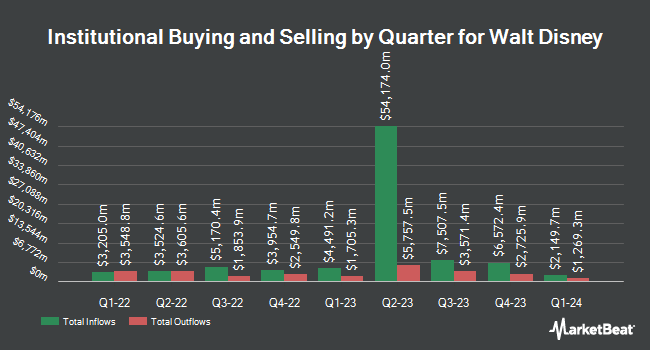
A number of other hedge funds have also recently added to or reduced their stakes in DIS. Brighton Jones LLC boosted its position in Walt Disney by 7.7% during the fourth quarter. Brighton Jones LLC now owns 26,767 shares of the entertainment giant's stock worth $2,980,000 after purchasing an additional 1,904 shares during the period. Sivia Capital Partners LLC boosted its position in Walt Disney by 31.9% during the second quarter. Sivia Capital Partners LLC now owns 5,470 shares of the entertainment giant's stock worth $678,000 after purchasing an additional 1,322 shares during the period. Schnieders Capital Management LLC. boosted its position in Walt Disney by 16.2% during the second quarter. Schnieders Capital Management LLC. now owns 17,955 shares of the entertainment giant's stock worth $2,227,000 after purchasing an additional 2,503 shares during the period. Main Street Financial Solutions LLC boosted its position in Walt Disney by 28.6% during the second quarter. Main Street Financial Solutions LLC now owns 8,330 shares of the entertainment giant's stock worth $1,033,000 after purchasing an additional 1,855 shares during the period. Finally, Ieq Capital LLC boosted its position in Walt Disney by 10.8% during the second quarter. Ieq Capital LLC now owns 115,759 shares of the entertainment giant's stock worth $14,355,000 after purchasing an additional 11,304 shares during the period. Institutional investors and hedge funds own 65.71% of the company's stock.
Wall Street Analyst Weigh In
A number of equities research analysts have issued reports on the company. Guggenheim upped their target price on Walt Disney from $115.00 to $120.00 and gave the stock a "buy" rating in a research report on Thursday, May 7th. Rosenblatt Securities upped their target price on Walt Disney from $121.00 to $126.00 and gave the stock a "buy" rating in a research report on Friday. Phillip Securities raised Walt Disney from a "moderate buy" rating to a "strong-buy" rating in a research report on Monday, May 11th. Weiss Ratings raised Walt Disney from a "hold (c)" rating to a "hold (c+)" rating in a research report on Wednesday, May 27th. Finally, Raymond James Financial raised Walt Disney from a "market perform" rating to an "outperform" rating and set a $115.00 target price for the company in a research report on Wednesday, April 1st. One equities research analyst has rated the stock with a Strong Buy rating, sixteen have given a Buy rating, five have issued a Hold rating and one has issued a Sell rating to the stock. Based on data from MarketBeat, the stock has a consensus rating of "Moderate Buy" and an average price target of $133.47.
Get Our Latest Research Report on Walt Disney
Key Stories Impacting Walt Disney
Here are the key news stories impacting Walt Disney this week:
Walt Disney Stock Up 0.1%
Shares of DIS stock opened at $99.83 on Monday. The stock has a market cap of $173.35 billion, a P/E ratio of 15.95, a price-to-earnings-growth ratio of 1.30 and a beta of 1.39. The Walt Disney Company has a one year low of $92.18 and a one year high of $124.69. The stock has a fifty day moving average price of $101.82 and a 200 day moving average price of $105.40. The company has a debt-to-equity ratio of 0.33, a current ratio of 0.68 and a quick ratio of 0.62.
Walt Disney (NYSE:DIS - Get Free Report) last issued its earnings results on Wednesday, May 6th. The entertainment giant reported $1.57 EPS for the quarter, topping the consensus estimate of $1.49 by $0.08. The firm had revenue of $25.17 billion during the quarter, compared to analysts' expectations of $24.87 billion. Walt Disney had a return on equity of 8.92% and a net margin of 11.54%.Walt Disney's quarterly revenue was up 6.5% compared to the same quarter last year. During the same period last year, the business earned $1.45 earnings per share. Walt Disney has set its FY 2026 guidance at 6.640-6.640 EPS. Analysts predict that The Walt Disney Company will post 6.85 earnings per share for the current year.
About Walt Disney
(
Free Report)
The Walt Disney Company NYSE: DIS, commonly known as Disney, is a diversified global entertainment and media conglomerate headquartered in Burbank, California. Founded in 1923 by Walt and Roy O. Disney, the company grew from an animation studio into a multi‑national entertainment enterprise known for iconic intellectual property and family‑oriented storytelling. Disney's operations span film and television production, streaming services, theme parks and resorts, consumer products, and live entertainment.
On the content side, Disney produces and distributes feature films and television programming through a portfolio of studios and labels that includes Walt Disney Pictures, Pixar, Marvel Studios, Lucasfilm and 20th Century Studios, along with broadcast and cable networks such as ABC, FX and National Geographic.
See Also
This instant news alert was generated by narrative science technology and financial data from MarketBeat in order to provide readers with the fastest reporting and unbiased coverage. Please send any questions or comments about this story to contact@marketbeat.com.
Before you consider Walt Disney, you'll want to hear this.
MarketBeat keeps track of Wall Street's top-rated and best performing research analysts and the stocks they recommend to their clients on a daily basis. MarketBeat has identified the five stocks that top analysts are quietly whispering to their clients to buy now before the broader market catches on... and Walt Disney wasn't on the list.
While Walt Disney currently has a Moderate Buy rating among analysts, top-rated analysts believe these five stocks are better buys.
View The Five Stocks Here
Robotics and automation are rapidly becoming essential infrastructure across healthcare, manufacturing, logistics, and many other industries.
"Physical AI" is coming to the United States, and there are four ways that investors can gain exposure to this new robotics revolution. Plus, learn which seven companies are most positioned to benefit as intelligent robots enter the workforce.
Get This Free Report
Like this article? Share it with a colleague.
Link copied to clipboard.
