Liberty Capital Management Inc. bought a new position in shares of NVIDIA Corporation (NASDAQ:NVDA - Free Report) during the 2nd quarter, according to the company in its most recent 13F filing with the Securities & Exchange Commission. The institutional investor bought 107,620 shares of the computer hardware maker's stock, valued at approximately $21,534,000. NVIDIA makes up 3.7% of Liberty Capital Management Inc.'s portfolio, making the stock its 6th largest position.
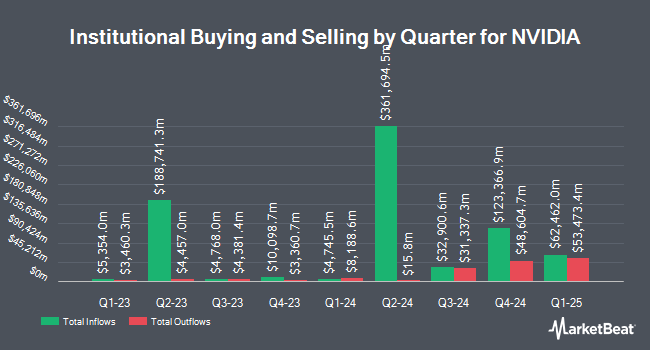
Several other hedge funds also recently bought and sold shares of the company. State Street Corp lifted its holdings in shares of NVIDIA by 1.2% during the 4th quarter. State Street Corp now owns 991,480,489 shares of the computer hardware maker's stock worth $184,911,111,000 after acquiring an additional 11,451,386 shares during the last quarter. Geode Capital Management LLC boosted its stake in shares of NVIDIA by 0.6% during the fourth quarter. Geode Capital Management LLC now owns 588,803,093 shares of the computer hardware maker's stock valued at $109,446,217,000 after purchasing an additional 3,383,441 shares during the period. Norges Bank purchased a new position in shares of NVIDIA in the fourth quarter valued at about $62,244,133,000. Bank of America Corp DE raised its position in NVIDIA by 2.1% during the 1st quarter. Bank of America Corp DE now owns 191,200,989 shares of the computer hardware maker's stock valued at $33,345,453,000 after purchasing an additional 4,019,505 shares during the last quarter. Finally, Legal & General Group Plc boosted its holdings in NVIDIA by 1.5% in the third quarter. Legal & General Group Plc now owns 181,203,035 shares of the computer hardware maker's stock valued at $33,808,862,000 after acquiring an additional 2,609,560 shares in the last quarter. Hedge funds and other institutional investors own 65.27% of the company's stock.
NVIDIA Stock Up 0.8%
Shares of NASDAQ NVDA opened at $230.36 on Friday. The stock's fifty day simple moving average is $210.61 and its two-hundred day simple moving average is $202.05. NVIDIA Corporation has a 12-month low of $164.07 and a 12-month high of $236.54. The company has a current ratio of 4.59, a quick ratio of 3.85 and a debt-to-equity ratio of 0.14. The stock has a market capitalization of $5.55 trillion, a PE ratio of 29.12, a price-to-earnings-growth ratio of 1.79 and a beta of 2.22.
NVIDIA (NASDAQ:NVDA - Get Free Report) last posted its quarterly earnings data on Wednesday, August 26th. The computer hardware maker reported $2.22 earnings per share for the quarter, topping analysts' consensus estimates of $2.09 by $0.13. The firm had revenue of $96.22 billion during the quarter, compared to analysts' expectations of $92.27 billion. NVIDIA had a return on equity of 96.04% and a net margin of 63.66%.The business's quarterly revenue was up 105.9% on a year-over-year basis. During the same quarter last year, the firm earned $1.05 EPS. As a group, analysts expect that NVIDIA Corporation will post 9.1 EPS for the current fiscal year.
NVIDIA Announces Dividend
The firm also recently announced a quarterly dividend, which will be paid on Thursday, October 1st. Stockholders of record on Thursday, September 10th will be paid a dividend of $0.25 per share. This represents a $1.00 annualized dividend and a dividend yield of 0.4%. The ex-dividend date of this dividend is Thursday, September 10th. NVIDIA's dividend payout ratio is presently 12.64%.
NVIDIA announced that its board has authorized a stock buyback plan on Wednesday, May 20th that permits the company to repurchase $80.00 billion in shares. This repurchase authorization permits the computer hardware maker to repurchase up to 1.5% of its shares through open market purchases. Shares repurchase plans are often a sign that the company's board believes its shares are undervalued.
Analyst Upgrades and Downgrades
A number of analysts have recently commented on the stock. William Blair restated an "outperform" rating on shares of NVIDIA in a report on Tuesday, June 2nd. Tigress Financial reissued a "strong-buy" rating and issued a $425.00 target price (up from $360.00) on shares of NVIDIA in a research report on Wednesday, May 27th. UBS Group set a $300.00 price target on NVIDIA and gave the stock a "buy" rating in a research note on Thursday, August 27th. TD Cowen reiterated a "buy" rating on shares of NVIDIA in a research report on Tuesday, August 18th. Finally, Stifel Nicolaus set a $315.00 price target on shares of NVIDIA in a research report on Thursday, August 27th. Two research analysts have rated the stock with a Strong Buy rating, fifty have given a Buy rating and three have issued a Hold rating to the company. According to data from MarketBeat.com, NVIDIA currently has a consensus rating of "Moderate Buy" and an average price target of $324.83.
Read Our Latest Research Report on NVIDIA
Insider Transactions at NVIDIA
In other NVIDIA news, Director Mark A. Stevens sold 63,501 shares of NVIDIA stock in a transaction on Tuesday, September 1st. The stock was sold at an average price of $220.06, for a total value of $13,974,030.06. Following the sale, the director owned 4,558,770 shares in the company, valued at $1,003,202,926.20. The trade was a 1.37% decrease in their ownership of the stock. The transaction was disclosed in a document filed with the Securities & Exchange Commission, which is available through the SEC website. Also, EVP Timothy S. Teter sold 30,000 shares of the firm's stock in a transaction on Monday, August 31st. The stock was sold at an average price of $217.88, for a total value of $6,536,400.00. Following the transaction, the executive vice president owned 2,687,660 shares of the company's stock, valued at approximately $585,587,360.80. This represents a 1.10% decrease in their ownership of the stock. The disclosure for this sale is available in the SEC filing. The transaction was executed under a pre-arranged Rule 10b5-1 trading plan. Insiders have sold 1,563,501 shares of company stock valued at $335,380,530 in the last three months. Corporate insiders own 3.94% of the company's stock.
Trending Headlines about NVIDIA
Here are the key news stories impacting NVIDIA this week:
- Positive Sentiment: Hugging Face expands NVIDIA’s AI ecosystem: The acquisition gives NVIDIA access to Hugging Face’s open-source platform, which hosts millions of models, applications and datasets used by more than 18 million developers. Investors view the deal as a way to deepen CUDA adoption, strengthen NVIDIA’s software moat and position the company as an AI platform provider rather than solely a chip supplier. Management says Hugging Face will remain open to the broader AI ecosystem. Why NVIDIA’s defensive move to acquire Hugging Face is about much more than chips
- Positive Sentiment: New consumer AI revenue channel: Lenovo and Acer are expected to launch Windows PCs powered by NVIDIA’s RTX Spark chip in October. Local AI processing could expand NVIDIA’s addressable market while reducing reliance on cloud data centers. HP also announced new OmniBook PCs using RTX Spark technology. NVIDIA sets October launch for RTX Spark AI PCs
- Positive Sentiment: Analyst support and demand remain strong: Needham and Rosenblatt reaffirmed Buy ratings with price targets of $300 and $390, respectively. Recent earnings showed revenue growth above 100%, a 63.7% net margin and results ahead of consensus, while management’s long-term outlook continues to imply robust AI infrastructure spending. NVIDIA’s equity investments in companies such as OpenAI, CoreWeave and Nebius have also grown substantially, reinforcing its influence across the AI supply chain. NVIDIA has built a $99 billion equity portfolio
- Neutral Sentiment: Competitive and valuation considerations: NVIDIA remains dominant, but AMD, Broadcom and Intel are pursuing AI and server opportunities. Rising memory and optical-networking costs could pressure gross margins even if they confirm that demand exceeds supply.
- Negative Sentiment: Insider selling adds a cautionary signal: Director Mark Stevens sold roughly 648,500 shares in two transactions, while EVP Timothy Teter sold 30,000 shares. The sales were disclosed under planned transactions and represent small portions of their remaining holdings, limiting their significance but potentially weighing on sentiment.
About NVIDIA
(
Free Report)
NVIDIA Corporation, founded in 1993 and headquartered in Santa Clara, California, is a global technology company that designs and develops graphics processing units (GPUs) and system-on-chip (SoC) technologies. Co-founded by Jensen Huang, who serves as president and chief executive officer, along with Chris Malachowsky and Curtis Priem, NVIDIA has grown from a graphics-focused chipmaker into a broad provider of accelerated computing hardware and software for multiple industries.
The company's product portfolio spans discrete GPUs for gaming and professional visualization (marketed under the GeForce and NVIDIA RTX lines), high-performance data center accelerators used for AI training and inference (including widely adopted platforms such as the A100 and H100 series), and Tegra SoCs for automotive and edge applications.
Featured Stories
This instant news alert was generated by narrative science technology and financial data from MarketBeat in order to provide readers with the fastest reporting and unbiased coverage. Please send any questions or comments about this story to contact@marketbeat.com.

Continue following MarketBeat
Add MarketBeat as your preferred source on Google to see our latest stories in your feed.
Before you consider NVIDIA, you'll want to hear this.
MarketBeat keeps track of Wall Street's top-rated and best performing research analysts and the stocks they recommend to their clients on a daily basis. MarketBeat has identified the five stocks that top analysts are quietly whispering to their clients to buy now before the broader market catches on... and NVIDIA wasn't on the list.
While NVIDIA currently has a Moderate Buy rating among analysts, top-rated analysts believe these five stocks are better buys.
View The Five Stocks Here
Robotics and automation are rapidly becoming essential infrastructure across healthcare, manufacturing, logistics, and many other industries. "Physical AI" is coming. Learn which seven companies are most positioned to benefit as intelligent robots enter the workforce.
Get This Free Report
