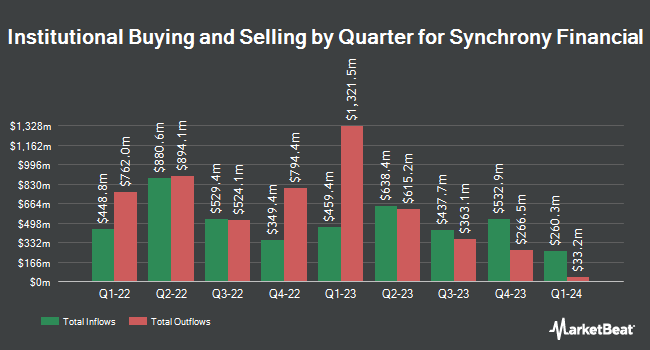
National Pension Service lowered its stake in Synchrony Financial (NYSE:SYF - Free Report) by 2.8% in the 4th quarter, according to its most recent disclosure with the SEC. The fund owned 964,955 shares of the financial services provider's stock after selling 27,325 shares during the quarter. National Pension Service owned 0.27% of Synchrony Financial worth $80,506,000 at the end of the most recent quarter.
Other hedge funds and other institutional investors have also recently bought and sold shares of the company. Westside Investment Management Inc. lifted its position in Synchrony Financial by 100.0% in the third quarter. Westside Investment Management Inc. now owns 358 shares of the financial services provider's stock valued at $25,000 after purchasing an additional 179 shares during the last quarter. FWL Investment Management LLC purchased a new position in Synchrony Financial during the 3rd quarter valued at about $26,000. Palisade Asset Management LLC purchased a new position in Synchrony Financial during the 3rd quarter valued at about $29,000. Geneos Wealth Management Inc. increased its stake in shares of Synchrony Financial by 337.0% during the first quarter. Geneos Wealth Management Inc. now owns 590 shares of the financial services provider's stock valued at $31,000 after buying an additional 455 shares during the period. Finally, Colonial Trust Co SC increased its stake in shares of Synchrony Financial by 40.2% during the third quarter. Colonial Trust Co SC now owns 474 shares of the financial services provider's stock valued at $34,000 after buying an additional 136 shares during the period. Institutional investors own 96.48% of the company's stock.
Insider Transactions at Synchrony Financial
In other news, insider Brian J. Sr. Wenzel sold 47,112 shares of the business's stock in a transaction that occurred on Tuesday, March 3rd. The stock was sold at an average price of $67.16, for a total value of $3,164,041.92. Following the sale, the insider directly owned 64,221 shares of the company's stock, valued at $4,313,082.36. The trade was a 42.32% decrease in their position. The sale was disclosed in a document filed with the SEC, which is available through the SEC website. Also, insider Brian D. Doubles sold 217,554 shares of the business's stock in a transaction that occurred on Monday, March 2nd. The stock was sold at an average price of $68.68, for a total value of $14,941,608.72. Following the completion of the sale, the insider directly owned 829,222 shares in the company, valued at approximately $56,950,966.96. This represents a 20.78% decrease in their ownership of the stock. The SEC filing for this sale provides additional information. Over the last 90 days, insiders sold 374,630 shares of company stock worth $25,731,741. Company insiders own 0.36% of the company's stock.
Wall Street Analyst Weigh In
Several equities analysts have recently issued reports on SYF shares. BTIG Research cut Synchrony Financial from a "buy" rating to a "neutral" rating in a research note on Wednesday, April 22nd. Loop Capital started coverage on Synchrony Financial in a research note on Friday, May 22nd. They set a "hold" rating and a $81.00 target price on the stock. Truist Financial boosted their target price on Synchrony Financial from $71.00 to $82.00 and gave the company a "hold" rating in a research note on Thursday, April 23rd. Robert W. Baird boosted their target price on Synchrony Financial from $83.00 to $86.00 and gave the company an "outperform" rating in a research note on Wednesday, April 22nd. Finally, Wall Street Zen cut Synchrony Financial from a "buy" rating to a "hold" rating in a research note on Saturday, January 31st. One research analyst has rated the stock with a Strong Buy rating, twelve have given a Buy rating and eight have given a Hold rating to the stock. Based on data from MarketBeat.com, Synchrony Financial has a consensus rating of "Moderate Buy" and a consensus price target of $86.05.
View Our Latest Research Report on Synchrony Financial
Synchrony Financial Price Performance
Shares of SYF stock opened at $71.44 on Friday. The stock has a market cap of $24.03 billion, a price-to-earnings ratio of 7.39, a PEG ratio of 0.62 and a beta of 1.37. The business's fifty day moving average is $71.92 and its 200 day moving average is $74.76. Synchrony Financial has a twelve month low of $56.51 and a twelve month high of $88.77. The company has a quick ratio of 1.24, a current ratio of 1.24 and a debt-to-equity ratio of 1.08.
Synchrony Financial (NYSE:SYF - Get Free Report) last issued its quarterly earnings results on Tuesday, April 21st. The financial services provider reported $2.27 earnings per share for the quarter, topping the consensus estimate of $2.14 by $0.13. Synchrony Financial had a return on equity of 23.41% and a net margin of 15.80%.The company had revenue of $3.70 billion for the quarter, compared to analysts' expectations of $3.81 billion. During the same period in the prior year, the firm earned $1.89 earnings per share. The firm's revenue for the quarter was down 7.4% on a year-over-year basis. Synchrony Financial has set its FY 2026 guidance at 9.100-9.500 EPS. Research analysts expect that Synchrony Financial will post 9.29 EPS for the current fiscal year.
Synchrony Financial announced that its board has approved a share repurchase program on Tuesday, April 21st that authorizes the company to repurchase $0.00 in outstanding shares. This repurchase authorization authorizes the financial services provider to repurchase shares of its stock through open market purchases. Shares repurchase programs are usually an indication that the company's management believes its stock is undervalued.
Synchrony Financial Announces Dividend
The business also recently declared a quarterly dividend, which was paid on Friday, May 15th. Stockholders of record on Tuesday, May 5th were given a $0.30 dividend. This represents a $1.20 dividend on an annualized basis and a dividend yield of 1.7%. The ex-dividend date of this dividend was Tuesday, May 5th. Synchrony Financial's payout ratio is currently 12.41%.
About Synchrony Financial
(
Free Report)
Synchrony Financial NYSE: SYF is a consumer financial services company that specializes in providing point-of-sale financing and private-label, co-branded and branded credit card programs. The company serves as a payments and lending partner to retailers, digital merchants and service providers, offering consumer financing solutions designed to drive customer engagement and sales. Synchrony also operates a direct bank that offers deposit products, including savings accounts and certificates of deposit, which support its funding and customer-facing product suite.
Its core product set includes private-label and co-branded credit cards, general-purpose credit cards, installment loan programs and promotional financing options that are integrated into merchants' checkout experiences.
Featured Articles
Want to see what other hedge funds are holding SYF? Visit HoldingsChannel.com to get the latest 13F filings and insider trades for Synchrony Financial (NYSE:SYF - Free Report).
This instant news alert was generated by narrative science technology and financial data from MarketBeat in order to provide readers with the fastest reporting and unbiased coverage. Please send any questions or comments about this story to contact@marketbeat.com.
Before you consider Synchrony Financial, you'll want to hear this.
MarketBeat keeps track of Wall Street's top-rated and best performing research analysts and the stocks they recommend to their clients on a daily basis. MarketBeat has identified the five stocks that top analysts are quietly whispering to their clients to buy now before the broader market catches on... and Synchrony Financial wasn't on the list.
While Synchrony Financial currently has a Moderate Buy rating among analysts, top-rated analysts believe these five stocks are better buys.
View The Five Stocks Here
Nuclear energy is entering a new growth cycle as rising power demand, expanding data centers, and renewed policy support bring the sector back into focus. After strong gains in recent years, the most impactful phase of nuclear investment may still be ahead.
This report highlights seven nuclear energy stocks positioned across the value chain—combining near-term revenue with long-term upside as next-generation technologies scale. Click the link below to unlock the full list.
Get This Free Report
