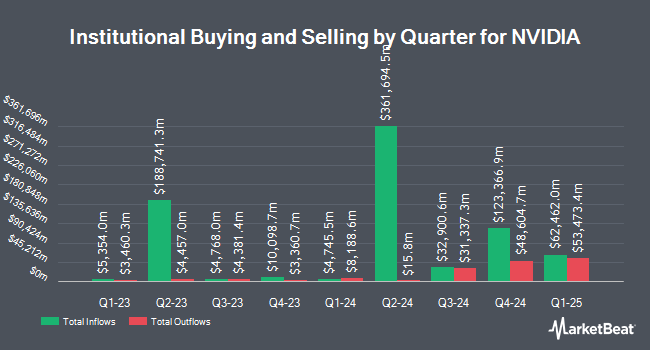
StoneCrest Wealth Management Inc. decreased its position in NVIDIA Corporation (NASDAQ:NVDA - Free Report) by 17.6% in the 2nd quarter, according to the company in its most recent filing with the Securities and Exchange Commission. The fund owned 64,534 shares of the computer hardware maker's stock after selling 13,768 shares during the period. NVIDIA makes up approximately 4.1% of StoneCrest Wealth Management Inc.'s holdings, making the stock its 4th biggest position. StoneCrest Wealth Management Inc.'s holdings in NVIDIA were worth $12,913,000 at the end of the most recent quarter.
Other large investors also recently made changes to their positions in the company. Spectrum Financial Alliance Ltd LLC raised its stake in NVIDIA by 3.8% during the 1st quarter. Spectrum Financial Alliance Ltd LLC now owns 1,395 shares of the computer hardware maker's stock valued at $243,000 after acquiring an additional 51 shares in the last quarter. LMG Wealth Partners LLC grew its stake in shares of NVIDIA by 0.7% in the fourth quarter. LMG Wealth Partners LLC now owns 7,649 shares of the computer hardware maker's stock worth $1,427,000 after purchasing an additional 53 shares in the last quarter. Vision Financial Markets LLC grew its stake in shares of NVIDIA by 1.2% in the third quarter. Vision Financial Markets LLC now owns 4,640 shares of the computer hardware maker's stock worth $866,000 after purchasing an additional 53 shares in the last quarter. JGP Global Gestao de Recursos Ltda. increased its holdings in shares of NVIDIA by 2.3% during the fourth quarter. JGP Global Gestao de Recursos Ltda. now owns 2,402 shares of the computer hardware maker's stock valued at $448,000 after purchasing an additional 55 shares during the period. Finally, Penobscot Wealth Management increased its holdings in shares of NVIDIA by 0.7% during the first quarter. Penobscot Wealth Management now owns 7,930 shares of the computer hardware maker's stock valued at $1,383,000 after purchasing an additional 55 shares during the period. Institutional investors and hedge funds own 65.27% of the company's stock.
NVIDIA Price Performance
NASDAQ:NVDA opened at $217.56 on Thursday. The business's 50-day moving average price is $207.04 and its 200 day moving average price is $199.23. The firm has a market cap of $5.26 trillion, a P/E ratio of 33.32, a PEG ratio of 0.44 and a beta of 2.23. NVIDIA Corporation has a 52-week low of $164.07 and a 52-week high of $236.54. The company has a quick ratio of 2.85, a current ratio of 3.44 and a debt-to-equity ratio of 0.04.
NVIDIA (NASDAQ:NVDA - Get Free Report) last released its earnings results on Wednesday, May 20th. The computer hardware maker reported $1.87 EPS for the quarter, beating the consensus estimate of $1.76 by $0.11. NVIDIA had a net margin of 62.97% and a return on equity of 96.94%. The business had revenue of $81.61 billion during the quarter, compared to analyst estimates of $78.42 billion. During the same period in the prior year, the business earned $0.81 earnings per share. The business's quarterly revenue was up 85.2% on a year-over-year basis. As a group, sell-side analysts predict that NVIDIA Corporation will post 8.59 earnings per share for the current fiscal year.
NVIDIA announced that its Board of Directors has approved a stock buyback plan on Wednesday, May 20th that permits the company to repurchase $80.00 billion in shares. This repurchase authorization permits the computer hardware maker to buy up to 1.5% of its shares through open market purchases. Shares repurchase plans are generally an indication that the company's board believes its stock is undervalued.
Analyst Upgrades and Downgrades
Several equities research analysts recently weighed in on NVDA shares. JPMorgan Chase & Co. upped their price objective on shares of NVIDIA from $265.00 to $280.00 and gave the stock an "overweight" rating in a report on Thursday, May 21st. Susquehanna reissued a "positive" rating and set a $275.00 target price (up from $250.00) on shares of NVIDIA in a research note on Tuesday, May 12th. Craig Hallum boosted their price target on shares of NVIDIA from $245.00 to $275.00 and gave the stock a "buy" rating in a research report on Thursday, May 21st. Royal Bank Of Canada set a $280.00 price target on shares of NVIDIA in a research note on Thursday, May 21st. Finally, Itau BBA Securities decreased their price objective on shares of NVIDIA from $256.00 to $218.00 in a report on Wednesday, June 24th. Three research analysts have rated the stock with a Strong Buy rating, forty-nine have assigned a Buy rating and two have given a Hold rating to the company. According to MarketBeat, the stock currently has an average rating of "Buy" and an average price target of $305.94.
Get Our Latest Stock Analysis on NVIDIA
Insider Activity at NVIDIA
In other news, Director Mark A. Stevens sold 885,000 shares of the firm's stock in a transaction on Thursday, June 18th. The stock was sold at an average price of $210.17, for a total value of $186,000,450.00. Following the completion of the sale, the director owned 5,207,271 shares of the company's stock, valued at $1,094,412,146.07. This trade represents a 14.53% decrease in their ownership of the stock. The sale was disclosed in a filing with the SEC, which is available at this link. Also, Director Stephen C. Neal sold 15,500 shares of the firm's stock in a transaction dated Wednesday, June 3rd. The stock was sold at an average price of $215.73, for a total value of $3,343,815.00. Following the sale, the director owned 116,135 shares of the company's stock, valued at $25,053,803.55. The trade was a 11.77% decrease in their ownership of the stock. The disclosure for this sale is available in the SEC filing. Insiders sold 1,901,125 shares of company stock worth $410,583,015 in the last quarter. 3.94% of the stock is owned by company insiders.
Trending Headlines about NVIDIA
Here are the key news stories impacting NVIDIA this week:
- Positive Sentiment: Potential China revenue boost: Reports indicate small shipments of NVIDIA’s H200 processors have reached mainland China, with ByteDance and Tencent reportedly receiving units. However, Beijing may restrict how the chips are used. Nvidia H200 chips reach China in small shipments
- Positive Sentiment: Analyst support remains strong: Stifel reaffirmed a Buy rating and a $282 target ahead of NVIDIA’s August 26 earnings report, while Bank of America reportedly sees substantial upside based on the company’s valuation and free-cash-flow potential. Analyst updates Nvidia stock price ahead of earnings
- Positive Sentiment: Supply-chain checks support the AI buildout: Stifel pointed to signals from Foxconn and Super Micro as evidence that demand for NVIDIA systems remains healthy heading into the company’s results. NVIDIA is also expanding its role by connecting Nordic GPU customers with available data-center capacity. What Foxconn and Super Micro are telling us about the AI boom
- Neutral Sentiment: Mercor investment under consideration: NVIDIA is reportedly discussing an investment in AI data-labeling provider Mercor at a valuation of about $20 billion. The deal could strengthen NVIDIA’s broader AI ecosystem, but its size and terms remain unknown. Nvidia weighs investment in Mercor
- Negative Sentiment: China uncertainty remains a key overhang: U.S. efforts to close loopholes allowing Chinese firms to access NVIDIA computing power through overseas data centers could limit sales, while any H200 shipments appear restricted and relatively small. U.S. export controls and Nvidia chips
- Negative Sentiment: The earnings bar is high: Investors are looking beyond a routine quarterly beat and want higher forward guidance, sustained data-center growth, strong Blackwell demand, and healthy margins. This creates volatility ahead of the August 26 report. NVIDIA earnings expectations and AI demand
- Negative Sentiment: Competition and concentration risks are intensifying: Investors are questioning whether custom chips, rivals such as AMD and Broadcom, and newer AI-chip startups could eventually pressure NVIDIA’s dominant position. Michael Burry discusses competition for Nvidia
NVIDIA Profile
(
Free Report)
NVIDIA Corporation, founded in 1993 and headquartered in Santa Clara, California, is a global technology company that designs and develops graphics processing units (GPUs) and system-on-chip (SoC) technologies. Co-founded by Jensen Huang, who serves as president and chief executive officer, along with Chris Malachowsky and Curtis Priem, NVIDIA has grown from a graphics-focused chipmaker into a broad provider of accelerated computing hardware and software for multiple industries.
The company's product portfolio spans discrete GPUs for gaming and professional visualization (marketed under the GeForce and NVIDIA RTX lines), high-performance data center accelerators used for AI training and inference (including widely adopted platforms such as the A100 and H100 series), and Tegra SoCs for automotive and edge applications.
See Also
This instant news alert was generated by narrative science technology and financial data from MarketBeat in order to provide readers with the fastest reporting and unbiased coverage. Please send any questions or comments about this story to contact@marketbeat.com.

Continue following MarketBeat
Add MarketBeat as your preferred source on Google to see our latest stories in your feed.
Before you consider NVIDIA, you'll want to hear this.
MarketBeat keeps track of Wall Street's top-rated and best performing research analysts and the stocks they recommend to their clients on a daily basis. MarketBeat has identified the five stocks that top analysts are quietly whispering to their clients to buy now before the broader market catches on... and NVIDIA wasn't on the list.
While NVIDIA currently has a Buy rating among analysts, top-rated analysts believe these five stocks are better buys.
View The Five Stocks Here
The AI boom extends far beyond the biggest tech names. Discover 10 companies supplying the memory, storage, networking, semiconductor manufacturing, and power infrastructure that make AI possible. Learn where the next wave of AI investment opportunities may emerge—and the key risks investors should watch as the global AI buildout accelerates.
Get This Free Report
