Assenagon Asset Management S.A. decreased its stake in Oracle Corporation (NYSE:ORCL - Free Report) by 49.9% in the 3rd quarter, according to its most recent Form 13F filing with the Securities & Exchange Commission. The firm owned 860,701 shares of the enterprise software provider's stock after selling 858,089 shares during the period. Assenagon Asset Management S.A.'s holdings in Oracle were worth $118,174,000 as of its most recent SEC filing.
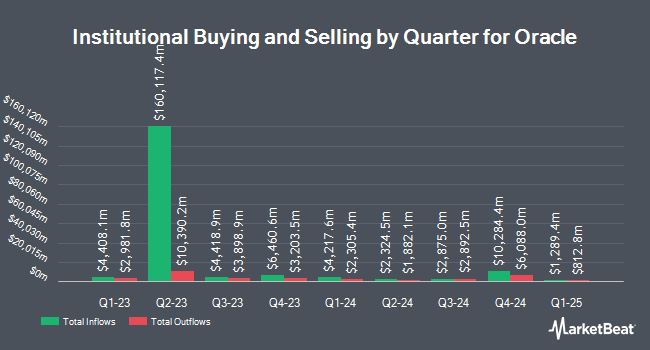
A number of other institutional investors have also recently added to or reduced their stakes in the stock. UBS AM a distinct business unit of UBS ASSET MANAGEMENT AMERICAS LLC increased its holdings in Oracle by 0.8% during the 2nd quarter. UBS AM a distinct business unit of UBS ASSET MANAGEMENT AMERICAS LLC now owns 14,680,278 shares of the enterprise software provider's stock valued at $2,151,395,000 after acquiring an additional 123,294 shares in the last quarter. Bank of New York Mellon Corp lifted its holdings in shares of Oracle by 3.0% in the first quarter. Bank of New York Mellon Corp now owns 13,251,059 shares of the enterprise software provider's stock valued at $1,949,363,000 after purchasing an additional 384,984 shares in the last quarter. Amundi lifted its holdings in shares of Oracle by 1.5% in the second quarter. Amundi now owns 9,878,184 shares of the enterprise software provider's stock valued at $1,447,648,000 after purchasing an additional 144,087 shares in the last quarter. Dimensional Fund Advisors LP grew its position in shares of Oracle by 1.7% in the first quarter. Dimensional Fund Advisors LP now owns 8,586,492 shares of the enterprise software provider's stock valued at $1,262,827,000 after purchasing an additional 147,048 shares during the last quarter. Finally, First Eagle Investment Management LLC increased its stake in shares of Oracle by 1.0% during the 2nd quarter. First Eagle Investment Management LLC now owns 8,516,878 shares of the enterprise software provider's stock worth $1,248,148,000 after purchasing an additional 81,700 shares in the last quarter. Hedge funds and other institutional investors own 42.44% of the company's stock.
Insider Activity at Oracle
In related news, Director Stephen Rusckowski purchased 25,000 shares of the business's stock in a transaction on Tuesday, September 29th. The shares were bought at an average price of $139.35 per share, with a total value of $3,483,750.00. Following the completion of the purchase, the director directly owned 25,390 shares in the company, valued at approximately $3,538,096.50. This trade represents a 6,410.26% increase in their position. The acquisition was disclosed in a filing with the SEC, which is available at this hyperlink. Also, EVP Maria Smith sold 2,631 shares of Oracle stock in a transaction on Tuesday, September 22nd. The shares were sold at an average price of $151.70, for a total transaction of $399,122.70. Following the completion of the transaction, the executive vice president owned 64,357 shares in the company, valued at approximately $9,762,956.90. This trade represents a 3.93% decrease in their position. Additional details regarding this sale are available in the official SEC disclosure. Over the last three months, insiders sold 36,075 shares of company stock worth $5,342,123. 38.40% of the stock is owned by company insiders.
Key Oracle News
Here are the key news stories impacting Oracle this week:
- Positive Sentiment: Oracle’s cloud business remains a key long-term catalyst. Its fiscal first-quarter results showed strong cloud growth, while remaining performance obligations reached a record $664 billion. If those commitments convert into revenue as scheduled, analysts and investors see substantial upside potential. Oracle’s Cloud Backlog Just Hit $664 Billion
- Positive Sentiment: Oracle’s role in AI infrastructure is attracting strategic business. Bloom Energy’s technology is reportedly being deployed to support Oracle-related AI data-center ambitions, highlighting demand for power and infrastructure around Oracle’s cloud expansion. Bloom Energy Is Up 157% in 2026
- Neutral Sentiment: Oracle is also benefiting from government business, with approximately $2.1 billion in award payments reportedly received over the past year, including major electronic health-record contracts. These awards support revenue visibility but are unlikely to change near-term market sentiment by themselves.
- Negative Sentiment: Investors are worried that Oracle’s substantial AI and cloud build-out is consuming cash before contracted revenue is collected. Recent results showed negative free cash flow, increasing focus on leverage, borrowing costs and execution risk. Oracle’s credit rating downgrade to BBB- has added to those concerns. Oracle Shares Fall as AI Infrastructure Worries Weigh on Sentiment
- Negative Sentiment: Hotter inflation data pushed interest-rate expectations and bond yields higher, pressuring capital-intensive AI infrastructure companies. A selloff in CoreWeave and other AI-related stocks intensified fears that expensive financing could reduce returns on Oracle’s expansion.
- Negative Sentiment: Reported insider activity has been heavily skewed toward selling, including substantial sales by Vice Chairman Jeffrey Henley and CEO Michael Sicilia. While insider transactions may reflect personal financial decisions, the pattern can weigh on investor confidence amid broader concerns about valuation and execution.
Oracle Stock Performance
NYSE ORCL opened at $128.31 on Friday. The business's 50-day moving average price is $145.38 and its 200 day moving average price is $158.64. Oracle Corporation has a twelve month low of $114.50 and a twelve month high of $304.28. The company has a market capitalization of $387.98 billion, a PE ratio of 19.77, a price-to-earnings-growth ratio of 0.95 and a beta of 1.78. The company has a current ratio of 1.17, a quick ratio of 1.17 and a debt-to-equity ratio of 1.89.
Oracle (NYSE:ORCL - Get Free Report) last issued its quarterly earnings results on Thursday, September 10th. The enterprise software provider reported $1.92 earnings per share (EPS) for the quarter, topping analysts' consensus estimates of $1.74 by $0.18. The firm had revenue of $19.34 billion for the quarter, compared to analyst estimates of $19.13 billion. Oracle had a return on equity of 48.85% and a net margin of 26.36%. The firm's quarterly revenue was up 29.6% on a year-over-year basis. During the same period last year, the company earned $1.47 EPS. Oracle has set its Q2 2027 guidance at 1.850-1.930 EPS and its FY 2027 guidance at 8.100-8.100 EPS. On average, research analysts predict that Oracle Corporation will post 6.73 earnings per share for the current year.
Oracle Announces Dividend
The business also recently announced a quarterly dividend, which will be paid on Friday, October 23rd. Investors of record on Friday, October 9th will be issued a $0.50 dividend. This represents a $2.00 dividend on an annualized basis and a yield of 1.6%. The ex-dividend date is Friday, October 9th. Oracle's payout ratio is presently 31.35%.
Analysts Set New Price Targets
Several research analysts recently issued reports on the company. BMO Capital Markets cut their price objective on Oracle from $220.00 to $195.00 and set an "outperform" rating for the company in a research report on Friday, September 11th. Citizens Jmp reissued a "market outperform" rating and set a $285.00 price target on shares of Oracle in a research report on Friday, October 2nd. DZ Bank reissued a "buy" rating on shares of Oracle in a report on Thursday, September 17th. Morgan Stanley upped their price objective on Oracle from $207.00 to $210.00 and gave the company an "equal weight" rating in a research report on Friday, September 4th. Finally, Jefferies Financial Group reaffirmed a "buy" rating and set a $290.00 price objective (down from $320.00) on shares of Oracle in a research note on Thursday, September 10th. One equities research analyst has rated the stock with a Strong Buy rating, thirty-five have assigned a Buy rating, nine have given a Hold rating and one has issued a Sell rating to the stock. According to data from MarketBeat.com, the stock presently has a consensus rating of "Moderate Buy" and a consensus target price of $251.72.
Check Out Our Latest Analysis on Oracle
Oracle Profile
(
Free Report)
Oracle Corporation NYSE: ORCL is a global technology company that develops enterprise software, cloud services and related hardware. Its offerings help businesses manage databases, applications, data, infrastructure and other core information-technology operations.
The company is best known for its Oracle Database, along with cloud-based infrastructure and platform services. Oracle also provides enterprise applications for functions such as finance, human resources, supply-chain management, customer experience and industry-specific operations.
Featured Stories
Want to see what other hedge funds are holding ORCL? Visit HoldingsChannel.com to get the latest 13F filings and insider trades for Oracle Corporation (NYSE:ORCL - Free Report).
This instant news alert was generated by narrative science technology and financial data from MarketBeat in order to provide readers with the fastest reporting and unbiased coverage. Please send any questions or comments about this story to contact@marketbeat.com.
Before you consider Oracle, you'll want to hear this.
MarketBeat keeps track of Wall Street's top-rated and best performing research analysts and the stocks they recommend to their clients on a daily basis. MarketBeat has identified the five stocks that top analysts are quietly whispering to their clients to buy now before the broader market catches on... and Oracle wasn't on the list.
While Oracle currently has a Moderate Buy rating among analysts, top-rated analysts believe these five stocks are better buys.
View The Five Stocks Here
Nuclear energy is entering a new growth cycle as rising power demand, expanding data centers, and renewed policy support bring the sector back into focus. After strong gains in recent years, the most impactful phase of nuclear investment may still be ahead. This report highlights seven nuclear energy stocks positioned across the value chain—combining near-term revenue with long-term upside as next-generation technologies scale. Click the link below to unlock the full list.
Get This Free Report
Continue following MarketBeat
Add MarketBeat as your preferred source on Google to see our latest stories in your feed.
