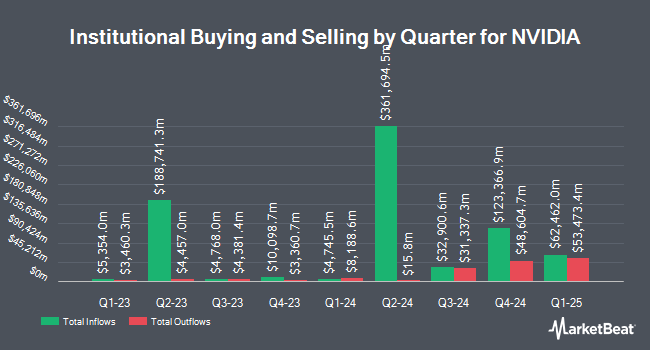
Quantbot Technologies LP reduced its stake in shares of NVIDIA Corporation (NASDAQ:NVDA - Free Report) by 49.0% in the 2nd quarter, according to its most recent 13F filing with the Securities and Exchange Commission. The firm owned 15,232 shares of the computer hardware maker's stock after selling 14,637 shares during the quarter. Quantbot Technologies LP's holdings in NVIDIA were worth $3,048,000 at the end of the most recent reporting period.
A number of other hedge funds have also modified their holdings of the company. Bank of America Corp DE boosted its position in shares of NVIDIA by 2.1% during the first quarter. Bank of America Corp DE now owns 191,200,989 shares of the computer hardware maker's stock worth $33,345,453,000 after purchasing an additional 4,019,505 shares in the last quarter. Invesco Ltd. increased its position in shares of NVIDIA by 0.3% in the 4th quarter. Invesco Ltd. now owns 143,239,504 shares of the computer hardware maker's stock valued at $26,714,167,000 after buying an additional 446,178 shares in the last quarter. Amundi raised its stake in NVIDIA by 10.4% during the 1st quarter. Amundi now owns 133,768,018 shares of the computer hardware maker's stock worth $23,329,141,000 after buying an additional 12,575,177 shares during the period. J. Stern & Co. LLP lifted its holdings in NVIDIA by 13,709.1% during the fourth quarter. J. Stern & Co. LLP now owns 125,760,307 shares of the computer hardware maker's stock worth $23,454,297,000 after acquiring an additional 124,849,603 shares in the last quarter. Finally, Dimensional Fund Advisors LP lifted its holdings in NVIDIA by 0.6% during the first quarter. Dimensional Fund Advisors LP now owns 94,521,253 shares of the computer hardware maker's stock worth $16,479,126,000 after acquiring an additional 555,221 shares in the last quarter. 65.27% of the stock is currently owned by institutional investors and hedge funds.
NVIDIA Stock Down 0.8%
Shares of NVIDIA stock opened at $237.36 on Thursday. The firm has a market cap of $5.72 trillion, a PE ratio of 30.01, a P/E/G ratio of 1.85 and a beta of 2.22. The business's 50 day simple moving average is $221.38 and its 200 day simple moving average is $208.88. The company has a debt-to-equity ratio of 0.14, a quick ratio of 3.85 and a current ratio of 4.59. NVIDIA Corporation has a 52-week low of $164.27 and a 52-week high of $243.37.
NVIDIA (NASDAQ:NVDA - Get Free Report) last released its quarterly earnings results on Wednesday, August 26th. The computer hardware maker reported $2.22 earnings per share for the quarter, topping analysts' consensus estimates of $2.09 by $0.13. The firm had revenue of $96.22 billion during the quarter, compared to the consensus estimate of $92.27 billion. NVIDIA had a return on equity of 96.04% and a net margin of 63.66%.The business's revenue was up 105.9% on a year-over-year basis. During the same quarter in the prior year, the firm posted $1.05 EPS. On average, analysts predict that NVIDIA Corporation will post 9.25 earnings per share for the current fiscal year.
NVIDIA Announces Dividend
The firm also recently announced a quarterly dividend, which was paid on Thursday, October 1st. Investors of record on Thursday, September 10th were issued a dividend of $0.25 per share. The ex-dividend date was Thursday, September 10th. This represents a $1.00 annualized dividend and a yield of 0.4%. NVIDIA's dividend payout ratio is presently 12.64%.
NVIDIA declared that its Board of Directors has approved a stock repurchase plan on Monday, September 28th that authorizes the company to buyback $150.00 billion in shares. This buyback authorization authorizes the computer hardware maker to purchase up to 2.8% of its shares through open market purchases. Shares buyback plans are usually a sign that the company's board believes its stock is undervalued.
More NVIDIA News
Here are the key news stories impacting NVIDIA this week:
- Positive Sentiment: SpaceX may become a major new customer. SpaceX is reportedly seeking approximately $40 billion in debt financing—potentially including bank loans and investment-grade bonds—to purchase NVIDIA GPUs for its AI infrastructure. The proposed transaction would reinforce demand for NVIDIA’s chips, although the debt-funded nature of the purchase raises questions about customer financing risk. Apollo, banks in talks to finance SpaceX's $40 billion Nvidia GPU purchase
- Positive Sentiment: NVIDIA is expanding beyond data centers into PCs and edge AI. Microsoft unveiled the $2,599 Surface Laptop Ultra with an NVIDIA AI chip, while ASUS and other manufacturers began offering RTX Spark-powered systems for local AI workloads. This could broaden NVIDIA’s addressable market and create a new consumer and enterprise revenue stream. Microsoft to sell Surface Laptop Ultra containing Nvidia AI chip
- Positive Sentiment: AI infrastructure adoption remains widespread. NVIDIA-backed Lambda is reportedly targeting up to $4 billion in additional funding ahead of a planned IPO, while robotics, sovereign-AI and cloud-computing companies continue announcing deployments using NVIDIA platforms. These developments support the company’s ecosystem and long-term demand outlook. Nvidia-backed Lambda targets $4 billion raise
- Positive Sentiment: Analyst sentiment remains bullish. Morgan Stanley raised its price target, and consensus estimates cited by analysts imply additional upside. NVIDIA’s prior quarterly earnings beat and more-than-doubling revenue growth continue to support the bullish case.
- Neutral Sentiment: Market conditions are mixed. Rising oil prices tied to renewed Strait of Hormuz tensions pressured broader equities, while investors also remained focused on interest rates and Federal Reserve minutes.
- Negative Sentiment: Valuation and concentration risks are becoming more prominent. NVIDIA is approaching a $6 trillion market capitalization after a powerful rally, increasing the potential for profit-taking. Michael Burry has reportedly shifted to longer-dated put options on NVIDIA, citing the risk of an eventual AI downturn.
- Negative Sentiment: Trade and execution risks could weigh on the shares. Fresh tariff threats and concerns about margin compression, inventory levels and the sustainability of debt-financed AI spending are tempering enthusiasm. Investors may also be reluctant to chase the stock near record highs without evidence that earnings growth can continue to exceed elevated expectations.
Analysts Set New Price Targets
Several brokerages have issued reports on NVDA. Itau BBA Securities lowered their price target on NVIDIA from $256.00 to $218.00 in a report on Wednesday, June 24th. DZ Bank reiterated a "buy" rating on shares of NVIDIA in a report on Wednesday, August 26th. Evercore set a $465.00 price objective on NVIDIA and gave the company an "outperform" rating in a research report on Thursday, August 27th. Daiwa Securities Group lowered their target price on NVIDIA from $255.00 to $245.00 and set an "outperform" rating for the company in a research note on Thursday, September 17th. Finally, Cantor Fitzgerald restated an "overweight" rating and set a $350.00 target price on shares of NVIDIA in a report on Thursday, October 1st. Four investment analysts have rated the stock with a Strong Buy rating, fifty have assigned a Buy rating and one has assigned a Hold rating to the company. Based on data from MarketBeat, NVIDIA has an average rating of "Buy" and a consensus price target of $321.89.
View Our Latest Research Report on NVIDIA
Insider Buying and Selling
In other NVIDIA news, EVP Timothy S. Teter sold 30,460 shares of the business's stock in a transaction dated Monday, September 21st. The shares were sold at an average price of $222.80, for a total transaction of $6,786,488.00. Following the sale, the executive vice president directly owned 2,687,660 shares of the company's stock, valued at $598,810,648. The trade was a 1.12% decrease in their position. The sale was disclosed in a filing with the SEC, which is available through this link. The transaction was executed under a pre-arranged Rule 10b5-1 trading plan. Also, Director Mark A. Stevens sold 622,239 shares of the stock in a transaction dated Friday, September 4th. The stock was sold at an average price of $231.62, for a total transaction of $144,122,997.18. Following the transaction, the director owned 2,336,531 shares of the company's stock, valued at approximately $541,187,310.22. This represents a 21.03% decrease in their ownership of the stock. Additional details regarding this sale are available in the official SEC disclosure. Over the last 90 days, insiders sold 1,766,118 shares of company stock worth $399,450,353. 3.94% of the stock is owned by insiders.
About NVIDIA
(
Free Report)
NVIDIA Corporation is a technology company that designs accelerated computing platforms, graphics processing units (GPUs), central processing units (CPUs), networking products and related software. Its technologies are used in artificial intelligence, data centers, scientific and technical computing, gaming, professional visualization, automotive systems and robotics.
The company's products include GeForce GPUs and gaming software, data center computing platforms, networking solutions, and enterprise software for AI development and deployment.
Featured Articles
Want to see what other hedge funds are holding NVDA? Visit HoldingsChannel.com to get the latest 13F filings and insider trades for NVIDIA Corporation (NASDAQ:NVDA - Free Report).
This instant news alert was generated by narrative science technology and financial data from MarketBeat in order to provide readers with the fastest reporting and unbiased coverage. Please send any questions or comments about this story to contact@marketbeat.com.
Before you consider NVIDIA, you'll want to hear this.
MarketBeat keeps track of Wall Street's top-rated and best performing research analysts and the stocks they recommend to their clients on a daily basis. MarketBeat has identified the five stocks that top analysts are quietly whispering to their clients to buy now before the broader market catches on... and NVIDIA wasn't on the list.
While NVIDIA currently has a Buy rating among analysts, top-rated analysts believe these five stocks are better buys.
View The Five Stocks Here
Robotics and automation are rapidly becoming essential infrastructure across healthcare, manufacturing, logistics, and many other industries. "Physical AI" is coming. Learn which seven companies are most positioned to benefit as intelligent robots enter the workforce.
Get This Free Report
Continue following MarketBeat
Add MarketBeat as your preferred source on Google to see our latest stories in your feed.
