Power Co. of Canada (TSE:POW - Get Free Report) had its target price raised by equities researchers at Royal Bank Of Canada from C$86.00 to C$87.00 in a note issued to investors on Monday,BayStreet.CA reports. The brokerage presently has an "outperform" rating on the financial services provider's stock. Royal Bank Of Canada's price objective would indicate a potential downside of 2.10% from the stock's previous close.
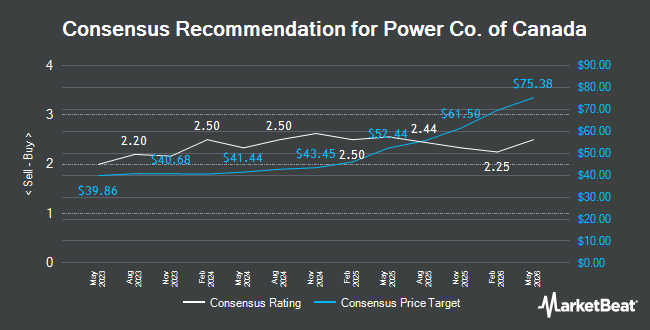
POW has been the topic of a number of other research reports. Desjardins lifted their price target on shares of Power Co. of Canada from C$81.00 to C$87.00 and gave the company a "buy" rating in a research note on Thursday, May 14th. Scotia increased their price objective on shares of Power Co. of Canada from C$79.00 to C$90.00 and gave the stock a "sector outperform" rating in a research report on Thursday, May 14th. Jefferies Financial Group raised their price objective on shares of Power Co. of Canada from C$73.00 to C$90.00 in a report on Thursday, May 14th. TD Securities cut shares of Power Co. of Canada from a "strong-buy" rating to a "hold" rating in a research report on Thursday, May 14th. Finally, Canadian Imperial Bank of Commerce upped their target price on shares of Power Co. of Canada from C$75.00 to C$78.00 and gave the stock a "hold" rating in a research note on Friday, March 20th. Four equities research analysts have rated the stock with a Buy rating and six have given a Hold rating to the stock. Based on data from MarketBeat, the stock presently has an average rating of "Hold" and an average target price of C$83.20.
View Our Latest Research Report on Power Co. of Canada
Power Co. of Canada Trading Down 2.4%
Shares of Power Co. of Canada stock traded down C$2.17 during trading hours on Monday, hitting C$88.87. The company's stock had a trading volume of 674,269 shares, compared to its average volume of 2,384,472. The company has a market capitalization of C$56.00 billion, a PE ratio of 21.36, a price-to-earnings-growth ratio of 0.57 and a beta of 0.73. The company has a debt-to-equity ratio of 86.98, a current ratio of 0.87 and a quick ratio of 107.64. The stock has a 50 day moving average of C$84.39 and a 200 day moving average of C$74.56. Power Co. of Canada has a 12 month low of C$52.97 and a 12 month high of C$92.16.
Power Co. of Canada (TSE:POW - Get Free Report) last released its quarterly earnings data on Tuesday, May 12th. The financial services provider reported C$1.43 earnings per share for the quarter. Power Co. of Canada had a return on equity of 11.34% and a net margin of 7.93%.The business had revenue of C$10.96 billion for the quarter. Analysts predict that Power Co. of Canada will post 4.9289678 earnings per share for the current year.
Power Co. of Canada Company Profile
(
Get Free Report)
Power Corporation is an international management and holding company that focuses on financial services in North America, Europe and Asia. Its core holdings are leading insurance, retirement, wealth management and investment businesses, including a portfolio of alternative asset investment platforms.
See Also
This instant news alert was generated by narrative science technology and financial data from MarketBeat in order to provide readers with the fastest reporting and unbiased coverage. Please send any questions or comments about this story to contact@marketbeat.com.
Before you consider Power Co. of Canada, you'll want to hear this.
MarketBeat keeps track of Wall Street's top-rated and best performing research analysts and the stocks they recommend to their clients on a daily basis. MarketBeat has identified the five stocks that top analysts are quietly whispering to their clients to buy now before the broader market catches on... and Power Co. of Canada wasn't on the list.
While Power Co. of Canada currently has a Hold rating among analysts, top-rated analysts believe these five stocks are better buys.
View The Five Stocks Here
Discover the 10 Best High-Yield Dividend Stocks for 2026 and secure reliable income in uncertain markets. Download the report now to identify top dividend payers and avoid common yield traps.
Get This Free Report
Like this article? Share it with a colleague.
Link copied to clipboard.
