The stock market welcomed a fresh wave of optimism when the artificial intelligence rally resumed in November, but not every sector joined the rebound. One notable absence is financial stocks, where results have been mixed in 2025 despite a friendly federal regime and a resilient consumer. As a result, the financial sector has become a stock picker’s market, where due diligence and attention to trends are rewarded.
Large-cap finance stocks like JPMorgan Chase Inc. NYSE: JPM and The Goldman Sachs Group Inc. NYSE: GS have been big winners in 2025, but if you want to maximize your bank stock profits, you’ll need to avoid the names primed to leave investors disappointed this holiday season.
3 Finance Stocks to Avoid Entering 2026
Complacency in the finance sector may finally be coming back to bite investors. With the Federal Reserve set to continue rate reductions, the high net interest income (NII) banks have enjoyed over the last few years could become less of a tailwind. Low rates might increase consumer activity, but banks lose margin since the interest they earn on loans outstrips what they pay to depositors.
Additionally, a rate-lowering cycle generally coincides with a weakening economy, and while consumer spending remains strong, cracks are starting to show in the job and housing markets. These headwinds are unevenly spread across the finance sector, which is why picking winners and avoiding losers has become paramount. Here are three stocks that could be at a disadvantage in this macroeconomic environment.
Interactive Brokers: Low Rates as a Headwind
Interactive Brokers Group Today
IBKR
Interactive Brokers Group
$86.18 -0.90 (-1.03%) As of 04:00 PM Eastern
- 52-Week Range
- $58.95
▼
$98.75 - Dividend Yield
- 0.41%
- P/E Ratio
- 34.47
- Price Target
- $98.90
If you’ve ever dabbled in serious trading, chances are you’ve encountered the Interactive Brokers NASDAQ: IBKR suite of trading tools.
Few platforms offer the same optionality and precision, and the company continues to set records for revenue and user growth. So why is this stock on the naughty list?
Over the last few years, IBKR has enjoyed huge profits on cash account balances, thanks to high interest rates.
If the high-rate environment ends, interest revenue is almost sure to take a haircut, leaving the company more dependent on high trading volumes and vulnerable to valuation concerns (IBKR already trades with a price-to-earnings ratio above 32).
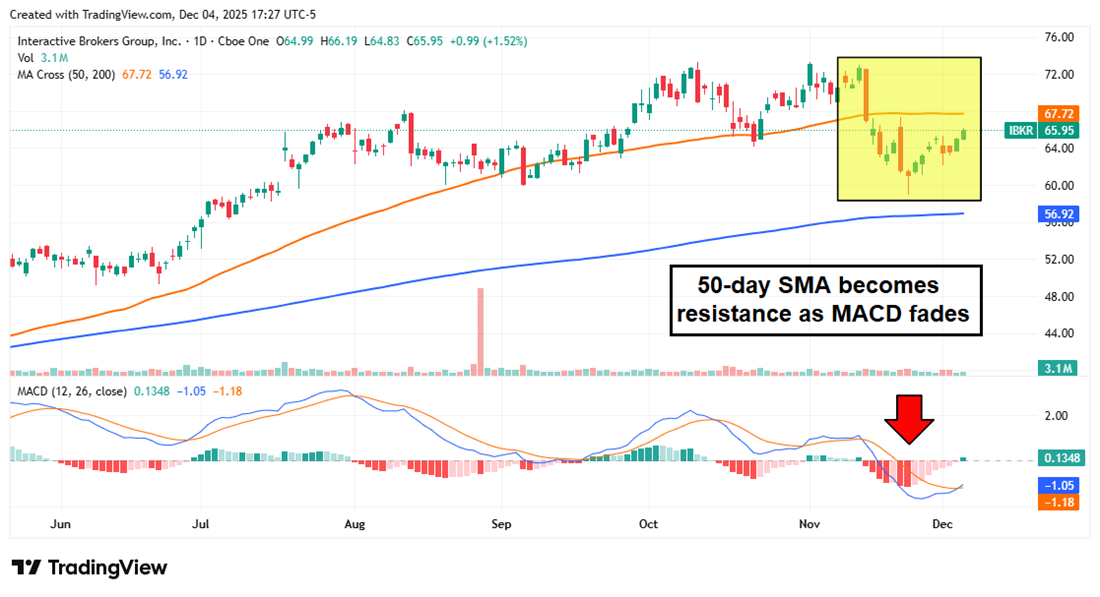
IBKR shares also recently broke below a key technical level, leaving investors on edge. The 50-day simple moving average (SMA) has been a fortress of support for most of the year, offering a liferaft to the stock whenever its head dipped under water. But if the liferaft still exists, it’s losing air quickly.
IBKR sank below the 50-day SMA last month, and the Moving Average Convergence Divergence (MACD) shows momentum fading faster than a winter sunset. Lower rates would likely be a boon to the firm’s trading operations, but the loss of interest income from deposits, loans, and securities lending could make it tough to square the earnings puzzle.
Raymond James Financial: Lending Weakness Could Expose Risks
Interactive Brokers Group Today
IBKRInteractive Brokers Group
$86.18 -0.90 (-1.03%) As of 04:00 PM Eastern
- 52-Week Range
- $58.95
▼
$98.75 - Dividend Yield
- 0.41%
- P/E Ratio
- 34.47
- Price Target
- $98.90
The primary headwind for Raymond James Financial NYSE: RJF is its exposure to credit risks in regional mortgage markets.
Rising credit stress in these areas could squeeze RJF’s profitability through excess provisions, especially given the company's higher-than-average operating leverage.
Additionally, rate cuts are taking a chunk out of RJF’s Private Client income, which caused a 4% drag in fiscal Q4 2025, according to management.
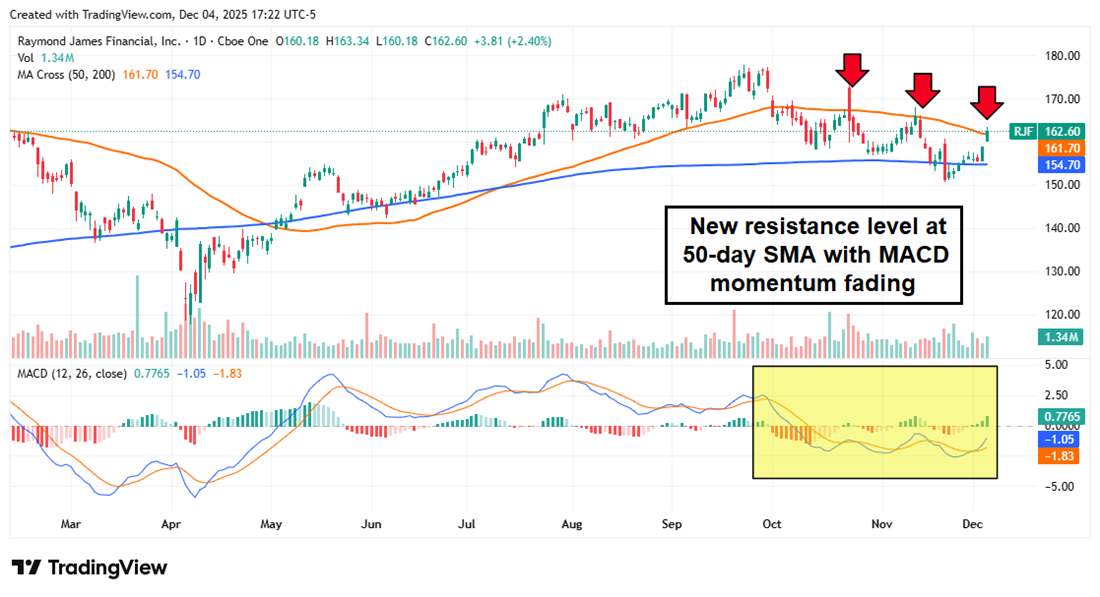
From a technical standpoint, the stock has failed to reclaim its 50-day SMA on three separate occasions, a bearish signal. The MACD has deteriorated with each rejection, suggesting declining momentum. If the stock fails to hold its current position, investors may want to reconsider their exposure.
MetLife: Insurers Bracing for Low Rate Environment
MetLife Today
$95.25 -0.57 (-0.59%) As of 03:59 PM Eastern
This is a fair market value price provided by Massive. Learn more. - 52-Week Range
- $67.33
▼
$100.93 - Dividend Yield
- 2.49%
- P/E Ratio
- 18.25
- Price Target
- $104.31
One thing a life insurer provider doesn’t want to hear is that rates are going down.
MetLife Inc. NYSE: MET is one of the largest insurers in the country, offering life, retirement, and group products.
Life insurance and annuity providers need a steady rate environment, since so much of their investment income is generated from fixed-income portfolios.
MetLife may already be experiencing this slowdown in investment income, as its Q3 2025 revenue massively missed expectations, dropping nearly 7% year-over-year.
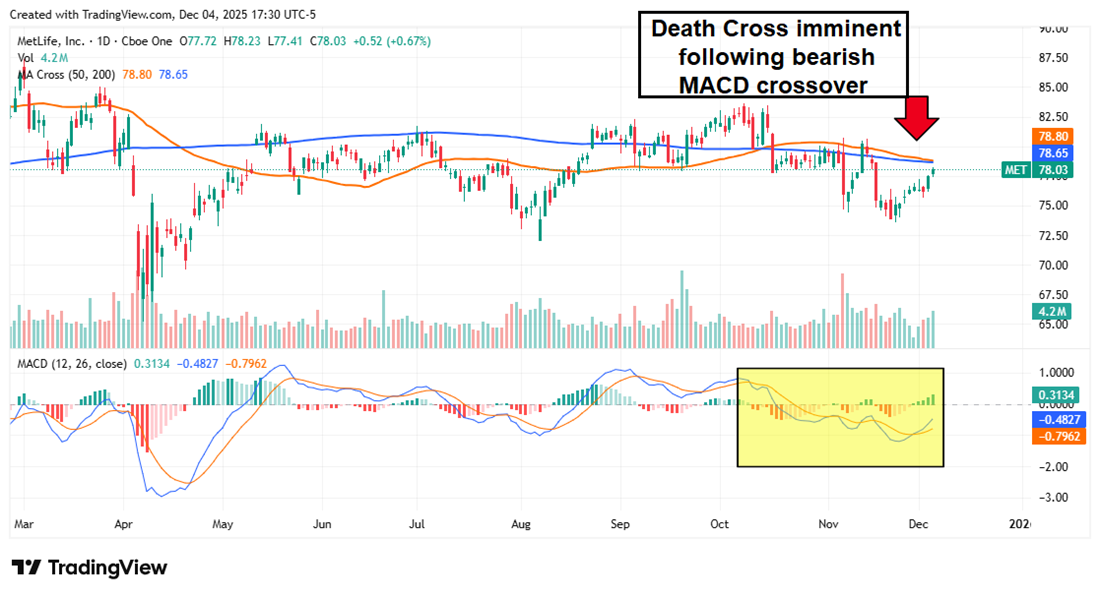
MET shares aren’t at a crossroad; they’re hanging off a precipice. After several months of range-bound trading, the stock’s momentum is tilting downward with few positive technical signals in place. Not only does the 200-day SMA appear to be the newest resistance level, but another rejection will likely create a Death Cross pattern, a signal that brings out bears faster than honey on porkroll. Unless fundamental factors improve, MetLife stock is likely to continue its descent.
Before you consider MetLife, you'll want to hear this.
MarketBeat keeps track of Wall Street's top-rated and best performing research analysts and the stocks they recommend to their clients on a daily basis. MarketBeat has identified the five stocks that top analysts are quietly whispering to their clients to buy now before the broader market catches on... and MetLife wasn't on the list.
While MetLife currently has a Buy rating among analysts, top-rated analysts believe these five stocks are better buys.
View The Five Stocks Here
Discover the next wave of investment opportunities with our report, 7 Stocks That Will Be Magnificent in 2026. Explore companies poised to replicate the growth, innovation, and value creation of the tech giants dominating today's markets.
Get This Free Report
Continue following MarketBeat
Add MarketBeat as your preferred source on Google to see our latest stories in your feed.
