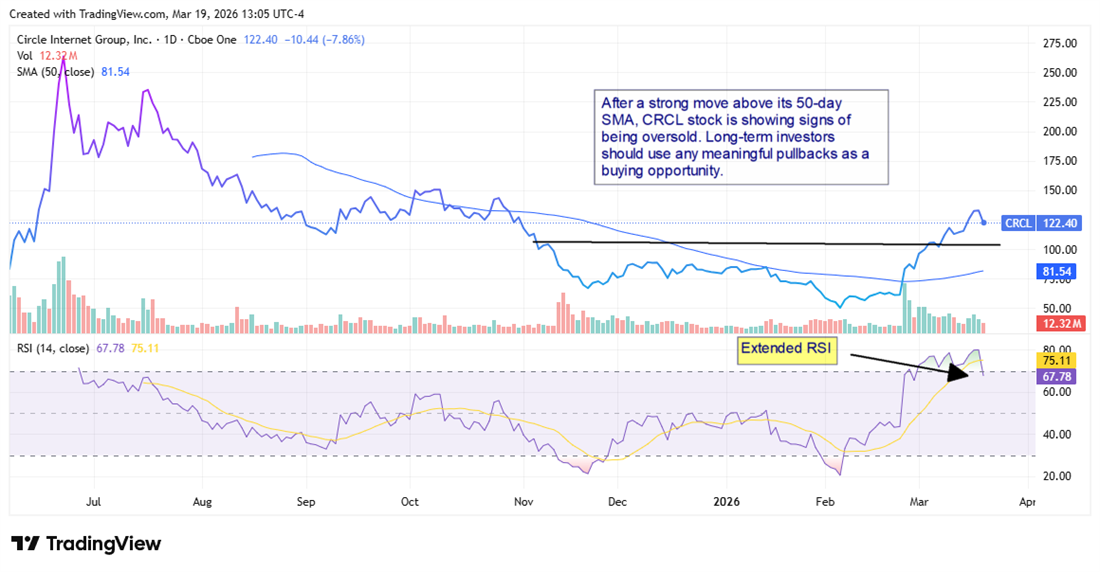
Circle Internet Group NYSE: CRCL went public on June 5, 2025. The stock was initially priced at $31 per share, nearly tripled on its first trading day, and climbed to nearly $299 by June 23.
Circle Internet Group Today
CRCL
Circle Internet Group
$80.18 -0.66 (-0.82%) As of 02:26 PM Eastern
This is a fair market value price provided by Massive. Learn more. - 52-Week Range
- $49.90
▼
$159.47 - P/E Ratio
- 54.52
- Price Target
- $97.82
Since that point, things got rough for investors who chased it higher. By the end of February 2026, the stock hit a low of around $50. That’s a heavy bag to carry for investors who bought near the top.
But Circle has been a market winner at a time when those have been hard to find. The reason is about how the regulatory architecture of American finance has been quietly redrawn. And Circle is one of the foundational pieces of that change.
This is a story about an act of Congressional legislation, the GENIUS Act, that may live up to its name.
Circle Internet Group Is Not a Traditional Finance Stock
Before getting into the GENIUS Act, it’s important to understand Circle’s business, which is very different from other finance stocks. The fintech company issues digital dollars—more accurately, stablecoins called USDC, that move on public blockchains. Every USDC token is backed one-for-one by cash and short-term U.S. Treasury bills. The reserve fund is managed by BlackRock NYSE: BLK.
Users can redeem USDC for actual dollars at any time. What makes it different from a bank account is the payment rail it moves on, specifically the blockchain. Blockchain settlement allows transactions to be made 24 hours a day, 365 days a year. There are no correspondent banks, no cut-off times, and no three-day ACH delays.
Circle also issues EURC, a euro-backed equivalent. But for this article, USDC is the product that matters. As of this writing, over $75 billion of USDC is in circulation. The company has processed over $6 trillion in adjusted transaction volume across more than one billion transactions.
How the GENIUS Act Changed Everything
The conventional narrative in crypto circles was that the GENIUS Act, passed in the summer of 2025, would be bullish across the board. Regulatory clarity equals institutional adoption equals higher prices for everything digital. The reality was more surgical. What the GENIUS Act actually did was define exactly what a stablecoin is, who can issue one, and under what conditions. It required 100% reserves in high-quality liquid assets, mandated regular disclosures, and established federal oversight. It also drew a line that decentralized assets like Bitcoin are structurally incapable of crossing: an identifiable, regulated issuer.
The practical effect was to formalize a two-tier digital money system. Compliant, reserve-backed stablecoins—led by USDC—became legally recognized payment instruments. Everything else, including Bitcoin (BTC), remained in a separate and murkier category. By January 2026, President Trump had signed an executive order banning federal agencies from issuing or endorsing a central bank digital currency. Congress followed with legislation proposing to make that prohibition permanent through at least 2030. The government didn't just step aside from building a digital dollar. It banned itself from doing so—and handed the lane to Circle.
Bitcoin’s Quiet Problem
This is where the analysis gets uncomfortable for Bitcoin holders. The bull case for Bitcoin has always rested on several pillars: digital scarcity, decentralization, censorship resistance, and, crucially, its role as a global 24/7 payment rail that bypasses traditional banking infrastructure. That last pillar is under pressure in a way that is not yet fully priced into the conversation.
The data is striking. Since the GENIUS Act passed, stablecoins have accounted for 93.2% of all transaction volume on public blockchains. Monthly stablecoin transaction counts have reached record highs, while Bitcoin transaction counts have declined more than 20% over the same period. If someone wants to move dollars across borders instantly without a bank, they no longer need Bitcoin to do so. USDC does the same job, faster, cheaper, and with a stable value.
To be clear, this is not a call for Bitcoin's demise. The digital scarcity and store-of-value arguments remain intact, and nation-state adoption as a reserve asset is a different category entirely. But losing even one leg of the investment thesis creates real pressure, and options markets' pricing equal odds of $70,000 and $130,000 for Bitcoin by June 2026 suggest the market has no consensus on what the asset is actually worth in this new environment
What the Bull Case Actually Requires
Circle Internet Group Stock Forecast Today
12-Month Stock Price Forecast:$97.8222.01% UpsideHoldBased on 24 Analyst Ratings | Current Price | $80.18 |
|---|
| High Forecast | $150.00 |
|---|
| Average Forecast | $97.82 |
|---|
| Low Forecast | $37.00 |
|---|
Circle Internet Group Stock Forecast DetailsThe case for CRCL at current prices requires several things to be true simultaneously:
- USDC circulation continues to grow at a 40% annual rate.
- Federal Reserve interest rates remain elevated long enough for reserve income to compound.
- Circle's Circle Payment Network generates meaningful transaction fee revenue to cushion against eventual rate cuts.
- The Coinbase revenue-sharing arrangement doesn't become more punitive as the relationship evolves.
What Circle has built is something historically rare: private financial infrastructure that the U.S. government has explicitly chosen not to compete with, embedded in the payment rails of Visa NYSE: V, Mastercard NYSE: MA, and Intuit NASDAQ: INTU, operating with BlackRock managing its reserves and BNY Mellon holding its custody. The moat is institutional trust, regulatory alignment, and network effects—not the technology itself, which any well-capitalized entity could replicate. The question is not whether Circle survives. It's whether the market is currently pricing in all the good news already.
The chart says: probably. The thesis says: possibly not yet. Like any good story, that tension is exactly what makes it worth watching.
Before you consider Circle Internet Group, you'll want to hear this.
MarketBeat keeps track of Wall Street's top-rated and best performing research analysts and the stocks they recommend to their clients on a daily basis. MarketBeat has identified the five stocks that top analysts are quietly whispering to their clients to buy now before the broader market catches on... and Circle Internet Group wasn't on the list.
While Circle Internet Group currently has a Hold rating among analysts, top-rated analysts believe these five stocks are better buys.
View The Five Stocks Here
The AI wave will soon hit public markets with Anthropic and OpenAI set to go public later this year. However, you don't have to wait to invest. This report shows seven AI stocks that you can buy today while the big model providers get ready to go public.
Get This Free Report
Continue following MarketBeat
Add MarketBeat as your preferred source on Google to see our latest stories in your feed.
