Microsoft Corporation NASDAQ: MSFT turned heads at its Build 2026 conference in June by introducing an ambitious platform vision. Specifically, the company is reframing Copilot as a multi-layered agentic system spanning productivity, development tools, and enterprise knowledge.
Microsoft Today
$516.91 +18.98 (+3.81%) As of 02:50 PM Eastern
This is a fair market value price provided by Massive. Learn more. - 52-Week Range
- $349.20
▼
$553.72 - Dividend Yield
- 0.70%
- P/E Ratio
- 28.82
- Price Target
- $569.29
Analysts have been waiting for Microsoft to map out a vision for Copilot beyond a chatbot in its productivity suite. But the initial reaction from investors is skepticism. MSFT is down almost 10% since the conference, and the stock is in the same general downtrend that’s been in place since October 2025.
There isn’t one single reason for the stock’s slide. But Copilot is part of it. When Microsoft reported Q3 fiscal year 2026 (FY2026) earnings on April 29, the company disclosed that paid Microsoft 365 Copilot seats had crossed 20 million. That was up from 15 million just one quarter earlier.
The stock still fell. Investors aren't waiting for more features. They want proof that the company’s record capital expenditure, now projected at $190 billion for FY2026, is translating into durable revenue. Build 2026 gave them investors a calendar to follow. Here are the three dates that will tell them whether it's working.
Date #1: Q4 FY2026 Earnings (July 29, 2026)
CFO Amy Hood was explicit on the Q3 call: Copilot seat growth will accelerate again in the September quarter, and GitHub is where management expects revenue growth rates and consumption models to produce visible top-line acceleration.
Microsoft is expected to deliver Q3 FY2026 earnings on July 29. The number worth watching is average revenue per user (ARPU) in M365 Commercial Cloud. Microsoft 365 Copilot has driven ARPU higher through E5 seat upsells, but that lever has limits.
If usage credits, which are the consumption layer on top of seats, begin contributing meaningfully to ARPU in Q4, it signals that the agentic model is monetizing on schedule. If ARPU is flat despite continued seat adds, the consumption thesis has not yet proven itself.
Investors will also want to watch for any agent-specific revenue disclosure. Management has not yet separated Copilot Studio or agent-workflow revenue in public guidance. An initial breakout would be a significant signal.
Date #2: Microsoft Ignite, November 17–20, 2026
Ignite is where Microsoft's enterprise product announcements get priced and deployed. Build tells developers what the platform is becoming. Ignite tells IT departments and their procurement teams what it will cost and when it ships. For investors, three specific disclosures would move the thesis:
Frontier Tuning GA date and pricing. Private preview at Build means enterprise sales teams can't close deals on it yet. A GA announcement at Ignite, with pricing, converts pipeline into bookings.
Copilot Studio agent billing structure. Agents built in Copilot Studio currently consume message credits. How Microsoft evolves this toward outcome-based or consumption pricing will determine margin structure for the agentic layer.
Microsoft IQ enterprise tier pricing. Work IQ, Fabric IQ, and Web IQ are live, but large enterprises will need defined pricing tiers and data residency commitments before deploying at scale.
Historically, Ignite has produced the most impactful enterprise pricing news Microsoft releases all year. In an agentic AI cycle, 2026's conference may be the most consequential since the original M365 Copilot launch.
Date #3: Q1 FY2027 Earnings (~October 2026)
This is the first earnings report in which Build 2026 features could meaningfully register in revenue. The September quarter (ending Sept. 30, 2026) will include a full quarter of Microsoft IQ's general availability. More importantly, it will be the first quarter where Copilot seat acceleration is reported rather than guided.
Analyst forecasts have agentic AI revenue exceeding Copilot assistant revenue by Q2 FY2027. Q1 FY2027 earnings will be the first test of that prediction. If consumption revenue is beginning to separate from seat-based M365 Copilot revenue in the disclosures, the structural shift is underway. GitHub Copilot's revenue line will also be worth watching because management specifically named it as a leading indicator.
The Risk That Doesn't Go Away
Even if Microsoft meets all those milestones, the company’s CapEx trajectory may be an unavoidable counterweight to the Copilot platform story. At $190 billion for FY2026, the company has committed to infrastructure at a scale that requires durable AI revenue.
The Noise May Be an Opportunity
Like many technology stocks, MSFT is down as investors begin to rethink their exposure to tech for a variety of reasons. Most of those reasons are likely just noise. These calendar dates are tangible benchmarks for investors to consider.
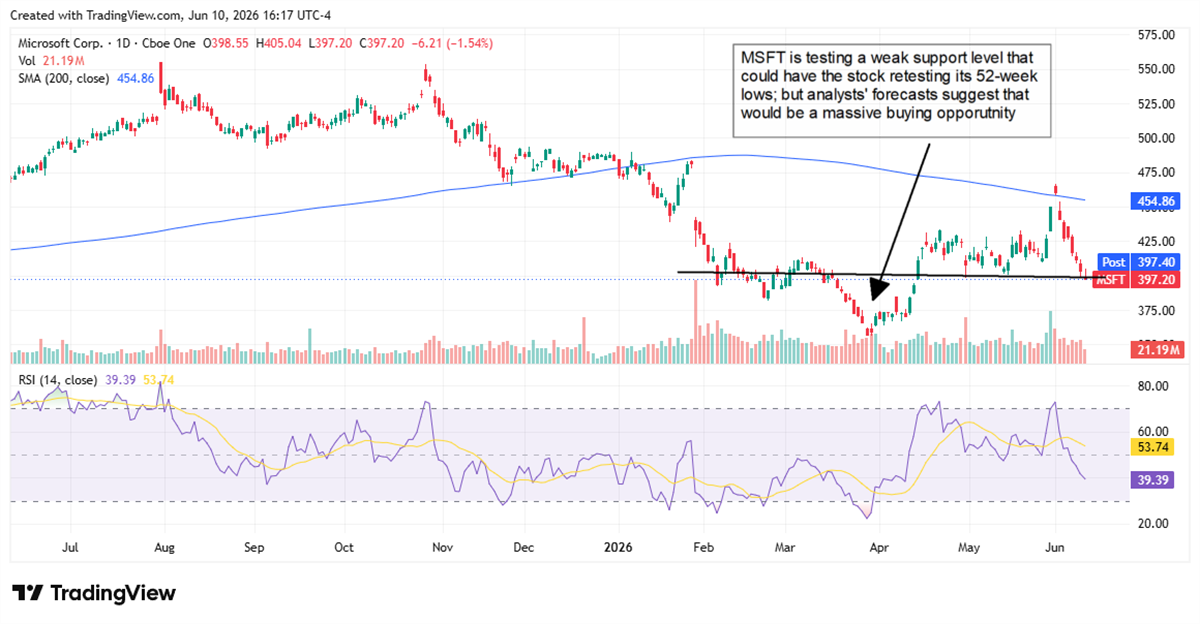
That said, the short-term bad news is that MSFT could test its 52-week low as selling pressure increases. The good news is that, because the current sell-off is sector-driven and not isolated to Microsoft, there's a strong possibility of a bullish correction. The stock is trading over 41% below its consensus price target of $561.20. If the stock were to hit that level, it would mark a new all-time high.
Before you consider Microsoft, you'll want to hear this.
MarketBeat keeps track of Wall Street's top-rated and best performing research analysts and the stocks they recommend to their clients on a daily basis. MarketBeat has identified the five stocks that top analysts are quietly whispering to their clients to buy now before the broader market catches on... and Microsoft wasn't on the list.
While Microsoft currently has a Moderate Buy rating among analysts, top-rated analysts believe these five stocks are better buys.
View The Five Stocks Here
MarketBeat just released its list of the 7 hottest IPOs expected to hit Wall Street in 2026. See which companies are preparing to go public and why investors are watching closely.
Get This Free Report
Continue following MarketBeat
Add MarketBeat as your preferred source on Google to see our latest stories in your feed.
Like this article? Share it with a colleague.
Link copied to clipboard.
