Microsoft Today
$516.17 +18.24 (+3.66%) As of 09/25/2026 04:00 PM Eastern
- 52-Week Range
- $349.20
▼
$553.72 - Dividend Yield
- 0.76%
- P/E Ratio
- 28.74
- Price Target
- $569.29
Microsoft Corp. NASDAQ: MSFT just launched its first AI superfactory—an advanced infrastructure initiative with the potential to reshape the future of artificial intelligence and cloud computing.
This isn’t one gigantic data center as the name might imply. Instead, the superfactory is a network of many sites working together.
In this case, Microsoft is connecting a site in Wisconsin with a site in Atlanta.
The resulting “AI superfactory” will accelerate the training of new AI models at scale.
The Next Evolution of Data Centers
Think of a data center as a single classroom where students are working together on a problem. The superfactory turns that model into a school-wide collaboration—multiple classrooms working together on a shared, complex assignment, continuously exchanging information to move faster and solve more complex challenges.
This collaborative approach dramatically improves efficiency, allowing Microsoft to train larger, more complex AI models faster and more cost-effectively than with isolated data centers.
The AI superfactory is the next evolution of data centers—shifting the model from hyperscaled training networks to “hyper-distributed” training networks.
Positioning for a Quantum Future
Microsoft is still in the early stages of deploying the hundreds of billions of dollars it's earmarked for AI infrastructure. It may seem strange that the company has pivoted to hyper-distributed networks so early in the game, but it's a calculated move that addresses key limitations of current systems.
Why is a hyper-distributed data center model needed? There are several reasons, including the size of the frontier model, GPU shortages, power constraints, network limitations, and the physics of single-site scaling.
At classical data centers, AI is being asked to solve increasingly complex issues in areas such as chemistry, optimization, and physics.
The superfactory architecture is a way of pushing classical computing as far as it can go before quantum computing reaches full scalability. Rather than being a replacement, the superfactory will act as a bridge to the quantum era, positioning Microsoft for success once quantum technology matures.
Driving CAPEX Efficiency and Performance
One of Microsoft's biggest challenges is making sure every dollar of data center investment delivers maximum value. A single-site data center is limited by physical space, power, and cooling, meaning that some expensive hardware is being underutilized.
Microsoft MarketRank™ Stock Analysis
- Overall MarketRank™
- 97th Percentile
- Analyst Rating
- Moderate Buy
- Upside/Downside
- 10.3% Upside
- Short Interest Level
- Healthy
- Dividend Strength
- Strong
- News Sentiment
- 0.76

- Insider Trading
- Selling Shares
- Proj. Earnings Growth
- 18.40%
See Full AnalysisThe superfactory solves this problem by linking multiple data centers into one coordinated network. Having GPUs working on the same AI job together across sites minimizes idle time and keeps the massive infrastructure running at peak efficiency.
In practical terms, Microsoft can train larger, more sophisticated AI models without needing to scale linearly with each new project. Every dollar spent on hardware, power, and cooling yields more compute output per unit of capital expenditure (CAPEX) than ever before.
For investors, this represents a significant competitive advantage.
Companies that can extract more performance from each data center dollar reduce long-term costs while maintaining the ability to train frontier AI models that drive future revenue.
By implementing the superfactory model, Microsoft can keep costs low while expanding its infrastructure, which can translate into higher margins and potentially stronger earnings growth.
Technical Weakness Could Present a Buying Opportunity
MSFT stock is trending towards its 200-day simple moving average (SMA). This isn’t exclusive to Microsoft; many other tech stocks have fallen near this critical benchmark. Investors should note that the MACD line has accelerated its bearish momentum recently, raising short-term caution signals.
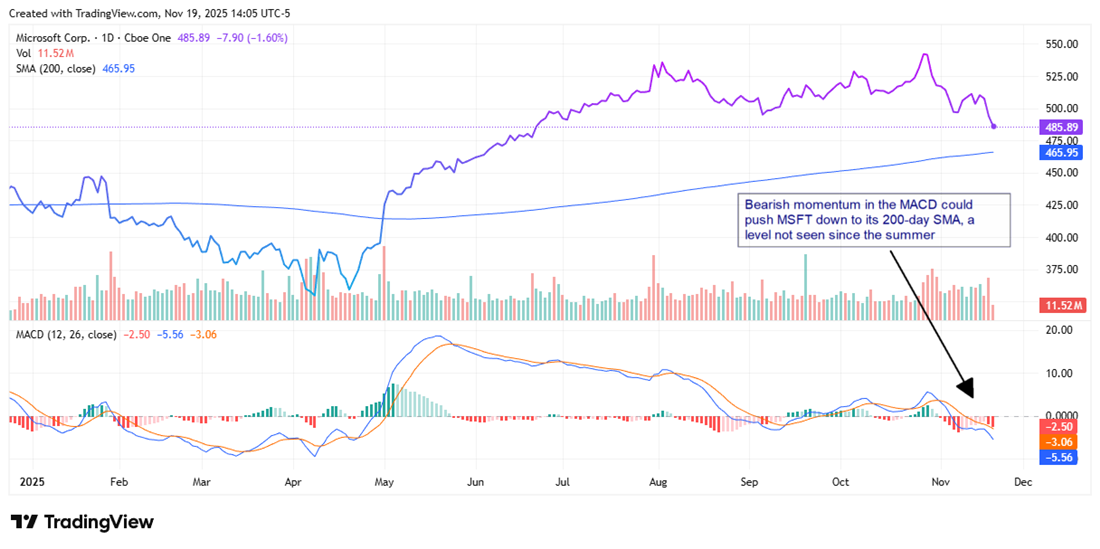
How low can MSFT stock go? It’s foolish to try to time it. But if you’re holding the stock, this may be a time to consider adding to your position. While some analysts have been downgrading the stock and/or lowering their price targets, those are in the minority.
Microsoft Stock Forecast Today
12-Month Stock Price Forecast:$569.2910.29% UpsideModerate BuyBased on 48 Analyst Ratings | Current Price | $516.17 |
|---|
| High Forecast | $870.00 |
|---|
| Average Forecast | $569.29 |
|---|
| Low Forecast | $430.00 |
|---|
Microsoft Stock Forecast DetailsThe consensus analyst price for Microsoft is $634.33, representing a gain of over 30% from its current level. Additionally, as recently as Nov. 19, analysts from JPMorgan Chase and the Royal Bank of Canada reiterated their Buy ratings on MSFT stock.
At 34 times earnings, Microsoft is trading at a slight premium to its historical average. The key question is whether this valuation is justified by expected 12% earnings growth over the next year.
The AI suferfactory may hold the answer. If the technology does what it’s expected to do, earnings estimates may be too low, and MSFT stock could be undervalued at current prices.
Before you consider Microsoft, you'll want to hear this.
MarketBeat keeps track of Wall Street's top-rated and best performing research analysts and the stocks they recommend to their clients on a daily basis. MarketBeat has identified the five stocks that top analysts are quietly whispering to their clients to buy now before the broader market catches on... and Microsoft wasn't on the list.
While Microsoft currently has a Moderate Buy rating among analysts, top-rated analysts believe these five stocks are better buys.
View The Five Stocks Here
Discover the 10 Best High-Yield Dividend Stocks for 2026 and secure reliable income in uncertain markets. Download the report now to identify top dividend payers and avoid common yield traps.
Get This Free Report
Continue following MarketBeat
Add MarketBeat as your preferred source on Google to see our latest stories in your feed.
