At GTC Taipei in late May, NVIDIA NASDAQ: NVDA unveiled the RTX Spark, a single "superchip" combining its Blackwell RTX graphics, Arm CPU cores, and an NPU, delivering roughly a petaflop of AI compute and up to 128GB of unified memory in a thin laptop or compact desktop. It's NVIDIA's first real push into the personal-computer silicon market, and the message the market should heed is bigger than the chip itself: AI is the future, and NVIDIA intends to command every layer of it—the data center, the edge, the PC, and the Internet of Things.
NVIDIA Today
$205.10 -13.56 (-6.20%) As of 04:00 PM Eastern
- 52-Week Range
- $140.85
▼
$236.54 - Dividend Yield
- 0.49%
- P/E Ratio
- 31.41
- Price Target
- $305.67
Already the source of AI power and infrastructure, NVIDIA is moving to enter the PC market, challenging competitors like Intel NASDAQ: INTC and Advanced Micro Devices NASDAQ: AMD, which collectively command 100% of the market. The primary advantage the RTX Spark offers is its petaflop of AI computing power and unified memory, which are suitable for running a wide range of agentic apps locally.
NVIDIA’s revenue outlook, which is robust and improving by the quarter, just got another supercharge. Valued at roughly $50 billion annually, the PC market could be disrupted by NVIDIA immediately upon the launch of the RTX Spark. The chip will be featured in a wide range of OEM products, including desktops and laptops, but there is a hurdle for adoption. The units are expected to command premium pricing, so adoption may be slow to start, especially among consumers.
Looking at the RTX Spark in the bigger picture, it aligns with NVIDIA’s strategy. The company is investing in AI across the stack, capitalizing on the revolution while ensuring future business. Recent moves include an investment in Marvell Technology NASDAQ: MRVL, which includes a silicon-photonics collaboration—one of several photonics bets NVIDIA has placed alongside Lumentum NASDAQ: LITE, Coherent NYSE: COHR, and Corning NYSE: GLW. NVIDIA is effectively securing its future while dictating it, betting on optical technology to solve numerous data-movement bottlenecks and on the edge as the endgame. Devices utilizing the RTX Spark will be transformed from machines into assistants, collaborators, and sidekicks.
NVIDIA Signals Upgrade Cycle Begins
A global semiconductor supercycle is underway, and RTX Spark will accelerate it. The cycle is underpinned by low inventory, high demand across segments, and the rise of AI. AI powers the IoT, and the IoT needs sensors, security modules, microcontrollers, and connectivity solutions.
The RTX Spark says the transition is not only gaining momentum but also broadening to include consumers, who account for nearly 50% of all IoT devices and traffic. In terms of revenue, the IoT opportunity presented by RTX Spark is worth approximately $750 million today and is expected to grow at a modest double-digit compound annual growth rate for the foreseeable future.
Analysts are responding favorably to the news, having issued numerous price target revisions and rating updates since the release. The takeaway is that updates are strengthening the outlook for shares to move higher (as high as $500 according to the most bullish targets) within 12 months. As it stands, the 53 analysts tracked by MarketBeat continue to rate this stock as a consensus Buy, with a 94% Buy-side bias.
NVIDIA’s Upside Is All But Guaranteed: Triple-Digit Gains Are Easy
It will take time to achieve, but NVIDIA’s upside is all but assured. The only thing standing in its way is execution and the threat of disruption, but it is quietly controlling AI's evolution, so disruption is unlikely. Execution is also under wraps, leaving only time to stand in the way, and forecasts suggest a triple-digit gain is easily achievable. The stock trades at only 6X its 2035 forecast, compared to a 36X multiple at its historical high, suggesting a 500% price increase over the coming years. Assuming the forecasts are too low, as they have been for years, the value opportunity is greater.
The story less talked about is NVIDIA’s cash flow, the portion not being used for acquisitions and investments. AI and GPU strength is driving substantial margins and robust cash flow. The net result is billions in quarterly free cash flow and the capacity to accelerate capital returns, which is happening.
Management targets about 50% of free cash flow for dividends and share buybacks. The dividend is a token, intended to keep dividend-only funds and buy-and-hold investors interested, but reliable. The buybacks are more substantial and reduce the count quarterly. The likely outcome is that buybacks and dividend growth will persist in the coming years, providing incentives for ownership and leverage for investors.
Chart price action is mixed; NVIDIA’s stock advanced following the RTX Spark news but hit a near-term top aligning with recent highs. The move suggests consolidation and a potential price pullback, but a deep pullback may not be forthcoming.
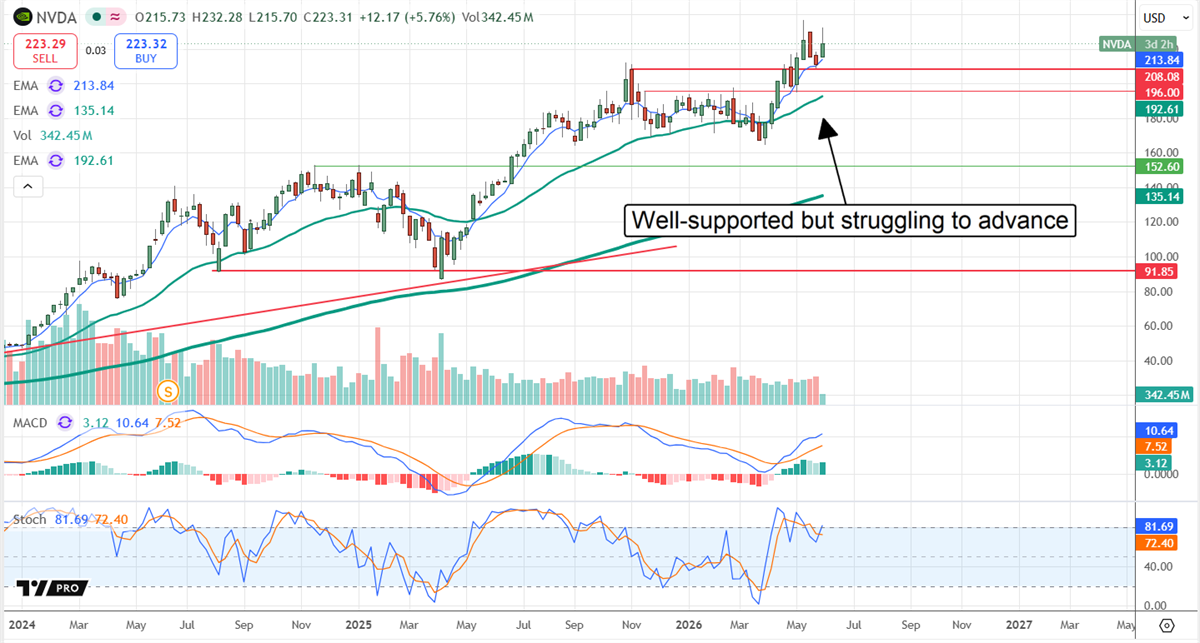
While upside is limited, this is a near-term phenomenon, with fundamentals and outlook improving, and technical support strengthening. Critical support is in the $195 to $210 range, coinciding with prior highs and closely watched moving averages.
Before you consider NVIDIA, you'll want to hear this.
MarketBeat keeps track of Wall Street's top-rated and best performing research analysts and the stocks they recommend to their clients on a daily basis. MarketBeat has identified the five stocks that top analysts are quietly whispering to their clients to buy now before the broader market catches on... and NVIDIA wasn't on the list.
While NVIDIA currently has a Buy rating among analysts, top-rated analysts believe these five stocks are better buys.
View The Five Stocks Here
The AI wave will soon hit public markets with Anthropic and OpenAI set to go public later this year. However, you don't have to wait to invest. This report shows seven AI stocks that you can buy today while the big model providers get ready to go public.
Get This Free Report
