After an 11th hour ceasefire framework was agreed upon by the United States and Iran on April 7, the slow reopening of the Strait for Hormuz sent oil prices plummeting. But the energy sector, which fell by nearly 5% last Wednesday, April 8, won’t be the only corner of the market to feel some pain if the ceasefire holds up and the war ultimately comes to a close.
iShares Defense Industrials Active ETF Today
IDEF
iShares Defense Industrials Active ETF
$30.44 -0.16 (-0.52%) As of 11:19 AM Eastern
This is a fair market value price provided by Massive. Learn more. - 52-Week Range
- $28.54
▼
$36.88 - Dividend Yield
- 0.33%
- Assets Under Management
- $3.70 billion
Aerospace and defense stocks, which fall into the broader industrials sector, saw mixed performances in the wake of the ceasefire announcement. But looking under the hood, there are indications that Wall Street views them on uncertain footing after outperforming the market so far this year.
Such is the case for the iShares Defense Industrials Active ETF NASDAQ: IDEF, which launched on May 19, 2025. The fund, despite gaining nearly 3% on April 8 and posting a roughly 10% year-to-date gain, has seen an astronomical increase in short interest.
Short Interest Whipsawed Into Mid-March, Then Unwound Sharply
Leading up to the ceasefire framework, short interest in IDEF didn’t build steadily so much as lurch from minimal to extreme and back again.
After sitting near negligible levels in late February (19,156 shares sold short, about $687,000 in dollar terms), reported short interest exploded to 116,385,961 shares—roughly $4.03 billion sold short and an outsized percentage of the public float—by the next short-interest report on March 13. Short interest above 100% of float can seem to defy logic, but it can occur mechanically when borrowed shares are sold, purchased by new holders, and then re-lent and re-shorted multiple times.
But that spike proved fleeting: by the next report on March 31, short interest had collapsed to 711,576 shares (about $23.28 million), essentially unwinding the prior surge.
IDEF Short Interest Recent History
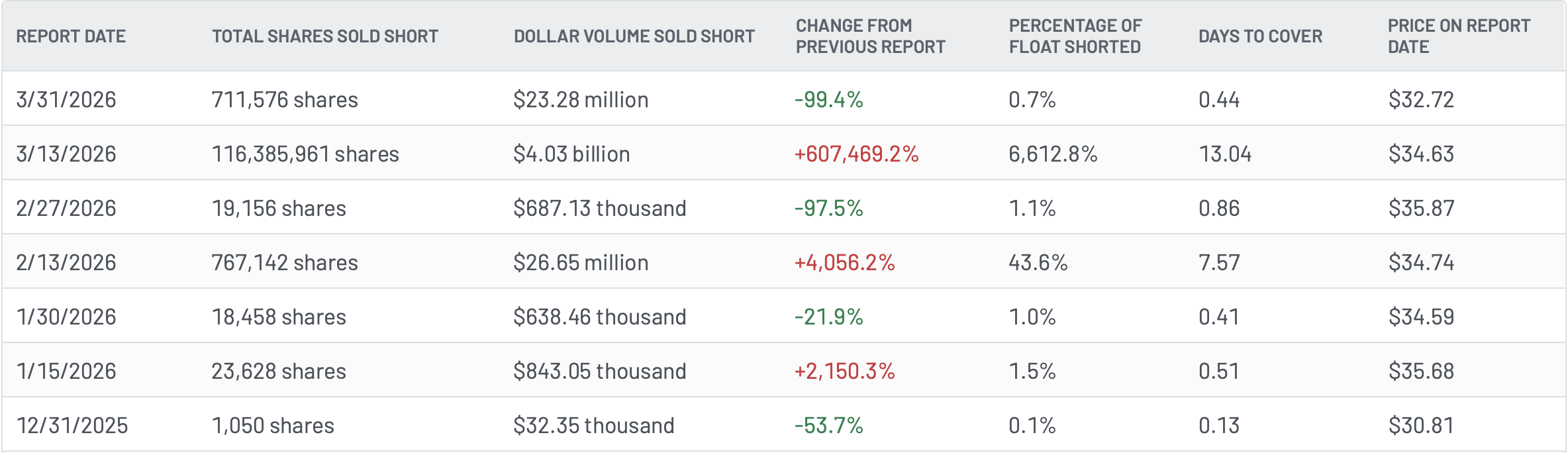
What matters here is the pattern: a sudden, extreme buildup followed by a rapid reversal, which reads like positioning that’s reacting to headline risk rather than a durable, single-direction bet. It also seems consistent with the broader unpredictability around the administration’s handling of the war, where sentiment can shift quickly and markets reprice just as fast.
Why the Bears Have Come for the iShares Defense Industrials Active ETF
First and foremost, investors have exhibited concerns about potential overvaluations for numerous holdings in the IDEF’s portfolio. After numerous holdings saw dramatic run-ups in price over the past few years, even the breakout of war in the Middle East wasn’t enough to reverse cautious, if not bearish, sentiment.
This is evidenced not only by the fund’s beta of 1.83—which makes it nearly twice as volatile as the broad market—but by the lofty valuations of some of its top holdings. That is particularly true of Palantir NASDAQ: PLTR, which has gained around 487% over the past five years. Now the stock, which is the fourth largest holding in the IDEF, currently sports a forward price-to-earnings (P/E) multiple of 482.17. That means investors are paying more than $482 for every $1 Palantir returns in the form of earnings.
Meanwhile, RTX NYSE: RTX—the ETF’s top holding with a more than 9% weighting—has gained more than 68% in the past year alone, though its forward P/E multiple of 33.21 pales in comparison to Palantir’s. Ditto for uranium producer Cameco NYSE: CCJ, which has gained nearly 214% over the past year, resulting in a forward P/E multiple of 91.48.
Beyond valuation concerns, investors have been engaging in sector-specific profit-taking when and where possible. Market uncertainty and heightened volatility this year have made the ability to lock in gains less predictable at best and fleeting at worst. The very geopolitical unrest that sparked rallies in many of the names in the IDEF’s portfolio have fallen victim to selloffs as investors look to capitalize on short-term momentum.
Lastly, because the large majority of passively managed funds outperform their actively managed counterparts, the latter can draw in higher short interest, specifically when they are thematic and operate in niche industries. The IDEF is both thematic and actively managed and, when combined with the aforementioned factors, a prime target for heightened short interest given present circumstances.
The Silver Lining for Buy-and-Hold Investors
iShares Defense Industrials Active ETF Dividend Payments
- Dividend Yield
- 0.33%
- Annual Dividend
- $0.10
- Recent Dividend Payment
- Jun. 18
IDEF Dividend HistoryWhile elevated short interest can introduce short-term volatility based on current sentiment, long-term, it is a less effective indicator. Keeping that in mind, the iShares Defense Industrials Active ETF currently holds an aggregate Moderate Buy rating based on 273 analyst ratings issued over the past year covering 15 companies in the fund’s portfolio.
For long-term investors, the IDEF’s modest dividend pays you to be patient. At its current yield of 0.15%, it pays five cents per share annually. While that isn’t enough to offset the fund’s expense ratio of 0.55%, decent potential upside could be in its future, especially if the U.S.-Iran ceasefire fails to end the war.
The ETF is currently testing overhead resistance around its 50-day simple moving average. If the IDEF is able to break above that level and establish it as support, it could challenge its 52-week high of $36.88—nearly 6% higher than current prices—later this spring. As a catalyst, defense contractors begin reporting earnings in late April.
Before you consider iShares Defense Industrials Active ETF, you'll want to hear this.
MarketBeat keeps track of Wall Street's top-rated and best performing research analysts and the stocks they recommend to their clients on a daily basis. MarketBeat has identified the five stocks that top analysts are quietly whispering to their clients to buy now before the broader market catches on... and iShares Defense Industrials Active ETF wasn't on the list.
While iShares Defense Industrials Active ETF currently has a Hold rating among analysts, top-rated analysts believe these five stocks are better buys.
View The Five Stocks Here
MarketBeat just released its list of the 7 hottest IPOs expected to hit Wall Street in 2026. See which companies are preparing to go public and why investors are watching closely.
Get This Free Report
Continue following MarketBeat
Add MarketBeat as your preferred source on Google to see our latest stories in your feed.
