Abivax Today
$92.38 +4.40 (+5.00%) As of 10/15/2026 04:00 PM Eastern
- 52-Week Range
- $69.81
▼
$148.83 - Price Target
- $156.69
Shares of Abivax NASDAQ: ABVX were up more than 40% in the month ending July 6, after the company announced positive results from its late-stage (Phase 3) trial of its lead candidate, Obefazimod, which is being designed as a long-term maintenance treatment for ulcerative colitis (UC). The rally pushed ABVX nearly to its all-time high of $146.41, set in December 2025.
The 40% move wasn't a single, straight-line reaction to the clinical trial results. Instead, it reflects two distinct catalysts hitting in succession.
The first catalyst was the Phase 3 results. The second was a $920 million share offering. In many cases, share offerings are sell-the-news moments because they dilute the value of current shares. However, in this case, Wall Street treated it as a vote of confidence rather than a red flag.
Abivax Passed an Important Test
Positive clinical trial results are important for the most established biotechnology companies. But when a company is still in the clinical stage (i.e., pre-revenue), these are make-or-break moments.
The results from Abivax's late-stage (Phase 3) trial showed that about half of patients on the drug (50.8% at the 25mg dose, 51.3% at the 50mg dose) achieved clinical remission, compared to just 10.4% on a placebo. That's roughly a 40-percentage-point advantage over placebo—a result several analysts called the best ever seen for a long-term UC treatment.
Despite those strong results, the stock dropped about 44% in a single day after the trial revealed a cancer-related safety signal among patients on the higher dose. Shares later recovered somewhat, settling in the $101–102 range—a swing that set up the case for using a call spread options strategy targeting July 2026.
The bullish argument is that the cancer scare is being overblown. Supporters point out that most of the reported cases were non-melanoma skin cancers (a less serious, more common form of skin cancer) occurring in older patients—the average age of those affected was notably higher than the trial's overall patient population. They also note that the reported colon cell changes (dysplasia) are consistent with what you'd expect from ulcerative colitis itself, not necessarily a drug side effect, and that trial investigators didn't attribute several of these cases to the drug at all.
That bull case got reinforced about four weeks later. On June 29, Abivax released a follow-up dataset (Part 2 of the same Phase 3 maintenance trial) covering a harder-to-treat patient population who hadn't responded to initial treatment or had relapsed. Alongside continued efficacy in that tougher group, the company pooled safety data across its full clinical program (1,704 patient-years of exposure) and reported that malignancy rates were within the range expected for UC patients generally, regardless of treatment.
Why Analysts Are Bullish About the Share Offering
It’s not uncommon for clinical-stage biotech companies to conduct share offerings. Unlike established companies, these companies don’t have cash reserves to fund the development and commercialization of new drugs. That’s precisely what Abivax plans to do with the funds from this share offering.
That said, it’s still uncommon for the announcement of a share offering to cause a stock to climb so sharply that it causes a pause in trading. Normally, the opposite is true.
The details tell the story. The announcement clearly notes that underwriters had fully exercised their option to purchase an additional 960,000 shares, upsizing the deal from 6.4 million to 7.36 million American Depositary Shares at $125 each.
Having the option fully exercised is typically a signal that institutional demand exceeded the company's initial offer. In effect, the sell side put real capital behind the bull case at the same time it was forming. That's the second, separate leg of this rally, distinct from the trial data that got the stock moving in the first place.
Understanding the Ulcerative Colitis Market
In the biotechnology space, total addressable market matters. Many investors can get tripped up chasing clinical-stage companies treating rare diseases. While this may give companies market exclusivity for a period of time, that advantage won’t matter much if the market isn’t large enough to move the needle on revenue and, more importantly, earnings.
Abivax’s lead candidate is in the ulcerative colitis market. This market is currently dominated by AbbVie NYSE: ABBV, which holds over 21% market share with drugs like Humira, Rinvoq, and Skyrizi. The company doesn’t break down revenue by indication, but the three drugs (which have indications for several other conditions, including Crohn’s Disease and psoriasis) combined delivered over $7 billion in Q1 2026.
Could Abivax Be an Acquisition Target?
Acquisitions are common in the biotech space. When a company like Abivax advances a drug deep into clinical trials, it can become a target for established biotech companies looking to add to their portfolios.
In fact, the decision to raise capital followed talks with potential buyers in mid-June when the company's market capitalization was about $7 billion. The decision to raise capital doesn’t mean Abivax won’t be acquired. However, it does relieve the possibility of a rushed deal.
That said, while estimates differ, Global Market Insights expects the total addressable market (TAM) of the UC market to reach $8.7 billion in 2026, then grow to $14.5 billion by 2035. That’s a compound annual growth rate (CAGR) of 5.8%.
What the Chart Says About Timing
Technically, ABVX is now trading back near the $148.83 all-time high it set in December 2025, after round-tripping through a violent V-shaped move: a spike down to roughly $70 in early June, a base built in the $100–$102 range, and a sharp reclaim of the prior trading channel that held between roughly $110 and $140 from November through May.
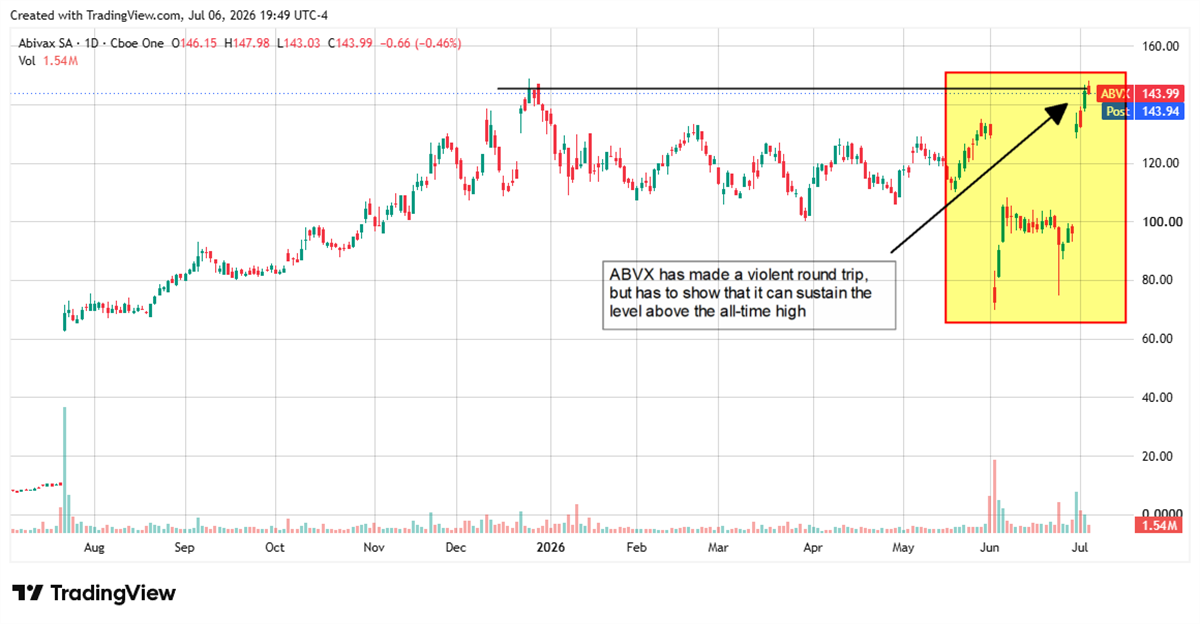
Shares have paused just under that all-time high, closing at $143.99 in the most recent session. That’s a level worth watching, since a decisive break above $146–$148 would put the stock into uncharted territory with no prior resistance to reference. However, a rejection there would put it back in a familiar consolidation zone investors have seen before.
The setup is clear, but the results require continued execution. As with any pre-revenue biotech name, the position size and time horizon an investor chooses should reflect the fact that binary regulatory outcomes, not just quarterly execution, will ultimately decide where this stock trades from here.
Before you consider Abivax, you'll want to hear this.
MarketBeat keeps track of Wall Street's top-rated and best performing research analysts and the stocks they recommend to their clients on a daily basis. MarketBeat has identified the five stocks that top analysts are quietly whispering to their clients to buy now before the broader market catches on... and Abivax wasn't on the list.
While Abivax currently has a Moderate Buy rating among analysts, top-rated analysts believe these five stocks are better buys.
View The Five Stocks Here
Discover the 10 Best High-Yield Dividend Stocks for 2026 and secure reliable income in uncertain markets. Download the report now to identify top dividend payers and avoid common yield traps.
Get This Free Report
Continue following MarketBeat
Add MarketBeat as your preferred source on Google to see our latest stories in your feed.
