Cardinal Health Today
CAH
Cardinal Health
$238.23 +0.66 (+0.28%) As of 10/12/2026 03:59 PM Eastern
This is a fair market value price provided by Massive. Learn more. - 52-Week Range
- $151.87
▼
$258.30 - Dividend Yield
- 0.86%
- P/E Ratio
- 32.95
- Price Target
- $266.56
Cardinal Health NYSE: CAH has been one of the best-performing stocks in one of the market’s best-performing sectors in 2026. Heading into the company’s fourth quarter earnings report for its 2026 fiscal year (FY), CAH was up more than 40% in the last 12 months. Despite mixed results, including a 2.2% revenue miss, the stock may soon reach a new 52-week high.
The only particular negative in the report came from the company’s Global Medical Products and Distribution (GMPD) unit. Revenue was down 2% year over year (YOY), and about 31 cents of its earnings were due to a one-time net benefit from IEEPA tariff refunds.
The company also said a number of factors could limit full-year profit for that business to the lower end of its FY2027 range.
CAH Was Priced for Perfection Before Earnings
CAH stock was up nearly 30% in the three months prior to the report. Institutional investors were doing the heavy lifting. In the quarter, institutions bought over $7.2 billion of the stock and only sold about $8 million. That contributed to the idea that Cardinal Health was priced for perfection.
That said, Cardinal Health was down from its 52-week high heading into earnings. The concern then—as it is now—was valuation. Many conventional metrics show that Cardinal Health is overvalued. That’s not new for the stock, and investors have made it clear so far that it isn’t a concern.
But is this a time for new money to get involved with CAH? To help answer that question, it’s important to understand Cardinal Health’s role in the healthcare sector. It shows why a stock that’s well known to income and value investors may also be a growth play for the rest of 2026 and beyond.
Cardinal Health’s Healthcare Supply Chain Role Supports Growth
Cardinal Health is a healthcare services and products company that sits at the middle of the healthcare supply chain, connecting patients, providers, payers, pharmacists, and manufacturers for integrated care coordination and better patient management. Cardinal Health is one of the "Big Three" U.S. drug distributors, alongside McKesson NYSE: MCK and Cencora NYSE: COR.
The company operates through two primary segments:
Pharmaceutical and Specialty Solutions: distributes branded and generic pharmaceutical, specialty pharmaceutical, and over-the-counter healthcare and consumer products. This is by far the largest segment of the business, generating $204.6 billion in revenue in fiscal 2025.
Global Medical Products and Distribution (GMPD): manufactures, sources, and allocates Cardinal Health–branded medical, surgical, and laboratory products, serving customers across the United States, Europe, Canada, Asia, and other international markets.
Cardinal Health Finds a High-Margin Niche in Gene Therapy
But there’s a third segment of the business to consider. The company’s NPHS, at-Home Solutions and OptiFreight business. This business unit delivered one of the headline takeaways from the report.
Cardinal has been a leader in handling the complex logistics of the cell-and-gene-therapy (CGT) business. The company announced that it secured two additional gene therapy commercialization agreements through its third-party logistics business.
With those wins, the company now exclusively serves nearly half of the cell and gene therapy market and about three-quarters of the total market. That market, while still relatively small, is a high-margin niche relative to the company’s core commodity drug distribution business. However, it’s expected to be a $106 billion market for Cardinal by 2033.
Analyst Price Targets and Dividend Growth Support CAH Stock
The Cardinal Health analyst forecasts on MarketBeat give CAH a consensus price target of $251.73. However, in late July, four analysts raised their price targets on the stock by 3% to 10% above the stock price as of this writing. That’s in addition to the gain of over 15% in 2026 and the gain of over 360% in the last five years.
Along with the stock price growth, CAH has rewarded buy-and-hold investors with a modest but growing dividend. Cardinal Health is a dividend aristocrat that has increased its dividend for 29 consecutive years.
CAH Holds Its Uptrend Despite Post-Earnings Pullback
When the market opened after Cardinal Health reported results, CAH hit a new all-time high of $258.30. Sellers quickly jumped in, perhaps led by the high-speed trading programs, and sent the stock lower. However, by the end of the session, CAH was up by about 1%.
CAH closed at $240.08 on Aug. 11, up $2.90, on a volume of 2.24 million shares, slightly above the average daily volume. The stock's 50-day simple moving average is $226.92 and has been rising steadily since May, with the price holding comfortably above it. That’s a sign the broader uptrend remains intact even after the post-earnings whipsaw.
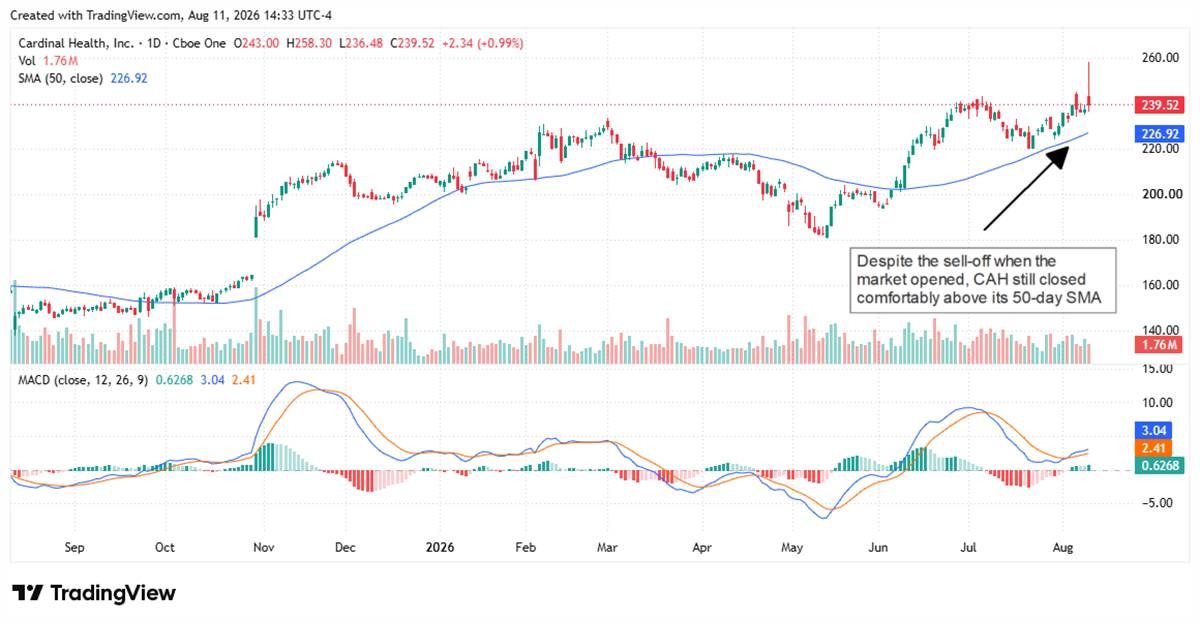
The MACD line reads 3.04, above its signal line at 2.41, with the histogram at 0.63—suggesting momentum has cooled from its July peak but remains net positive. In other words, the pullback from the all-time high looks more like profit-taking after a "priced for perfection" report than a trend reversal.
Before you consider Cardinal Health, you'll want to hear this.
MarketBeat keeps track of Wall Street's top-rated and best performing research analysts and the stocks they recommend to their clients on a daily basis. MarketBeat has identified the five stocks that top analysts are quietly whispering to their clients to buy now before the broader market catches on... and Cardinal Health wasn't on the list.
While Cardinal Health currently has a Moderate Buy rating among analysts, top-rated analysts believe these five stocks are better buys.
View The Five Stocks Here
Discover the next wave of investment opportunities with our report, 7 Stocks That Will Be Magnificent in 2026. Explore companies poised to replicate the growth, innovation, and value creation of the tech giants dominating today's markets.
Get This Free Report
Continue following MarketBeat
Add MarketBeat as your preferred source on Google to see our latest stories in your feed.
Like this article? Share it with a colleague.
Link copied to clipboard.
