Constellation Energy Today
CEG
Constellation Energy
$300.40 +32.78 (+12.25%) As of 04:00 PM Eastern
- 52-Week Range
- $228.63
▼
$412.70 - Dividend Yield
- 0.57%
- P/E Ratio
- 29.28
- Price Target
- $351.76
shares jumped on Tuesday, Oct. 6, after
Alphabet's NASDAQ: GOOGL Google signed
two long-term power deals with the nuclear operator. The first is a 20-year agreement for 890 megawatts of new nuclear capacity. The second is a separate 15-year deal for 2,700 megawatts from Constellation's existing plants. Combined, the deals total about 3,590 megawatts in PJM Interconnection, the largest U.S. power grid.
Most of the coverage will focus on Google. A hyperscaler with another nuclear deal and more proof that AI's power appetite is real. That's true, but for investors who have been paying attention to where capital is flowing, there's a more interesting part of the story.
That is where the new power comes from. In this case, Constellation isn't building a new reactor. It's upgrading 11 reactors that are already running in Illinois, Pennsylvania, and New Jersey.
That distinction says a lot about how the AI power race is changing, and ultimately, which companies may win. Speed matters more than scale.
It also changes how investors should approach CEG. The headline sounds like a one-time windfall. The fundamentals describe something slower and more disciplined: a capital project with a buyer that's locked in for two decades.
Constellation’s Shortcut to More Nuclear Power
An uprate squeezes more electricity out of a reactor that already exists. Think of it as a major tune-up rather than a new engine.
Engineers replace or improve key equipment so the plant can safely produce more power. In this deal, that means upgraded turbines, steam generators, and digital control systems across the 11 units.
The reactor itself is unchanged. The site, the cooling systems, the transmission connections, and the operating license are already in place. Constellation is adding output to plants that the grid already knows how to handle.
The AI Power Race Is Becoming a Speed Race
That last point is the most important part for investors to understand. A brand-new power plant faces more than construction. It has to wait in line to connect to the grid. In PJM, that interconnection queue can stretch on for years before a single megawatt flows.
Uprates are like a fast pass. The plant is already connected, so the extra output rides on existing infrastructure. Upgrading a plant typically takes far less time than building a new one.
Speed is still a relative term, but the first increment is expected by 2028, not sometime in the 2030s. For Google, which needs power for data centers now, speed is worth paying for.
The companies also framed the deal as a response to PJM's "bring your own power" proposal. The idea is that large new users should bring their own supply rather than lean on the shared grid. Uprates let Google do that without waiting a decade.
What Constellation Gets From the Google Deal
Here's where the headlines can be misleading. Some coverage calls this a "$4.3 billion deal." That figure is Constellation's own investment in the uprates. It is not what Google is paying, which wasn't disclosed.
Constellation Energy Stock Forecast Today
12-Month Stock Price Forecast:$351.7616.55% UpsideModerate BuyBased on 22 Analyst Ratings | Current Price | $301.80 |
|---|
| High Forecast | $441.00 |
|---|
| Average Forecast | $351.76 |
|---|
| Low Forecast | $277.00 |
|---|
Constellation Energy Stock Forecast DetailsSo what does Constellation get for spending more than $4.3 billion? Three things.
First, a committed buyer for 20 years. That removes much of the risk of spending billions on new capacity and hoping the market pays for it later.
Second, revenue certainty for plants already running. The 2,700-megawatt agreement isn't tied to a specific plant. It works as a long-term floor under the existing fleet.
Third, a repeatable playbook. Constellation has already tied uprates to deals with Meta Platforms NASDAQ: META, Amazon NASDAQ: AMZN, and the federal government.
That said, Google’s project is the biggest uprate commitment yet. However, each signed contract makes the next one easier to sell.
The Long Timeline Is the Biggest Catch
There are three key risks for investors to consider. Price is the biggest unknown. Without it, investors can't judge the return on $4.3 billion. After all, a 20-year contract is only as good as the rate behind it.
The payoff is also years away. The first increment arrives by 2028, and the rest will likely be staggered after that. That means near-term earnings won't change much. Meanwhile, Constellation must execute upgrades across 11 units, with construction costs and regulatory approvals as real risks.
Finally, some of this may already be priced into the stock. CEG has long been the market's favorite way to play AI power demand. Investors expected more hyperscaler deals. A deal arriving isn't the same as a surprise.
But here's the twist. Even after the post-announcement rally, CEG remained down double digits for 2026. The stock's performance reflected lingering questions about how durable hyperscaler demand for nuclear power would be. Google's 20-year commitment offers a strong answer to that concern.
CEG’s Rally Clears an Important Hurdle
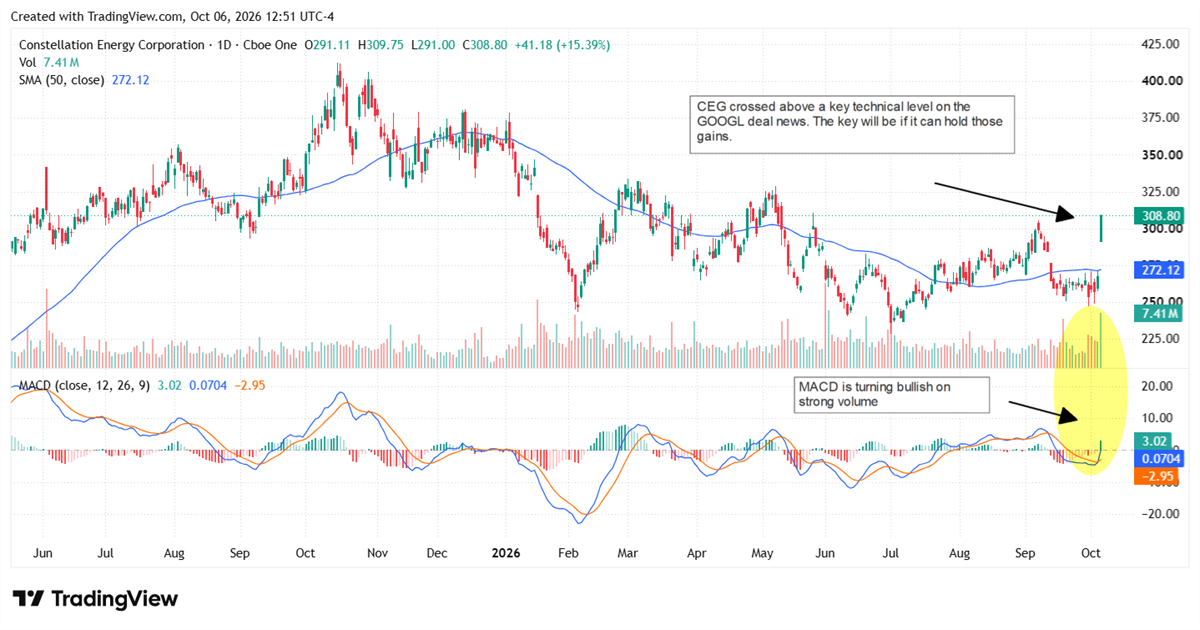
CEG gapped sharply higher after the announcement and climbed more than 15% at its session high. The stock held most of its opening gap, reinforcing the strength of the move.
The move cleared two levels at once. Shares had been stuck below the 50-day moving average, now near $272, since mid-September. They also topped the September high near $305. Volume of 7.4 million shares by midday was already the heaviest in months, which suggests real buying, not a thin drift higher.
Momentum is turning, too. The MACD line just crossed above its signal line, and the histogram flipped positive. That crossover is happening near the zero line, an early bullish signal rather than an exhausted one.
The next test is the $325 to $330 zone, where rallies stalled in March and May. On the downside, the $291 gap is the first support, with the 50-day near $272 below it. Keep the bigger picture in view: CEG has made lower highs since its peak above $400 last October. One strong day doesn't reverse that trend. Holding the gap would make the case that it has started to.
Is Constellation Energy Stock a Buy After the Google Deal?
The story isn't that Google wants nuclear power. Everyone knew that. The story is that Constellation found a way to deliver new nuclear megawatts this decade, using reactors it already owns.
The deal trades near-term excitement for long-term visibility. Traders buying the headline may be frustrated by the timeline. However, investors who read the structural details may find a more durable story.
Before you consider Constellation Energy, you'll want to hear this.
MarketBeat keeps track of Wall Street's top-rated and best performing research analysts and the stocks they recommend to their clients on a daily basis. MarketBeat has identified the five stocks that top analysts are quietly whispering to their clients to buy now before the broader market catches on... and Constellation Energy wasn't on the list.
While Constellation Energy currently has a Moderate Buy rating among analysts, top-rated analysts believe these five stocks are better buys.
View The Five Stocks Here
AI spending is reshaping the market, and the opportunity extends far beyond the biggest chipmakers. Discover 10 stocks set to benefit from powerful trends in AI infrastructure, cloud computing, energy, capital returns, and consumer growth this fall.
Get This Free Report
Continue following MarketBeat
Add MarketBeat as your preferred source on Google to see our latest stories in your feed.
