Dave & Buster's Entertainment Today
PLAY
Dave & Buster's Entertainment
$6.74 -0.01 (-0.07%) As of 01:36 PM Eastern
This is a fair market value price provided by Massive. Learn more. - 52-Week Range
- $6.26
▼
$22.10 - Price Target
- $17.33
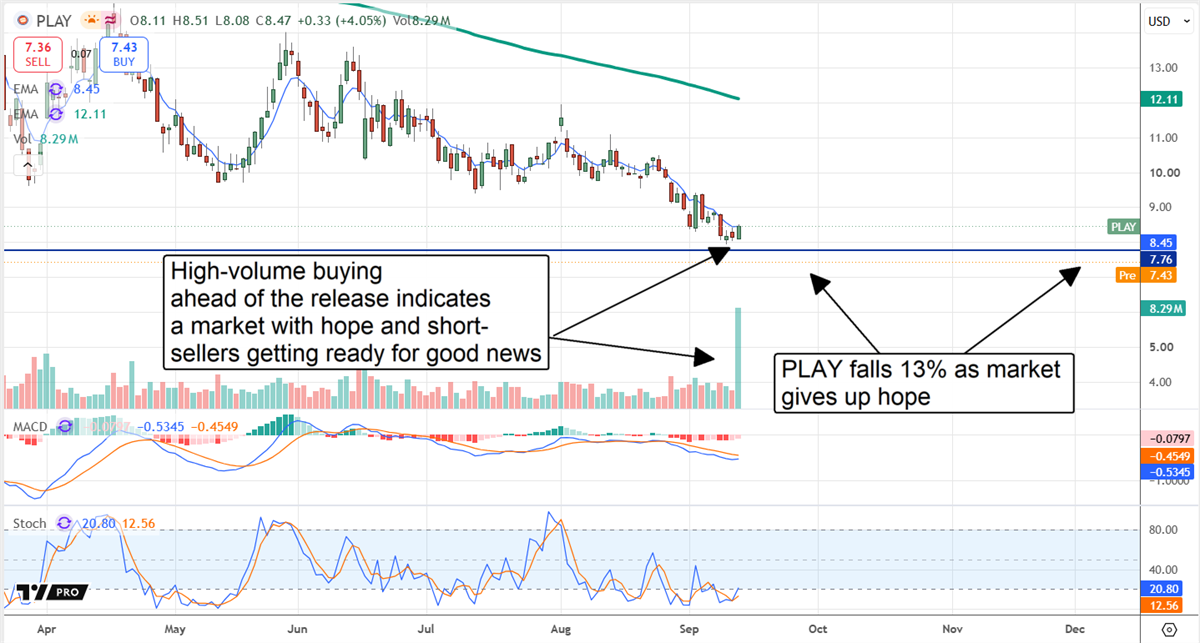
Dave & Buster’s NASDAQ: PLAY has its share of headwinds, but not to the degree its stock price action suggests. The mid-September plunge, triggered by weaker-than-expected Q2 results, pushed the stock to a record low, well below existing support and on track for what could be a monumental slide.
But the panic-selling and heavy volume behind the move have the hallmarks of market capitulation—the point at which investors give up hope and sell en masse, often marking the bottom of a downtrend rather than the start of a new one.
Put simply, stocks don't usually move lower when there's no one left to sell. The factors in play suggest this drop marks the end of PLAY's decline, not the beginning of a fresh down leg.
Back-to-Basics Strategy Progresses
While consumer headwinds affect traffic and costs continue to rise, the company is leaning hard into its Back-to-Basics strategy, and it is paying off. Remodeled and new stores significantly outperform the old, with improvements across business channels. The takeaway is that headwinds will impair results but will not last forever, and the stage is set for an accelerated recovery when consumer habits shift. Until then, the company’s efforts are producing positive free cash flow (FCF), primarily due to spending control, which is a universally good sign of business improvement.
The biggest risk is the debt load, but it appears to be contained as of Q2. Debt is high, impairing cash flow and limiting visibility, but improvements in FCF, the impact of sale-leaseback transactions, and available liquidity offset these pressures. Available liquidity is nearly $500 million and provides a decent cushion for near- to mid-term operations.
Weak Results Trigger Market Reset for PLAY Stock
Dave & Buster’s did not have a good quarter, despite the signs of structural improvement. Sales fell by 2.4% to $544.1 million, 230 bps worse than expected. The decline was driven by negative comp store growth of about 2.9%, offset by a higher store count. Store count grew 5.5%, increasing store operating weeks by 4.5%, but gains were undermined by a 6.3% decrease in weekly revenue per square foot.
Looking ahead, a return to comp growth is the trigger for buying and may occur over the next few quarters. Highlights from the release include commentary indicating sequential monthly comp improvement at quarter-end and a trend extending into early Q3. Management, however, has backed off on an explicit timeline, choosing a “laser focus” on new store openings instead until comps turn decisively positive.
Earnings were a mixed bag. Headline GAAP and adjusted earnings per share (EPS) were weaker than expected, including a $12.5 million net loss and lower EBITDA. The good news is positive free cash flow and the ability to continue executing the strategy. That includes permanently lifting former CFO Darin Harper to CEO. He has intimate knowledge of the operations, having been Main Event's CFO prior to its acquisition and central to developing the Back-to-Basics strategy.
Short Sellers Drive PLAY to Fresh Lows While Analysts See Deep Value
Short sellers are part and parcel of this stock price decline. Short interest was down from its summer peaks as of early September, but still aggressively high at over 25%. With this in play, the stock had little choice but to move lower amid bearish catalysts, and it did.
Dave & Buster's Entertainment MarketRank™ Stock Analysis
- Overall MarketRank™
- 79th Percentile
- Analyst Rating
- Hold
- Upside/Downside
- 157.4% Upside
- Short Interest Level
- Bearish
- Dividend Strength
- N/A
- News Sentiment
- 0.17

- Insider Trading
- Acquiring Shares
- Proj. Earnings Growth
- Growing
See Full AnalysisThe caveat is that analysts and institutions continue to reflect confidence in the long-term outlook. Nine analysts tracked by MarketBeat peg the stock as a consensus Hold, with coverage and sentiment steady over the trailing 12 months and a deep value indicated by the price targets.
The consensus target suggested more than 135% upside from the post-release open, but it is the range of price targets, specifically the low end, that matters. PLAY’s post-release stock price plunge took it not only below critical support but also nearly 40% below the low-end price target, to irresistible value levels. The question now is whether the shorts will start covering soon or wait until subsequent reports, when better results may be revealed.
The market got the report wrong by focusing on headline losses and consumer weakness while missing the structural improvement. The quarter-end shift to comp improvement and positive free cash flow are tailwinds to carry the business into Q3, which is traditionally the weakest. A strong Q3, followed by a stronger Q4 and subsequent Q1, traditionally the strongest period of the year, will go a long way towards restoring investor confidence. As it stands, the forecast for holiday retail spending is a year-over-year acceleration to nearly 5%, suggesting strength in other consumer segments.
Among the risks for Dave & Buster’s is consumer strain. Higher energy costs and overall inflation pinch consumer wallets, especially among lower-income households, potentially limiting discretionary purchases. The latest income and spending data revealed inflation rising faster than wages, a clear sign that consumers are feeling the pressure.
Before you consider Dave & Buster's Entertainment, you'll want to hear this.
MarketBeat keeps track of Wall Street's top-rated and best performing research analysts and the stocks they recommend to their clients on a daily basis. MarketBeat has identified the five stocks that top analysts are quietly whispering to their clients to buy now before the broader market catches on... and Dave & Buster's Entertainment wasn't on the list.
While Dave & Buster's Entertainment currently has a Hold rating among analysts, top-rated analysts believe these five stocks are better buys.
View The Five Stocks Here
Learn the basics of options trading and how to use them to boost returns and manage risk with this free report from MarketBeat. Click the link below to get your free copy.
Get This Free Report
Continue following MarketBeat
Add MarketBeat as your preferred source on Google to see our latest stories in your feed.
Like this article? Share it with a colleague.
Link copied to clipboard.
