CVS Health Today
$83.67 +2.34 (+2.88%) As of 01:33 PM Eastern
This is a fair market value price provided by Massive. Learn more. - 52-Week Range
- $69.51
▼
$110.68 - Dividend Yield
- 3.18%
- P/E Ratio
- 9.73
- Price Target
- $108.25
When is a double beat and raise not enough to prevent a double-digit drawdown? When you drop a surprise business transaction on the market with little information or concrete figures. That’s exactly what happened when CVS Health Corp. NYSE: CVS reported its third-quarter results on Nov. 4.
Management announced it would split the health services and pharmacy businesses but did not provide specifics on costs or balance sheet allocation. Markets hate uncertainty, and unfortunately CVS clouded a strong Q3 report with vague details on a major announcement. Can management provide enough color to satisfy shareholders?
A Beat, Raise, and Company Split Announcement Can’t Prevent 12% Sell-Off
CVS reported its Q3 2026 results before the bell on Nov. 4 and surpassed both earnings per share (EPS) and revenue estimates. EPS of $2.09 beat the consensus $1.65 by more than 20%, and sales of $108.4 billion grew 5.4% year over year (YOY). Management also upped its adjusted full-year 2026 EPS guidance to a minimum of $8.29, and cash flow from operations now guides to at least $15.5 billion (with $15.3 billion already collected), up from an earlier projection of $11.5 billion.
But the big news from the conference call was the announced split of the company’s segments, which is scheduled to take effect in the first half of 2028. CVS would split into a healthcare solutions company (tentatively called CVS Health) and a pharmacy company that would include the MinuteClinic locations. The split still needs final board approval, and the report did not include standalone financials. Shares fell more than 12% after the report, erasing nearly all the stock’s year-to-date (YTD) gains.
What Shareholders Get From the Split and Why the Stock Sold Off
The separation hasn’t been fully mapped out yet, and it caught the market somewhat off guard since no mention of a split had come up on previous conference calls. But the basic plan would split the health services and pharmacy segments into separate publicly traded companies, each sharing the separation costs, though the companies have not yet detailed how those costs will be allocated.
The health services company (CVS Health) would include Aetna, CVS Caremark, CVS Specialty, Oak Street Health, and Signify Health. This would be the “parent” company, led by current CEO and chairman David Joyner. Current group president Prem Shah would lead CVS Pharmacy and would include the company’s 9,000 retail pharmacies, mail pharmacy services, MinuteClinics and virtual care, and Health100 technology services. The split is intended to be tax-free for CVS and its shareholders for federal income tax purposes.
The stock sold off after the announcement because it was both a surprise and seen as a defensive response to potential regulation. A Democratic midterm sweep could favor rivals with more government plans, and the company is in the middle of a legal fight with Tennessee over the FAIR Rx Act, which would bar pharmacy benefit managers (PBMs) from owning or operating pharmacies in the state. The separation also included no figures on how the debt would be split or how the dividend, which currently pays $2.66 annually, would be distributed between the two new shares. The split is set for 18 months, leaving a long window for changes in Medicare rates or state and federal law to alter the shape of the arrangement.
Additionally, 2027 is shaping up to be a weak year for the core business. Management’s adjusted 2027 EPS guidance is at least $8.65, only 5% above the 2026 floor projection, signaling a weak year for growth. Pharmacy growth for 2027 was also guided in the low single digits.
Analyst Revisions and Technical Headwinds Point to More Short-Term Downside Ahead
CVS Health MarketRank™ Stock Analysis
4.929881337645 of 5 stars- Overall MarketRank™
- 99th Percentile
- Analyst Rating
- Moderate Buy
- Upside/Downside
- 28.5% Upside
- Short Interest Level
- Healthy
- Dividend Strength
- Moderate
- News Sentiment
- 0.41

- Insider Trading
- N/A
- Proj. Earnings Growth
- 3.78%
See Full AnalysisOf the 25 analysts tracked by MarketBeat, 22 still rate CVS shares a Buy, with three Neutral ratings. The average price target of $109.08 represents upside of more than 34% from the post-earnings closing price, but analysts are beginning to wind back their targets in response to the report.
While both firms kept the stock rated as a Buy, Leerink Partners and Barclays Securities lowered their price targets to $104 and $107, respectively. Both targets still represent about 30% upside from current levels, but this could be the first wave in a series of revisions as the market digests the split news.
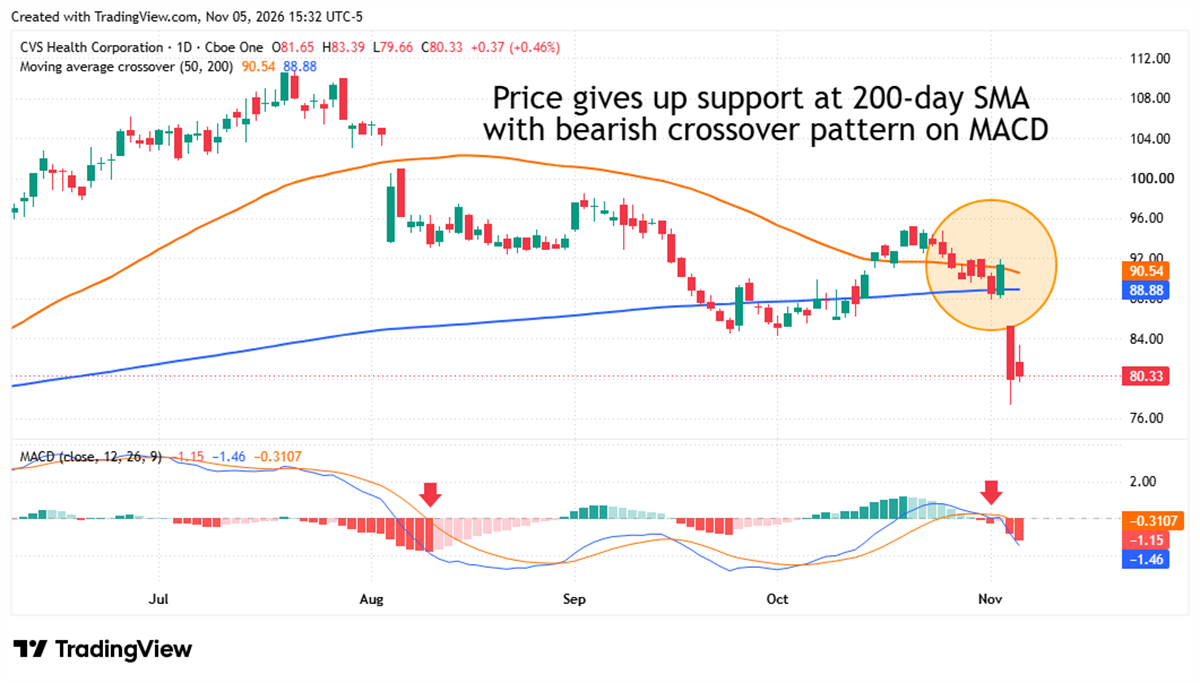
A technical drawdown in CVS shares began in July when the stock dipped below the 50-day moving average. The Moving Average Convergence Divergence (MACD) indicator confirmed the drawdown, but the stock found support at the 200-day moving average until the Q3 report.
Now both the 50-day and 200-day moving averages have been breached, and the MACD has surrendered momentum once again. Investors may be pricing in more turbulence in 2027, and the drawdown could continue until more clarity emerges on the business separation.
Before you consider CVS Health, you'll want to hear this.
MarketBeat keeps track of Wall Street's top-rated and best performing research analysts and the stocks they recommend to their clients on a daily basis. MarketBeat has identified the five stocks that top analysts are quietly whispering to their clients to buy now before the broader market catches on... and CVS Health wasn't on the list.
While CVS Health currently has a Moderate Buy rating among analysts, top-rated analysts believe these five stocks are better buys.
View The Five Stocks Here
The AI boom is creating opportunities across semiconductors, cloud computing, enterprise software, infrastructure, cybersecurity, and automation.
Inside this report, you’ll find 10 companies positioned to benefit as artificial intelligence moves from hype to real-world deployment and becomes a core growth driver for corporate America.
Get This Free Report
Continue following MarketBeat
Add MarketBeat as your preferred source on Google to see our latest stories in your feed.
Like this article? Share it with a colleague.
Link copied to clipboard.
