Microsoft Corporation NASDAQ: MSFT stock is closing in on familiar territory. Shares traded around $530 this week. That puts MSFT within 5% of its 52-week high of $553.72.
Microsoft Today
$534.49 +11.88 (+2.27%) As of 02:24 PM Eastern
This is a fair market value price provided by Massive. Learn more. - 52-Week Range
- $349.20
▼
$553.72 - Dividend Yield
- 0.73%
- P/E Ratio
- 29.74
- Price Target
- $578.73
That's a remarkable turnaround. Microsoft gained about 37% in the third quarter of 2026. It was the company's best quarterly performance since 1998. In late June, shares were trading around $372.
But the easy part of this rally may be over. The next leg is less about Microsoft's business and more about investor psychology.
MSFT peaked near $555 in October 2025. It then spent roughly eight months falling. At the bottom, a $10,000 investment made at the peak was worth about $6,510. Many of those investors are finally close to breaking even.
That creates a different kind of test for MSFT stock. Investors tend to sell winners too early and hold losers too long. When a losing position finally gets back to even, the urge to sell can be overwhelming.
Microsoft's fundamentals have earned this rally. Now the stock has to work through a wall of breakeven sellers. And it has to do that heading into an earnings report where expectations are much higher than they were three months ago.
Q4 Turned a Pariah Into Wall Street's Darling
It's hard to overstate how fast the narrative changed. Heading into July, the story around Microsoft was capital expenditures (CapEx) fatigue. Investors questioned whether its massive AI spending would ever earn an adequate return.
Then Microsoft reported fiscal fourth-quarter 2026 results on July 29. Revenue came in at $90 billion, up nearly 18% year-over-year. Azure crossed $100 billion in annual revenue for the first time. Earnings per share (EPS) of $4.74 topped the $4.24 consensus estimate.
The stock jumped about 15% the next day. It was Microsoft's biggest single-day gain since 2008.
Analysts have followed the price higher. Stifel upgraded MSFT to Buy in late September. On Oct. 5, Melius Research upgraded the stock to Buy with a $665 price target. Scotiabank raised its target to $615 from $510.
This is the same company, with largely the same AI strategy, that investors were avoiding in the spring. What changed was perception. In other words, the numbers gave investors permission to believe again.
Why $555 Is a Psychological Level, Not Just a Technical One
Most investors will see $553.72 as resistance on a chart. That's true, but it misses the behavioral story behind the number.
Think about who owns MSFT at that level. Many bought during the AI enthusiasm of late 2025. Some added on the way down, convinced the sell-off was overdone. Others simply held through a drawdown of roughly 35%.
Behavioral economists call the tendency to sell winners and hold losers the disposition effect. A related bias, sometimes called "get-evenitis," keeps investors anchored to their purchase price. Once a stock gets back there, the relief of not losing money often beats the hope of more gains.
That doesn't mean Microsoft can't break through. It means the stock needs a reason to absorb that supply. Momentum alone may not be enough. A fresh catalyst usually does the job. For Microsoft, that catalyst is its Q1 earnings report for fiscal year 2027 (FY2027).
Earnings Will Have to Clear a Higher Bar
Microsoft hasn't confirmed its next earnings date, but the report date is estimated for Oct. 28. The headline number will be Azure growth. Management guided for growth of about 45% in the quarter.
Three months ago, a number like that would have looked like upside. Now it's closer to the baseline. With the stock up nearly 40% in a quarter, investors may want more than a match.
There's also some fine print in last quarter's beat. The $4.74 EPS figure included a $3.2 billion gain on Microsoft's Anthropic stake. That's a real gain, but it isn't a repeatable operating result.
Spending remains part of the debate, too. Quarterly capital expenditures roughly doubled year-over-year, and free cash flow fell about 23%. Management also expects CapEx to grow again in fiscal 2027.
None of this breaks the bull case. CFO Amy Hood said in July that demand still exceeds available capacity. But it does mean the stock has less room for a merely good quarter.
Chasing MSFT at $530 Is a Different Trade
For long-term investors, Microsoft's story looks stronger than it did six months ago. Its AI investments are showing up in revenue, and Wall Street sentiment has turned firmly bullish.
But buying MSFT at $530 isn't the same trade as buying it at $372. At roughly 30x trailing earnings, the stock is priced for steady execution. The margin for error is thinner.
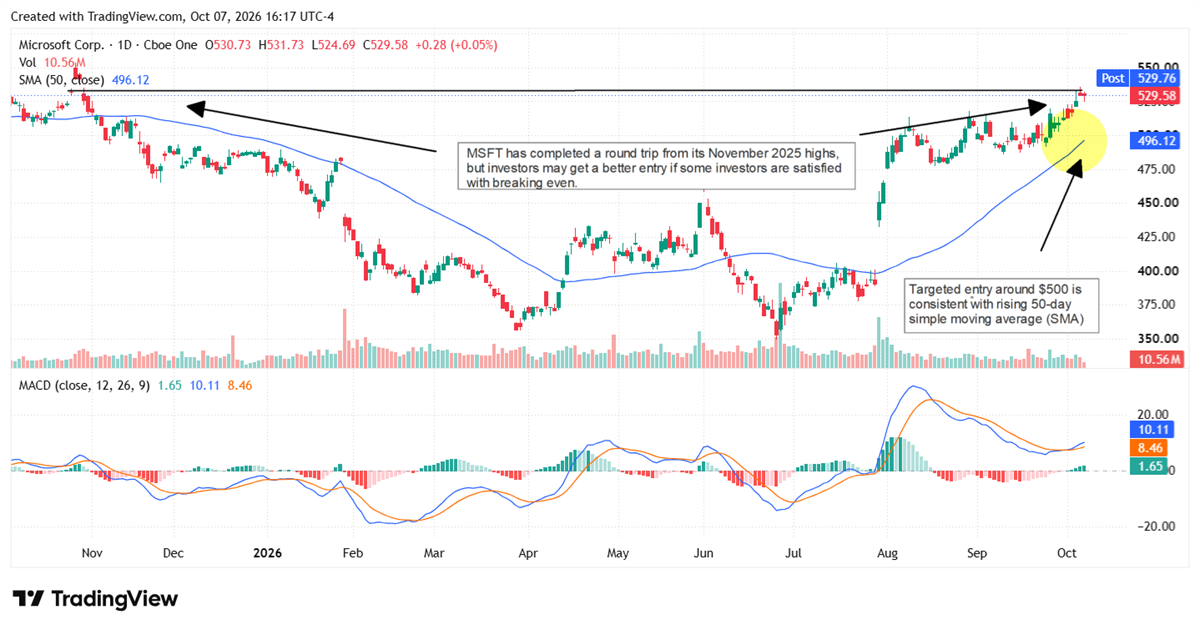
Investors who want exposure may be better served by scaling in. A pullback toward $500, where the stock consolidated in late September, would offer a more comfortable entry. A decisive close above $553.72 on strong volume would confirm a breakout.
If MSFT stalls near its old high, don't read it as a verdict on the business. It may simply be breakeven investors heading for the exits. Once they're gone, the path higher could get a lot easier.
Before you consider Microsoft, you'll want to hear this.
MarketBeat keeps track of Wall Street's top-rated and best performing research analysts and the stocks they recommend to their clients on a daily basis. MarketBeat has identified the five stocks that top analysts are quietly whispering to their clients to buy now before the broader market catches on... and Microsoft wasn't on the list.
While Microsoft currently has a Moderate Buy rating among analysts, top-rated analysts believe these five stocks are better buys.
View The Five Stocks Here
Discover the 10 Best High-Yield Dividend Stocks for 2026 and secure reliable income in uncertain markets. Download the report now to identify top dividend payers and avoid common yield traps.
Get This Free Report
Continue following MarketBeat
Add MarketBeat as your preferred source on Google to see our latest stories in your feed.
