Visa Today
V
Visa
$413.52 +2.98 (+0.73%) As of 03:59 PM Eastern
This is a fair market value price provided by Massive. Learn more. - 52-Week Range
- $293.89
▼
$417.00 - Dividend Yield
- 0.75%
- P/E Ratio
- 33.55
- Price Target
- $438.41
closed out its fiscal year 2026 on a strong note. Visa's
fiscal fourth-quarter earnings beat revenue and profit expectations. Adjusted earnings per share (EPS) of $3.48 topped the $3.43 consensus.
Net revenue of $12.14 billion edged past the $12.09 billion estimate.
On a year-over-year (YOY) basis, the numbers were even stronger. Net revenue climbed 13%. Adjusted EPS rose 17%, while GAAP EPS jumped 22% to $3.19. Full-year revenue hit a record $46 billion, up 15%. CEO Ryan McInerney called it Visa's strongest growth in over 15 years, excluding the post-pandemic rebound and acquisitions.
All of this fits the role Visa stock has played in 2026. It's been a steady, defensive holding, a port in the market storm. The business model explains why. Visa works like a toll booth on global commerce. The company collects a small fee on every swipe, tap, and click.
Still, the reaction was muted. Shares dipped about 1.5% in premarket trading on Oct. 28 before recovering to roughly flat near $402. With the stock near its 52-week high, investors are asking two questions. How much of this growth was a one-time event? And how much good news is already priced in?
Cross-Border Volume Is the Real Story
International payments volume grew 9% in constant dollars, slightly slower than the 10% pace in fiscal Q3. Management described it as consistent with the full year. U.S. payments volume held steady at 10%.
The acceleration came from cross-border volume, which tracks cards used outside their home country. It rose 14%, excluding intra-Europe transactions, up from 12% in fiscal Q3. That matters because cross-border transactions typically generate higher fees for Visa.
It's fair to ask whether the FIFA World Cup inflated those numbers. Management confirmed that U.S. inbound travel spending was elevated during matches in July. But the tournament ended July 19, just three weeks into the quarter.
The monthly data also argues against a one-time bump. Cross-border growth peaked in September, well after the final match of the World Cup. It was still running near 13% through Oct. 21. Travel-related cross-border volume rose 13%, which CFO Chris Suh attributed primarily to improvements in travel to and from Central Europe, the Middle East, and Africa. Cross-border e-commerce grew 17%, driven by retail, including spending on AI platforms.
That's not to say it had no impact. The World Cup's bigger footprint may be in "other revenue," which jumped 40% to $1.65 billion. Some of that reportedly came from World Cup and Olympics marketing deals that won't repeat. That helps explain why fiscal 2027 guidance calls for low-double-digit revenue growth, a step down from 15%.
The Consumer: Uneven, Not Broken
Visa reported solid spending in the quarter. Suh said growth across spend bands stayed consistent with prior quarters. He added that the highest spend band continued to grow fastest, with no sign of weakness among lower-spend consumers.
That is a mild version of a bifurcated market. The top is pulling ahead, but the bottom isn't falling behind. McInerney acknowledged elevated consumer uncertainty. He credited strong employment and real wage growth for keeping wallets open. One detail worth watching: U.S. credit volume grew 11%, outpacing debit at 9%.
Valuation: Expensive, But Less Than It Looks
Visa traded at about 34 times earnings heading into the report. However, at $402, the stock trades near 32.6 times trailing GAAP EPS of $12.32, and about 30 times adjusted EPS of $13.27. Using the midpoint of management's fiscal 2027 adjusted EPS growth guidance, the forward multiple is closer to 27.
There is a cost line to watch, however. Client incentives, the rebates Visa pays banks and other partners to win card programs, jumped 21% to $5.12 billion. That's faster than revenue growth for a second straight quarter.
Analysts Are Chasing the Stock Higher
The counterargument is that Wall Street is getting more bullish. Morgan Stanley raised its target to $471 from $416. TD Cowen moved to $450 from $420, and Oppenheimer to $440 from $403. Susquehanna, Clear Street, and KeyBanc all lifted targets above $460 before the report. All of those are above the consensus target of $437.27 among analysts tracked by MarketBeat.
These increases suggest analysts remain confident in Visa's earnings outlook, despite the muted initial reaction to the report.
Is Visa Stock a Buy After Record Fiscal 2026 Earnings?
The chart tells a story of cooling, not cracking. The relative strength index has eased from overbought levels near 78 to about 62. Shares remain well above the 50-day simple moving average (SMA) near $379.
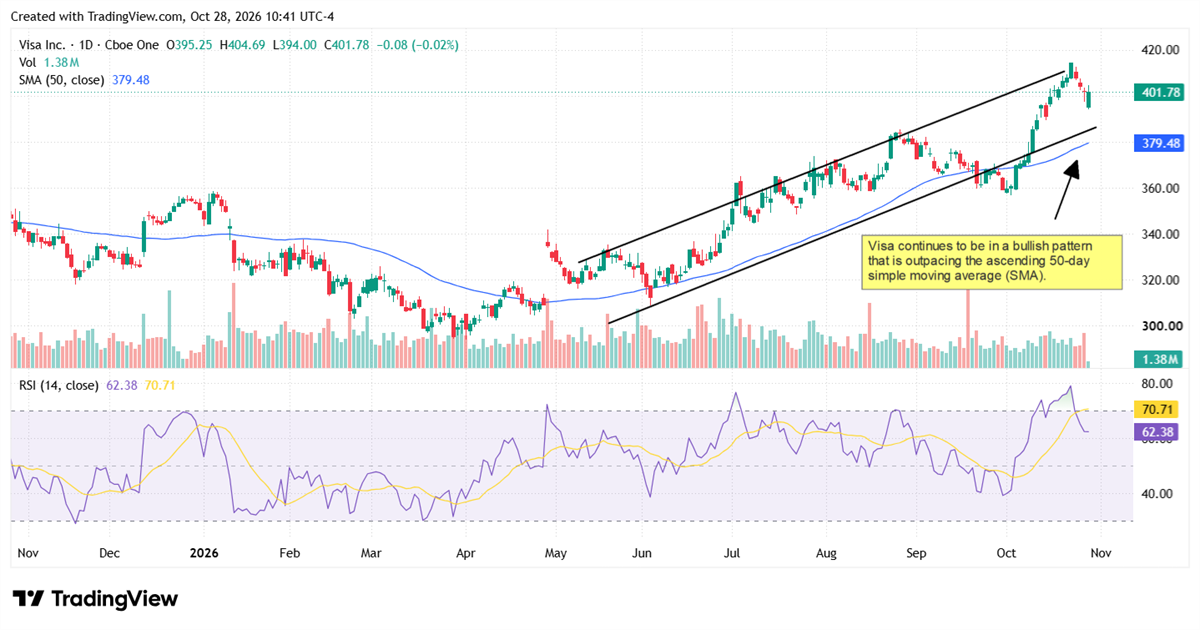
The perception is that Visa had a World Cup-boosted quarter priced for perfection. The fundamentals suggest a toll booth with more traffic than expected, durable cross-border demand, and a consumer that's bending but not breaking.
Either way, Visa has rewarded long-term shareholders, delivering a total return of more than 400% over the last 10 years. For buy-and-hold investors, the premium may be the price of that predictability.
Before you consider Visa, you'll want to hear this.
MarketBeat keeps track of Wall Street's top-rated and best performing research analysts and the stocks they recommend to their clients on a daily basis. MarketBeat has identified the five stocks that top analysts are quietly whispering to their clients to buy now before the broader market catches on... and Visa wasn't on the list.
While Visa currently has a Buy rating among analysts, top-rated analysts believe these five stocks are better buys.
View The Five Stocks Here
Nuclear energy is entering a new growth cycle as rising power demand, expanding data centers, and renewed policy support bring the sector back into focus. After strong gains in recent years, the most impactful phase of nuclear investment may still be ahead. This report highlights seven nuclear energy stocks positioned across the value chain—combining near-term revenue with long-term upside as next-generation technologies scale. Click the link below to unlock the full list.
Get This Free Report
Continue following MarketBeat
Add MarketBeat as your preferred source on Google to see our latest stories in your feed.

