Boeing Today
$166.93 -1.25 (-0.74%) As of 03:57 PM Eastern
This is a fair market value price provided by Massive. Learn more. - 52-Week Range
- $165.01
▼
$254.35 - P/E Ratio
- 72.28
- Price Target
- $250.77
Investors hoping
The Boeing Company NYSE: BA would build on its 737 MAX 10 approval notice got a hard reality check when the company reported lackluster results this week.
The stock dropped more than 10% in a single session following the report, marking its worst day since the height of the COVID-19 drawdown and bringing shares back to levels not seen since the April 2025 tariff-driven sell-off.
How has a company with more than 6,300 airplanes on order seen its stock lose 25% in a year?
It’s all about expectations, and Boeing keeps telling the market to lower its expectations for its turnaround timeline.
Cash Flow and Production Delays Overshadow Headline Numbers
Boeing reported its fiscal Q3 2026 results before the market opened on Oct. 27, and the investors who only glimpsed the headline numbers were probably surprised by the stock’s reaction. First, the good news: the company missed earnings per share (EPS) estimates but still reported a much narrower loss than a year ago at 34 cents per share versus $7.47. Revenue also beat expectations by $238 million, growing 3.9% year over year (YOY). The total backlog grew to a record $745 billion, with the Defense, Space, and Security segment accounting for $101 billion. Most critically, cash flow was positive for the second consecutive quarter at $464 million, nearly double the Q3 2025 figure. After accounting for the one-time $700 million settlement payment to the Department of Justice (DOJ), free cash would rise to about $1.2 billion in the quarter, by far the best figure since the company initiated its turnaround plan. CEO Kelly Ortberg narrowed the free cash flow guidance projection to $2 billion from the previous range of $1 billion to $3 billion.
Back-to-back positive free cash flow quarters are a positive development, but the company’s own projections push the timeline out. After fiscal 2026 free cash flow expectations hit $3 billion at the high end, Boeing now expects $3 billion in free cash flow by the end of 2027, with another $6 billion in 2028 and $10 billion in 2029. Ortberg described this as a “one-year shift to the right,” but the company’s inability to hit production targets has exacerbated it.
Boeing delivered 161 commercial aircraft in Q3, the most it has sold in a quarter since 2018. But that still brings nine-month total deliveries to just 475, and management acknowledged their full-year goal of 500 was likely unattainable. The culprit is the 737 line, which is falling short of the company’s production goals. Boeing expected to comfortably produce 47 Model 737 planes per month by now, but factory delays have prevented it from sustainably meeting that goal. Management also pushed out its next step (52 planes per month) to the second half of 2027.
Recovery Dependent on Factors Outside the Company’s Control
The production delays highlight how much of Boeing’s recovery is dependent on outside factors. The Federal Aviation Administration (FAA) approval of the 737 MAX 10 on Oct. 21 is just one of many regulatory approvals needed for production to reach full potential, and the company doesn’t make a dollar until it delivers a jet. Management expects to deliver 30 prebuilt 737-7 and 737-10 aircraft starting in 2027, with deferred production balances flattening in 2027 before becoming significant cash sources in 2028 and beyond, which supports the cash flow benefit thesis. But the first MAX 10 plane will go to WestJet, which will require Transport Canada approval. Additional MAX 10 deliveries to Europe will also need approval from the European Union Aviation Safety Agency (EASA), so regulatory burdens remain in the way of converting these orders into cash flow.
Production delays also stem from factory issues, such as problems at the company’s wing back shop in Renton or fuselage issues in Wichita. To reach 52 planes per month by the end of 2027, management needs several components to arrive on time and under budget. (And every additional production step also requires FAA approval.) Additionally, the $2 billion end-of-year cash flow target requires $2.4 billion in Q4, including an expected advance payment from an Air Force tanker contract. If that payment isn’t made in fiscal Q4, fiscal 2026 cash flow will likely miss guidance.
Cash Flow Looks Like a 2028 Story, But Stock Rebound Could Start in 2027
Boeing management has essentially punted its cash-flow recovery story to 2028, and enough potential roadblocks remain to make this more than an ‘undersell and overdeliver’ report. But stocks often turn in the early chapters of a recovery story, and the chart suggests Boeing may have finally bottomed after its post-earnings plummet.
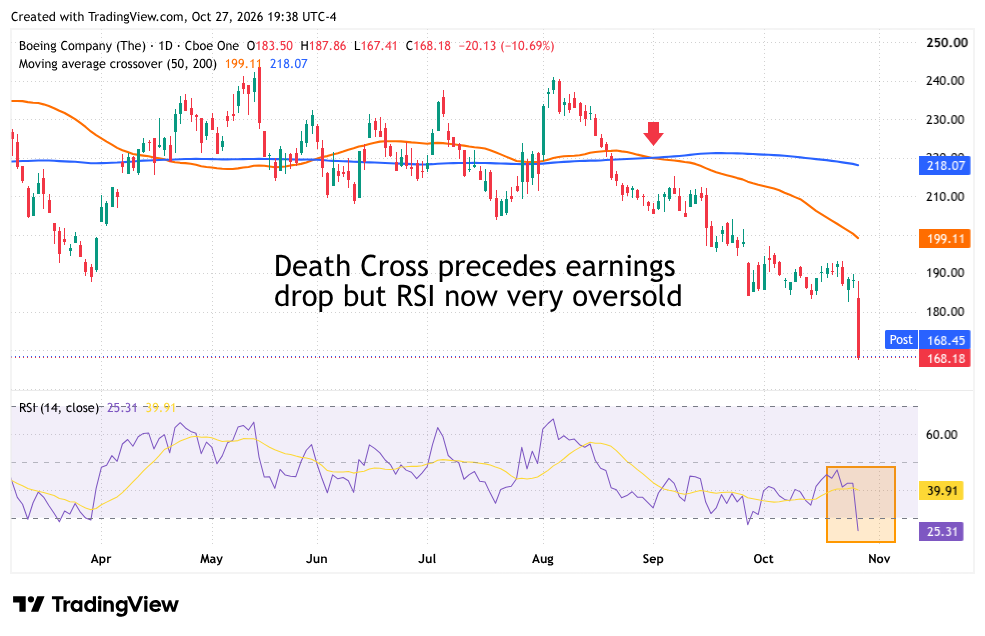
A death cross in September was the canary in the coal mine regarding this report, as the Relative Strength Index (RSI) had dipped into bearish territory the prior month. But now that the stock has lost 10% in a single day, the RSI has hit extremely oversold levels near 25, often signaling that buyers are about to step in.
A true rebound will likely show up in the long-term technicals before the fundamentals, and for now, there’s evidence that the short-term bottom has been reached. Investors focused on fundamentals will need to watch Q4 free cash flow, regulatory approval status in Canada and Europe, and production stability in the 737 line to ensure the 2027 and 2028 free cash flow targets are on solid footing.
Before you consider Boeing, you'll want to hear this.
MarketBeat keeps track of Wall Street's top-rated and best performing research analysts and the stocks they recommend to their clients on a daily basis. MarketBeat has identified the five stocks that top analysts are quietly whispering to their clients to buy now before the broader market catches on... and Boeing wasn't on the list.
While Boeing currently has a Moderate Buy rating among analysts, top-rated analysts believe these five stocks are better buys.
View The Five Stocks Here
A strong long-term portfolio starts with companies that can survive recessions, inflation, changing consumer habits, and shifting market leadership.
This report names seven blue-chip stocks across technology, retail, consumer staples, healthcare, networking, sporting goods, and utilities that offer investors a mix of stability, income, growth, and staying power.
Get This Free Report
Continue following MarketBeat
Add MarketBeat as your preferred source on Google to see our latest stories in your feed.
Like this article? Share it with a colleague.
Link copied to clipboard.

