Fastenal Today
$45.74 -1.31 (-2.78%) As of 04:00 PM Eastern
- 52-Week Range
- $38.97
▼
$50.63 - Dividend Yield
- 2.27%
- P/E Ratio
- 40.12
- Price Target
- $48.31
Fastenal’s NASDAQ: FAST stock price declined following its Q2 earnings release, creating another solid entry point for investors. The worst that can be said about the report is that earnings were only in alignment with the consensus forecast, providing no immediate impetus for bullish behavior.
However, “tepid” as the results may have been, the company revealed strengths investors like to own, including double-digit growth and strength across all segments, categories, and end markets, driven by new clients, client penetration, and digitization. Fastenal, among industrial suppliers, is uniquely positioned to benefit from digitization and AI, as it is a leader in technology-backed inventory management, providing effective solutions for businesses.
Fastenal Fires on All Cylinders: Persistent Strength Expected
Fastenal had a solid Q2 with revenue growing by nearly 15% on broad-based strength. Revenue outpaced MarketBeat’s reported consensus by a slim margin, underpinned by a 14.7% increase in daily sales. Strength was driven by market share gains linked to large-client penetration, with double-digit demand across product lines and end markets. The single area of weakness was the comparison between national-level and localized business, which grew at a 7.2% pace compared to the stronger 17.9% posted by the national-level business.
Margin news was also good, despite the relative weakness in bottom-line results. A slight contraction in gross margin was offset by SG&A leverage, leaving operating and net margins flat to slightly up year over year. Net income grew by 14.9%, enabling balance sheet improvement while investing and returning capital to investors. The capital return is the operational factor, as quarterly strength and business trends allowed management to accelerate buyback activity.
Fastenal is a healthy capital-returning machine. The company’s dividend yields about 2% with shares near the middle of a long-term trading range and is expected to grow annually. Share buybacks have a smaller, but still significant, impact on capital returns, offsetting the impact of share-based compensation, with higher levels expected in upcoming quarters. Q2 capital returns came in at nearly 80% of the net income, well above the long-running 69% average.
Fastenal’s balance sheet highlights provided no red flags for investors, only incentives for ownership. The company's cash balance declined in Q2, but was offset by increases in assets, debt reduction, and equity improvements. Equity improved by more than 3% year-to-date, more than offsetting the incremental increase in the share count logged for the quarter. Looking ahead, investors can expect to see Fastenal’s balance sheet continue improving as it locks in market share and cash flow.
Sell-Side Data Reflects Strong Support for Fastenal
Sell-siders may have wanted more from the Fastenal Q2 release, but it was not sufficient to alter their stance, which reflects strong support. MarketBeat tracks 15 analysts rating the stock as a consensus Hold; there is a 33% Buy-side bias within the data, coverage is increasing, and price targets are steady. Forecasting only modest upside as of mid-July, analyst trends are positive and likely to continue supporting market action. Institutions, meanwhile, are accumulating aggressively, limiting downside risk.
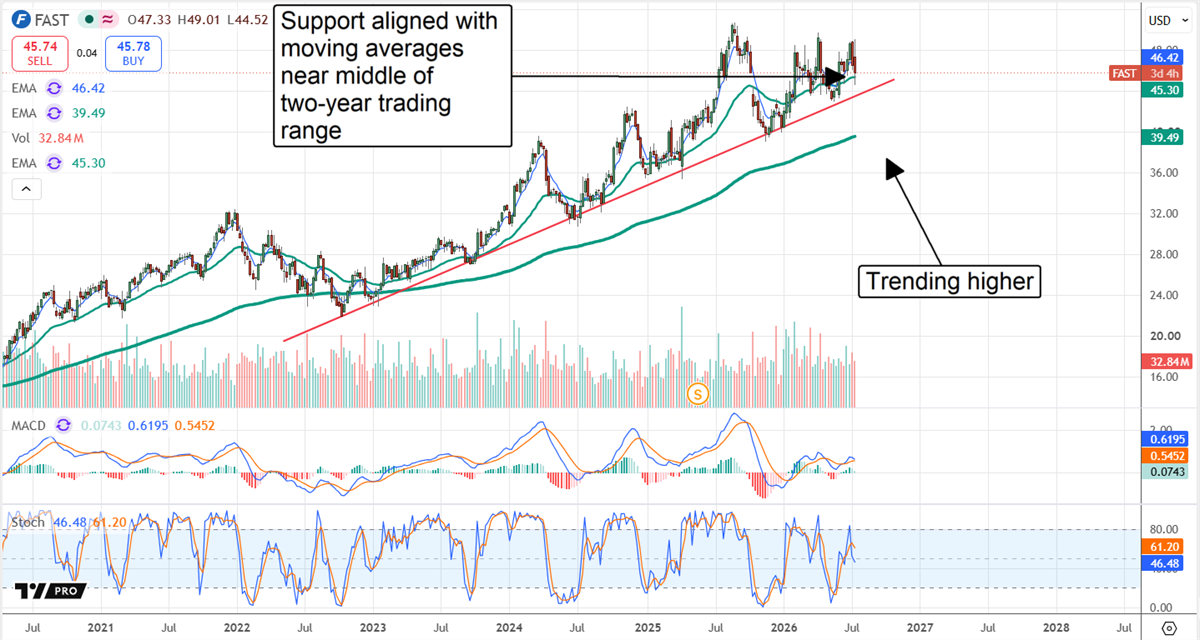
The stock price action also reflects strong, rising support, with the price trending higher over the past two years. The story in 2026 is that price action hit a ceiling in 2025 that will likely be retested before the year ends. The question is whether new highs will be set, and cash flow and capital returns suggest they will. Between then and now, the critical support is near a cluster of exponential moving averages (EMAs), including the 150-day EMA. It is a trigger likely to spur institutional investment when (if) reached.
Fastenal’s primary catalyst this year is the accelerating rollout of its digitized inventory management systems, FastBin and FastVend. They enable manufacturers, industries, and enterprises the ability to manage and control supply costs while providing Fastenal with visibility. Easing inflation is another catalyst, affecting the company’s margin and end-market demand. Assuming energy prices remain subdued, economic activity could pick up across the board.
What the market gets wrong about Fastenal is that its gross margin contractions are part of the overall strategy. The company is leaning hard into national contracted accounts that naturally have lower margins and expenses. Lower expenses are the critical factor, as reduced SG&A more than offsets the decline in gross margin. Meanwhile, the company is becoming entrenched in the end-market ecosystems, a fractured end-market at that, with its FastBin and FastVend systems, establishing a wide moat that competitors will not be able to cross. More importantly, localized vendors are unable to match Fastenal’s scale and digital capabilities, which enable it to gain share across the entire business cycle.
Before you consider Fastenal, you'll want to hear this.
MarketBeat keeps track of Wall Street's top-rated and best performing research analysts and the stocks they recommend to their clients on a daily basis. MarketBeat has identified the five stocks that top analysts are quietly whispering to their clients to buy now before the broader market catches on... and Fastenal wasn't on the list.
While Fastenal currently has a Hold rating among analysts, top-rated analysts believe these five stocks are better buys.
View The Five Stocks Here
Discover the next wave of investment opportunities with our report, 7 Stocks That Will Be Magnificent in 2026. Explore companies poised to replicate the growth, innovation, and value creation of the tech giants dominating today's markets.
Get This Free Report
Like this article? Share it with a colleague.
Link copied to clipboard.
