Johnson & Johnson Today
JNJ
Johnson & Johnson
$247.55 -6.30 (-2.48%) As of 03:59 PM Eastern
This is a fair market value price provided by Massive. Learn more. - 52-Week Range
- $159.80
▼
$269.43 - Dividend Yield
- 2.17%
- P/E Ratio
- 28.62
- Price Target
- $261.26
Johnson & Johnson NYSE: JNJ is an elite income investment because of its Dividend King status, healthy balance sheet, and incredibly strong, defensive business model. Critical details include its product portfolio and pipeline, which are producing numerous catalysts simultaneously in 2026.
A wave of approvals, expanded uses, and pipeline advances promises sustained growth, robust cash flow, and capital return safety long into the future. Which is why the mid-July price pullback, triggered by the earnings results and guidance, is a textbook entry point.
JNJ Pulls Back to Buy Zone
JNJ hit a peak ahead of the earnings release, indicating potential for a pullback. Down approximately 2% following the release, the stock is on track for a nearly-10% pullback, which would represent a significant discount relative to the recent high, but lower lows are unlikely.
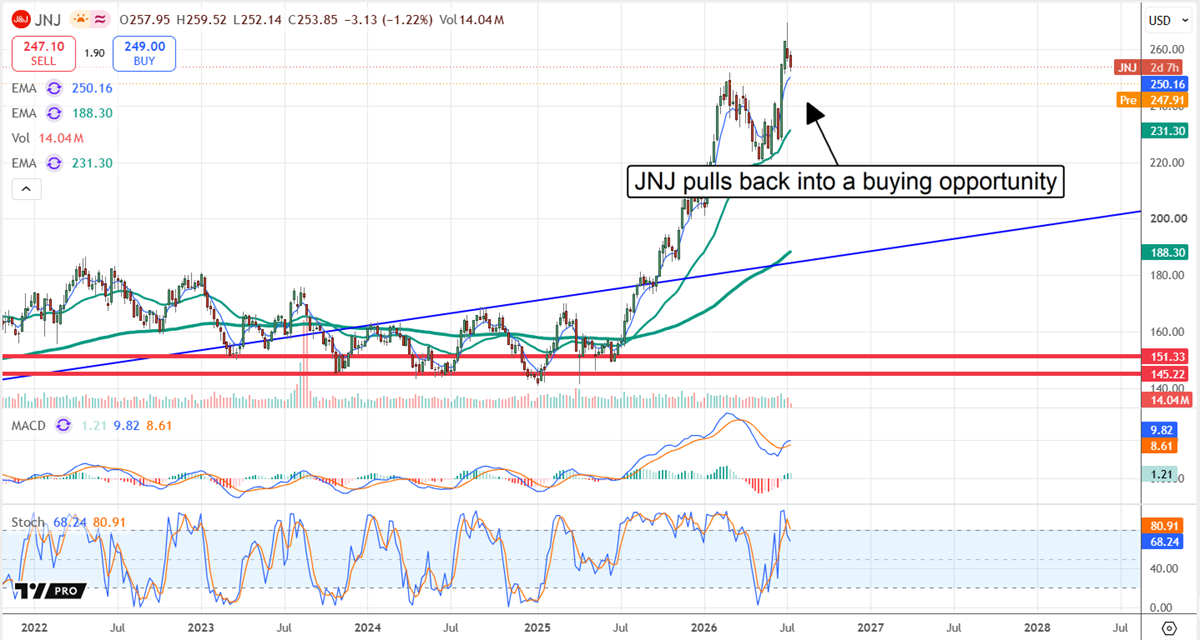
Likely buyers on the dip include the institutional group, which owns more than 60% of the stock and has been accumulating, and the analysts, whose trends reflect increasing confidence in an already fundamentally stable company.
Analyst trends include increased coverage versus last year, firmer sentiment, a 74% Buy-side bias to the Moderate Buy rating, and an uptrend in the price targets. Consensus is a sticking point, with fair value near the early-July highs, but the trend matters, leading to the high end of $300 and fresh all-time highs. A move to fresh all-time highs is significant for chart watchers, as it would indicate a continuation of the trend, with near-term targets at $300 and longer-term targets in the $350 region.
Analyst chatter following the release focused on the beat relative to the high bar set. Strength in the pharmaceutical pipeline and fundamental health in MedTech were also noted. Importantly, the market views JNJ as having successfully moved past its patent cliff, on track for sustainable growth, cash flow, and capital returns.
Capital returns include buybacks, but they are opportunistic and often insufficient to offset dilutive activity; the dividend is much more significant. The dividend yields an above-average 2.1% and has grown at a mid-single-digit compound annual growth rate in recent years. The likely outcome is that JNJ will continue with annual increases well into the future.
Johnson & Johnson’s Strength Driven by Diversified Portfolio
Johnson & Johnson had a strong quarter, revealing the strength of its repositioning efforts and portfolio. The company’s $25.31 billion in net revenue was up 6.8% year-over-year (YOY), 100 basis points (bps) better than expected, on strength in U.S. and International markets across the Innovative Medicine and MedTech portfolios. There were spotty weaknesses within each segment tied to legacy products, but each was offset by a strength. Critical details include the half-dozen new approvals and a dozen or so positive pipeline updates.
Margin news was also good. The company experienced margin pressures but was able to offset them to a large degree. Bottom-line results include $2.90 in adjusted earnings per share (EPS), up 4.7% YOY and a nickel ahead of consensus, and $8.7 billion in free cash flow (FCF), more than sufficient to support balance sheet health while investing and returning capital to investors.
Looking ahead, the company expects the strengths to continue and has raised guidance accordingly. The new full-year targets were increased by 30 bps at the midpoint, expecting 7.3% top-line growth and $11.68 in adjusted earnings, well above the consensus estimate. Among the factors investors should consider is that JNJ expects revenue to surpass the $100 billion mark for the first time in its history, a psychological threshold for institutional investors.
JNJ: Low Risk, High Reward
Johnson & Johnson’s primary risks include its patent cliff and ongoing talc litigation. The talc litigation refers to decades of lawsuits alleging that the company's talc-based products—most notably its baby powder were contaminated with asbestos and caused ovarian cancer and mesothelioma.
The patent cliff appears to be mitigated, with approvals and pipeline gaining momentum, leaving talc as the primary hurdle for investors. The company continues to face thousands of individual claims despite its attempts to settle. This leaves it open to cash-draining adverse decisions that can drain investment capital and capacity for capital returns. What the market gets wrong is that talc isn’t a company-ending threat but rather a slow drain on capital that may or may not worsen.
Catalysts include the planned spin-off of the company's orthopedics business. Analysts view it as a price-multiple unlocking move, trimming lower-margin, lower-growth businesses in favor of higher-performing ones. The resulting company will be a pharma and medtech powerhouse with strong franchises in oncology, cardiology, and potentially robotics. The OTTAVA robotic system is on track for approval as soon as later this year, setting the stage for it to gain share versus competitors like Intuitive Surgical NASDAQ: ISRG.
Before you consider Johnson & Johnson, you'll want to hear this.
MarketBeat keeps track of Wall Street's top-rated and best performing research analysts and the stocks they recommend to their clients on a daily basis. MarketBeat has identified the five stocks that top analysts are quietly whispering to their clients to buy now before the broader market catches on... and Johnson & Johnson wasn't on the list.
While Johnson & Johnson currently has a Moderate Buy rating among analysts, top-rated analysts believe these five stocks are better buys.
View The Five Stocks Here
Robotics and automation are rapidly becoming essential infrastructure across healthcare, manufacturing, logistics, and many other industries.
"Physical AI" is coming to the United States, and there are four ways that investors can gain exposure to this new robotics revolution. Plus, learn which seven companies are most positioned to benefit as intelligent robots enter the workforce.
Get This Free Report
Like this article? Share it with a colleague.
Link copied to clipboard.
