Air Canada (OTCMKTS:ACDVF - Get Free Report) was upgraded by stock analysts at Scotiabank from a "hold" rating to a "strong-buy" rating in a report released on Tuesday,Zacks.com reports.
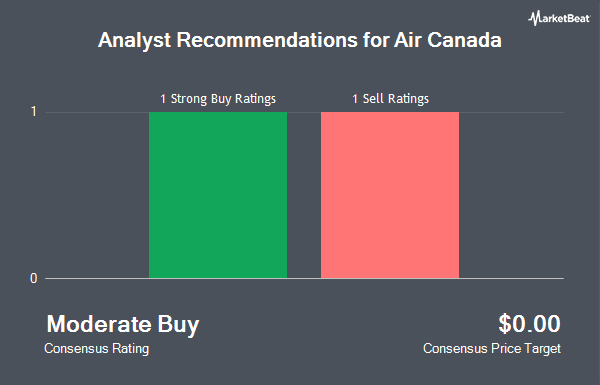
ACDVF has been the topic of a number of other reports. Zacks Research raised Air Canada from a "strong sell" rating to a "hold" rating in a research note on Tuesday, May 19th. National Bank Financial raised Air Canada from a "hold" rating to a "strong-buy" rating in a research note on Tuesday, July 7th. Finally, BMO Capital Markets reiterated an "outperform" rating on shares of Air Canada in a report on Wednesday, July 8th. Two investment analysts have rated the stock with a Strong Buy rating, two have assigned a Buy rating and five have issued a Hold rating to the stock. According to MarketBeat, the company presently has a consensus rating of "Moderate Buy".
Check Out Our Latest Research Report on ACDVF
Air Canada Stock Up 5.9%
Shares of ACDVF opened at $19.57 on Tuesday. Air Canada has a 52 week low of $12.03 and a 52 week high of $19.61. The stock has a market capitalization of $5.48 billion, a price-to-earnings ratio of 10.58, a PEG ratio of 0.56 and a beta of 1.42. The company has a debt-to-equity ratio of 3.32, a quick ratio of 0.53 and a current ratio of 0.56. The stock has a fifty day moving average of $17.01 and a 200-day moving average of $15.07.
Air Canada (OTCMKTS:ACDVF - Get Free Report) last issued its quarterly earnings data on Tuesday, August 11th. The company reported $0.29 earnings per share for the quarter, topping analysts' consensus estimates of $0.11 by $0.18. Air Canada had a return on equity of 27.71% and a net margin of 3.45%.The business had revenue of $4.41 billion for the quarter, compared to analyst estimates of $4.34 billion. As a group, sell-side analysts anticipate that Air Canada will post 0.93 earnings per share for the current fiscal year.
Air Canada News Roundup
Here are the key news stories impacting Air Canada this week:
- Positive Sentiment: Aeroplan investment provides substantial balance-sheet support. Blackstone, La Caisse and other Canadian institutional investors will purchase a 25% non-controlling stake in Aeroplan for C$2.5 billion, valuing the loyalty program at approximately C$10 billion. Air Canada retains control of Aeroplan’s strategy and operations while receiving significant capital to pursue an investment-grade credit rating and reduce financial pressure. Air Canada Announces $2.5 Billion Minority Equity Investment in Aeroplan Led by Blackstone and La Caisse
- Positive Sentiment: Second-quarter earnings exceeded expectations. Air Canada reported adjusted EBITDA of C$719 million, at the top end of its guidance range, and EPS of $0.29 versus the consensus estimate of $0.11. Record quarterly operating revenue of C$6.3 billion indicates strong travel demand across the airline’s network. Air Canada Reports Second Quarter 2026 Financial Results
- Neutral Sentiment: International expansion could support long-term growth. Air Canada reportedly received approval for its first Nigeria expansion, potentially adding network reach and new demand opportunities, though the near-term financial contribution is unclear. Air Canada Nigeria Expansion
- Negative Sentiment: Underlying operating results still show pressure. The company recorded a C$215 million operating loss, including C$388 million in labor-related and other charges. Air Canada also has substantial leverage, which makes the balance-sheet improvement important but does not eliminate financial risk. Air Canada Second Quarter 2026 Financial Results
About Air Canada
(
Get Free Report)
Air Canada is the largest airline in Canada and one of the leading carriers in North America. Founded in 1937 as Trans-Canada Air Lines and rebranded as Air Canada in 1965, the company operates scheduled passenger and cargo services on six continents. The airline maintains membership in the Star Alliance network, offering seamless connections and coordinated loyalty benefits to travelers worldwide.
Through its mainline operations and subsidiaries—including Air Canada Rouge, Air Canada Cargo and Air Canada Vacations—the company provides a broad range of services.
Further Reading
This instant news alert was generated by narrative science technology and financial data from MarketBeat in order to provide readers with the fastest reporting and unbiased coverage. Please send any questions or comments about this story to contact@marketbeat.com.

Continue following MarketBeat
Add MarketBeat as your preferred source on Google to see our latest stories in your feed.
Before you consider Air Canada, you'll want to hear this.
MarketBeat keeps track of Wall Street's top-rated and best performing research analysts and the stocks they recommend to their clients on a daily basis. MarketBeat has identified the five stocks that top analysts are quietly whispering to their clients to buy now before the broader market catches on... and Air Canada wasn't on the list.
While Air Canada currently has a Moderate Buy rating among analysts, top-rated analysts believe these five stocks are better buys.
View The Five Stocks Here
Robotics and automation are rapidly becoming essential infrastructure across healthcare, manufacturing, logistics, and many other industries.
"Physical AI" is coming to the United States, and there are four ways that investors can gain exposure to this new robotics revolution. Plus, learn which seven companies are most positioned to benefit as intelligent robots enter the workforce.
Get This Free Report
Like this article? Share it with a colleague.
Link copied to clipboard.
