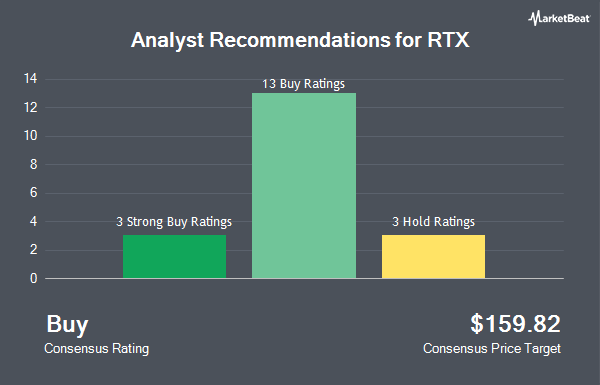
Shares of RTX Corporation (NYSE:RTX - Get Free Report) have been given an average recommendation of "Moderate Buy" by the twenty-one analysts that are covering the stock, Marketbeat.com reports. One analyst has rated the stock with a sell rating, five have assigned a hold rating, fourteen have assigned a buy rating and one has issued a strong buy rating on the company. The average 12-month price objective among brokerages that have issued a report on the stock in the last year is $228.5882.
RTX has been the subject of a number of research reports. Robert W. Baird set a $240.00 target price on shares of RTX in a report on Friday, July 24th. Sanford C. Bernstein upped their price objective on shares of RTX from $213.00 to $232.00 and gave the stock a "market perform" rating in a research report on Monday, August 3rd. Jefferies Financial Group set a $250.00 price objective on shares of RTX in a research note on Sunday, July 26th. Weiss Ratings upgraded shares of RTX from a "buy (b-)" rating to a "buy (b)" rating in a research report on Tuesday, August 25th. Finally, Argus set a $245.00 target price on shares of RTX in a research note on Thursday, July 30th.
Get Our Latest Stock Report on RTX
Insider Buying and Selling
In other RTX news, VP Kevin G. Dasilva sold 2,250 shares of the stock in a transaction dated Tuesday, July 28th. The stock was sold at an average price of $216.93, for a total value of $488,092.50. Following the completion of the transaction, the vice president directly owned 20,099 shares in the company, valued at approximately $4,360,076.07. This trade represents a 10.07% decrease in their ownership of the stock. The transaction was disclosed in a document filed with the Securities & Exchange Commission, which can be accessed through this link. Also, EVP Ramsaran Maharajh sold 13,655 shares of the business's stock in a transaction dated Tuesday, August 18th. The stock was sold at an average price of $223.92, for a total value of $3,057,627.60. Following the sale, the executive vice president owned 13,184 shares in the company, valued at approximately $2,952,161.28. This trade represents a 50.88% decrease in their ownership of the stock. The disclosure for this sale is available in the SEC filing. Insiders have sold 29,222 shares of company stock worth $6,362,003 in the last 90 days. Insiders own 0.10% of the company's stock.
Institutional Investors Weigh In On RTX
Several hedge funds have recently added to or reduced their stakes in the business. Commonwealth Retirement Investments LLC bought a new stake in shares of RTX in the fourth quarter worth $26,000. Core Wealth Advisors LLC bought a new position in RTX during the 4th quarter worth $31,000. 1 North Wealth Services LLC raised its position in RTX by 456.7% during the 4th quarter. 1 North Wealth Services LLC now owns 167 shares of the company's stock worth $31,000 after purchasing an additional 137 shares during the last quarter. Evergreen Advisors LLC acquired a new position in RTX during the 1st quarter worth about $31,000. Finally, Signature Resources Capital Management LLC grew its position in shares of RTX by 111.5% in the 1st quarter. Signature Resources Capital Management LLC now owns 184 shares of the company's stock valued at $36,000 after buying an additional 97 shares during the last quarter. 86.50% of the stock is currently owned by institutional investors and hedge funds.
Trending Headlines about RTX
Here are the key news stories impacting RTX this week:
- Positive Sentiment: Record backlog supports revenue visibility. RTX’s backlog reportedly reached $289 billion, providing substantial future demand across commercial aerospace and defense programs. RTX’s Backlog Just Hit a Record $289 Billion
- Positive Sentiment: Pratt & Whitney is expanding in Poland. RTX’s aircraft-engine unit plans a $25 million engine-parts expansion, strengthening its international manufacturing footprint and potentially supporting future commercial and military engine demand. RTX’s Pratt & Whitney Deepens Poland Bet
- Neutral Sentiment: Defense-sector spending remains a potential tailwind. A new framework agreement involving Lockheed Martin’s JATM missile program could increase missile production and benefit defense-focused exchange-traded funds. The development is supportive for the broader sector, although the article does not identify a direct RTX award. Defense ETFs Stand to Gain as Trump Administration Signs JATM Deal
- Negative Sentiment: Valuation and interest-rate concerns are weighing on sentiment. Jim Cramer argued that RTX remains expensive despite its large Tomahawk missile contract and backlog. Rising rates generally pressure high price-to-earnings stocks by reducing the value investors assign to future earnings. Jim Cramer Says Defense Giant Still Too Expensive
- Negative Sentiment: Recent trading weakness reflects the valuation overhang. Coverage noted that RTX declined even as the broader market gained, suggesting investors are taking profits or reassessing the stock’s premium valuation rather than immediately rewarding its strong defense pipeline. RTX Stock Sinks as Market Gains
RTX Price Performance
RTX stock opened at $193.34 on Monday. The company has a debt-to-equity ratio of 0.47, a quick ratio of 0.78 and a current ratio of 1.01. RTX has a 52 week low of $155.64 and a 52 week high of $226.88. The stock has a market capitalization of $260.58 billion, a P/E ratio of 34.04, a price-to-earnings-growth ratio of 2.50 and a beta of 0.29. The stock has a fifty day moving average of $208.16 and a 200-day moving average of $195.69.
RTX (NYSE:RTX - Get Free Report) last released its quarterly earnings data on Thursday, July 23rd. The company reported $1.89 earnings per share for the quarter, beating the consensus estimate of $1.66 by $0.23. RTX had a return on equity of 13.99% and a net margin of 8.28%.The business had revenue of $24.71 billion for the quarter, compared to analyst estimates of $22.89 billion. During the same period last year, the firm posted $1.56 earnings per share. RTX's revenue was up 14.5% compared to the same quarter last year. RTX has set its FY 2026 guidance at 7.100-7.250 EPS. On average, sell-side analysts expect that RTX will post 7.22 earnings per share for the current fiscal year.
RTX Dividend Announcement
The company also recently disclosed a quarterly dividend, which was paid on Thursday, September 3rd. Investors of record on Friday, August 14th were issued a dividend of $0.73 per share. The ex-dividend date of this dividend was Friday, August 14th. This represents a $2.92 annualized dividend and a dividend yield of 1.5%. RTX's dividend payout ratio (DPR) is 51.41%.
RTX Company Profile
(
Get Free Report)
RTX Corporation NYSE: RTX is an aerospace and defense company that develops and manufactures systems, products and services for commercial aviation, business aviation and government customers. Its offerings include aircraft engines, avionics, flight-control systems, cabin interiors, communications equipment, radar, air and missile defense systems, precision weapons and cybersecurity solutions.
The company operates through three principal businesses: Collins Aerospace, which provides aerospace systems and components; Pratt & Whitney, which designs and manufactures aircraft engines and provides related maintenance services; and Raytheon, which develops integrated defense systems, sensors, missiles and other mission technologies.
See Also
This instant news alert was generated by narrative science technology and financial data from MarketBeat in order to provide readers with the fastest reporting and unbiased coverage. Please send any questions or comments about this story to contact@marketbeat.com.
Before you consider RTX, you'll want to hear this.
MarketBeat keeps track of Wall Street's top-rated and best performing research analysts and the stocks they recommend to their clients on a daily basis. MarketBeat has identified the five stocks that top analysts are quietly whispering to their clients to buy now before the broader market catches on... and RTX wasn't on the list.
While RTX currently has a Moderate Buy rating among analysts, top-rated analysts believe these five stocks are better buys.
View The Five Stocks Here
A strong long-term portfolio starts with companies that can survive recessions, inflation, changing consumer habits, and shifting market leadership.
This report names seven blue-chip stocks across technology, retail, consumer staples, healthcare, networking, sporting goods, and utilities that offer investors a mix of stability, income, growth, and staying power.
Get This Free Report
Continue following MarketBeat
Add MarketBeat as your preferred source on Google to see our latest stories in your feed.
Like this article? Share it with a colleague.
Link copied to clipboard.
